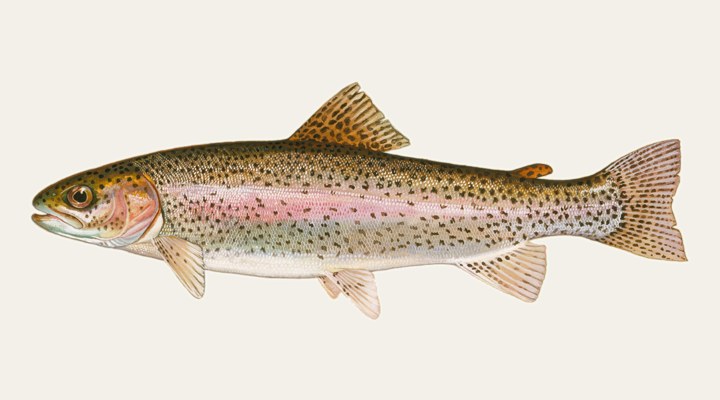
Identification and biology
The rainbow trout is the most widely stocked sport fish in Canada: silver to olive with a pink band along the side and small black spots across the back, sides and tail. Resident rainbows live in thousands of lakes and rivers, and the sea-run form is the steelhead. In BC, the rainbows of the Kamloops region gave their name to the Kamloops trout, and Kootenay Lake’s Gerrard rainbows grow very large feeding on kokanee. The Bow River below Calgary holds wild rainbows that feed on its rich insect life.
Where they live through the year
In lakes, rainbows cruise the shallows after ice-off, feeding on chironomids and leeches, then drop below the thermocline in summer and return to the shallows in fall when the lake turns over; many lakes are fished through the ice in winter. In rivers, they hold in the riffles and runs and feed on hatches through the open season.
The mistakes that cost fish
Fishing the surface of a lake in the heat of summer, when the fish are deep. Using gear that is too heavy for clear water. Ignoring the special rules on famous rivers and lakes, such as bait bans, catch-and-release reaches and the Kootenay Lake surcharge. Keeping more stocked fish than the lake limit, which is set lake by lake in the synopsis, is a common and avoidable one.
Reading the report for rainbows
On lakes, the water temperature estimate shows the season: ice-off and fall are the best times. On rivers, the gauge shows the spring runoff, which makes mountain rivers unfishable for weeks, and the drop that opens the season.
Where to fish them in Canada
On this site, rainbow trout are on the Bow River at Calgary, the Elk at Fernie, Kootenay Lake, Okanagan Lake at Kelowna, Tunkwa Lake and the Kamloops page for the plateau lakes, and on the Lake Ontario, Huron and Superior pages for the lake-run fish. The Bow, Elk, Kootenay and Okanagan pages carry live Water Survey of Canada gauges; the Kootenay Lake page explains the Gerrard rainbow and the surcharge needed to fish for it.
Tackle setups
| Situation | Setup | Why it works |
|---|---|---|
| Chironomid under an indicator | 3 m rod for a 5 or 6 weight line, floating line, long leader, chironomid pattern set just off the bottom | The spring method on the interior lakes |
| Leech on a sinking line | 3 m rod for a 6 weight line, intermediate or sinking line, leech pattern stripped slowly | Summer and fall on the lake drop-offs |
| Small spoon trolled | 2.1 m light spinning rod, 2 to 3 kg line, small spoon or spinner trolled slowly | Covers water from a boat or float tube |
| River dries and nymphs | 2.7 m rod for a 5 weight line, dry fly or nymph under an indicator | Hatches on the Bow and other rivers |
Playbook by water temperature
The plan the daily report picks for rainbow trout in each band; the water temperature on each page is a seasonal estimate for its type of water and says so.
Hot water (over 27 °C)
Lake fish drop below the thermocline. Troll or fish chironomids deep over the drop-offs at first light; in rivers, the shaded riffles.
Warm water (18 to 27 °C)
Prime time on the lakes after ice-off and in fall: chironomids and leeches under an indicator, or a slow troll with a small spoon. In rivers, dries and nymphs through the riffles.
Cool water (10 to 18 °C)
Fish shallower as the lake turns over; leeches and small lures along the shoals. Rivers fish best in the warmest hours.
Cold water (under 10 °C)
Under the ice where it is safe: small jigs and bait near the bottom in shallow bays. On open rivers, nymphs slow and deep.
Month by month
Activity for the Canadian year, 1 slow to 5 peak; January is midwinter, with most lakes under ice. Current month highlighted.
Waters we cover for rainbow trout
6 Canada waters carry rainbow trout on their species card, each with a daily report.
Common questions
What is a Kamloops trout?
The name given to the rainbow trout of the Kamloops region of BC.
When is the best time to fish for rainbows in lakes?
After ice-off in spring and again in fall, when the fish are shallow.
Are rainbow trout stocked in Canada?
Yes, in thousands of lakes, especially in BC, Alberta and the prairies.