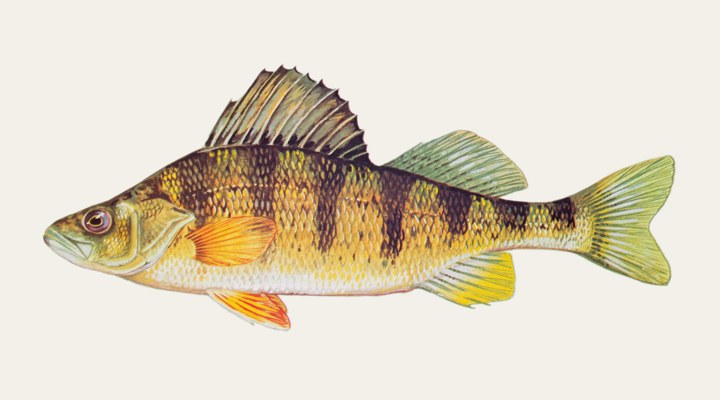
Identification and biology
The yellow perch is a small, schooling fish with a golden-yellow body, six to eight dark vertical bars and orange lower fins, found across Canada from the Maritimes to Alberta. It is the ice-fishing fish of Lake Simcoe and Long Point Bay, a summer staple of every Great Lakes shore and one of the best-eating freshwater fish. Perch spawn in spring, laying long ribbons of eggs over weeds and brush in the shallows, and spend their lives moving in schools that can be hard to find and easy to catch once found.
Where they live through the year
In spring, perch move into the shallow bays to spawn; in summer they spread along the weed edges and the sand flats; in fall they school up tighter on the deeper flats. Under the ice, they feed on the flats and the transitions near weed beds, and the schools move constantly, which is why ice anglers drill many holes.
The mistakes that cost fish
Staying in one hole or one spot too long: perch schools move, and anglers who follow them catch more. Using gear that is too heavy for a small fish with a light bite. Venturing onto ice that has not been checked: no agency certifies the ice on Lake Simcoe or Long Point Bay.
Reading the report for perch
Perch bite through the day, with peaks in the morning and the late afternoon; a stable barometer is easier fishing than a front. In winter, the water temperature estimate sits near freezing under the ice, and the bite depends more on finding the school than on the weather.
Where to fish them in Canada
On this site, perch are on the pages for Lake Simcoe, Long Point Bay, Erieau, Port Glasgow, Wheatley, Lake St. Clair, Rice Lake, the Bay of Quinte and the prairie lakes such as Pigeon and Sylvan. Each page carries the weather for that water and a report built from it; none of them says the ice is safe, because no agency measures it. Lake Simcoe’s Cook’s Bay and the inner bay at Long Point are the classic perch ice-fishing areas, and both change with every winter’s ice.
Tackle setups
| Situation | Setup | Why it works |
|---|---|---|
| Summer jigging | 1.8 m light spinning rod, 2 to 3 kg line, small jig tipped with a minnow or worm | Light gear for a light bite |
| Spreader rig | Two small hooks on a wire spreader with a sinker, baited with minnows | Two baits near the bottom over a school |
| Through the ice | Short ice rod, 1.5 to 2 kg line, small tungsten jig or spoon with a minnow head or wax worm | Heavy for its size, gets down quickly to the school |
| From a pier | 2.1 m rod, 3 kg line, float and minnow | Spring and fall perch runs on the Lake Erie piers |
Playbook by water temperature
The plan the daily report picks for yellow perch in each band; the water temperature on each page is a seasonal estimate for its type of water and says so.
Hot water (over 27 °C)
Deep schools on the flats: small jigs and minnows on a spreader, moving until you find them.
Warm water (18 to 27 °C)
Small jigs and minnows along the weed edges and the sand flats.
Cool water (10 to 18 °C)
Schools tighten on the deeper flats; bait near the bottom.
Cold water (under 10 °C)
The ice season where the ice is safe: small spoons and tungsten jigs tipped with minnow heads, moving hole to hole to find the school.
Month by month
Activity for the Canadian year, 1 slow to 5 peak; January is midwinter, with most lakes under ice. Current month highlighted.
Waters we cover for yellow perch
17 Canada waters carry yellow perch on their species card, each with a daily report.
Common questions
Where is the best perch fishing in Canada?
Lake Simcoe and Long Point Bay on Lake Erie are two of the best known, in open water and through the ice.
What is the best bait for perch?
A small minnow or minnow head on a small jig or spoon, or worms and wax worms.
Why do I have to move so often when perch fishing?
Perch travel in schools that move constantly; finding them is most of the job.