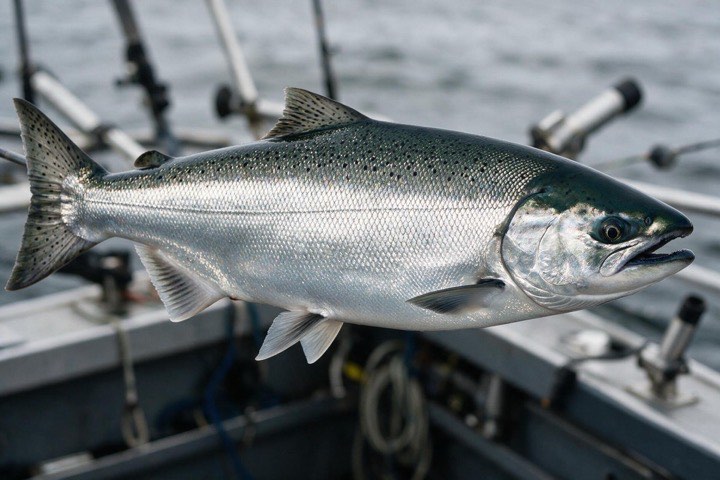
Identification and biology
The chinook is the largest of the Pacific salmon, called spring salmon on the BC coast and king salmon to the south, and a fish over about fourteen kilograms earns the name tyee at Campbell River. At sea it is silver with a dark back, small black spots on the back and on both lobes of the tail, and black gums at the base of the teeth, the detail that separates it from a coho at a glance. Chinook spend two to five years at sea before returning to the river where they hatched to spawn once and die; the big rivers of BC, the Fraser, the Skeena and the rivers of Vancouver Island, each have their own runs and their own timing. Chinook were also introduced to the Great Lakes, where they are now stocked and naturally reproducing, and run the tributaries of Lake Ontario and Lake Huron in the fall.
Where they live through the year
On the BC coast there are two kinds of chinook fishing. Resident or feeder chinook, often called winter springs, stay in the Strait of Georgia and the waters off Victoria through the winter, feeding on herring and sand lance. Migrating chinook pass along the coast from late spring to late summer on their way to the rivers, following the bait along the kelp lines, points and tide rips, and are the fish of Sooke, Nootka Sound, Barkley Sound and Campbell River in July and August. In the Great Lakes, chinook spend the summer deep and offshore, following cold water, and move toward the river mouths in late summer before running up the tributaries in September and October.
The mistakes that cost fish
Fishing the wrong depth: chinook are often deeper than people think, especially in bright weather, and a downrigger set ten metres too shallow catches nothing. Ignoring the tide: on the BC coast the change of the tide concentrates bait along the rips, and the hour around it is usually the best. Keeping a fish without checking the notice: chinook retention on the coast is managed area by area, with size limits and closures that DFO changes in season. Handling a fish to be released out of the water: a chinook that has to go back should stay in the water, supported, while the hook comes out.
Reading the report for chinook
On the coastal pages, the tide panel, a modelled curve labelled as one, gives the timing of the changes; the wind row decides whether the open water is fishable at all. The water temperature estimate shows the season rather than the day, and on the river pages the gauge shows the rises that move fish upstream in the fall. Pressure matters less than for lake fish, but a stable spell is easier fishing than the day a front comes through.
Tackle setups
| Situation | Setup | Why it works |
|---|---|---|
| Coastal trolling | 3 m mooching or downrigger rod, 11 to 14 kg line, 28 cm flasher with a hoochie or an anchovy in a teaser head on 1.8 to 2 m of leader | The flasher draws fish from a distance, the bait closes the deal |
| Mooching | 3 to 3.3 m mooching rod, single-action reel, 7 to 9 kg leader, cut-plug herring on two hooks with a 60 to 120 g banana weight | A slow drift in the tide rip, the classic Campbell River method |
| Great Lakes trolling | Downrigger rod, 9 to 11 kg line, spoon or flasher and fly at the depth of the temperature break | Chinook follow the cold water offshore in summer |
| River in the fall | 3 to 3.3 m float rod, 7 kg line, roe bag or bead under a float, or a large spinner | Staging and running fish in the deeper runs |
Playbook by water temperature
The plan the daily report picks for chinook (spring) salmon in each band; the water temperature on each page is a seasonal estimate for its type of water and says so.
Hot water (over 27 °C)
The fish go deep and the bite goes early. Troll flashers and hoochies or anchovy in a teaser head on a downrigger at first light, then deeper as the sun climbs.
Warm water (18 to 27 °C)
Peak season on the coast. Work the tide changes along the points and the kelp beds with a flasher and bait, adjusting depth until you mark fish.
Cool water (10 to 18 °C)
Fish are staging or moving to the rivers. On the coast, the deeper banks and the winter feeders; in Great Lakes rivers, drifted roe and spinners in the deeper runs.
Cold water (under 10 °C)
Winter feeders on the BC coast, deep and slow, on the calm days only. In the Great Lakes, the run is over until next fall.
Month by month
Activity for the Canadian year, 1 slow to 5 peak; January is midwinter, with most lakes under ice. Current month highlighted.
Waters we cover for chinook (spring) salmon
28 Canada waters carry chinook (spring) salmon on their species card, each with a daily report.
British Columbia
Common questions
What is the difference between a chinook and a coho?
Chinook have black gums and spots on both lobes of the tail; coho have white gums at the base of the teeth and spots only on the upper lobe.
When is chinook season on the BC coast?
Migrating chinook pass from late spring to late summer, and resident fish are fished in winter in the Strait of Georgia and off Victoria; retention is set by DFO notices for each area.
Are there chinook in the Great Lakes?
Yes, stocked and naturally reproducing in Lake Ontario and Lake Huron, trolled in summer and fished in the tributaries in the fall.