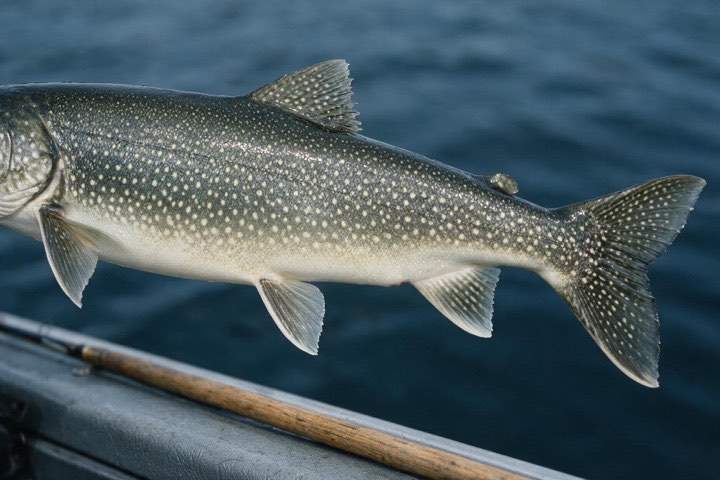
Identification and biology
The lake trout is a char of cold, deep lakes: grey-green with pale spots all over, a deeply forked tail and white leading edges on the lower fins. It grows slowly and lives long, which makes large fish vulnerable to overfishing, and many lakes have special limits. Lake Simcoe, Lake Superior, the Kootenay system and the lakes of the Shield and the north are known for lake trout, and they are a favourite of winter ice anglers where the season allows.
Where they live through the year
After ice-out, lake trout are near the surface and close to shore; as the lake warms and stratifies in summer, they go deep below the thermocline, often thirty metres or more; in fall they spawn on rocky shoals; in winter they roam under the ice over deep water and chase bait up and down the water column.
The mistakes that cost fish
Fishing too shallow in summer. Fishing during a closed season: many lakes close lake trout in fall for the spawn, and the winter season is set lake by lake. Bringing a deep fish up and releasing it at the surface without care. Going out on early or late ice to reach deep water is the most dangerous mistake of all.
Reading the report for lake trout
The water temperature estimate shows when the lake is stratified and the fish are deep. In winter, bright calm days can be slow, and a change in pressure often brings a bite.
Where to fish them in Canada
On this site, lake trout are on the pages for Lake Simcoe, Lake of the Woods, Kootenay Lake, Lake Ontario, Lake Huron and Lake Superior. Simcoe is the best-known lake-trout ice fishery in southern Ontario, with its own zone seasons; Lake Superior is the coldest and deepest of the Great Lakes, where lake trout are the main fish of the open water. None of these pages says the ice is safe: no agency measures it, and each page says to check it yourself. The Great Lakes pages carry no water level, because those levels are published by the Canadian Hydrographic Service under a licence that does not allow commercial use.
Tackle setups
| Situation | Setup | Why it works |
|---|---|---|
| Downrigger trolling | Downrigger rod, 5 to 7 kg line, spoon or plug set just above the fish on the sonar | Summer fish below the thermocline |
| Vertical jigging | 2 m medium-heavy rod, 7 kg braid, 30 to 60 g tube jig or bucktail | Fish marked on the sonar over deep water |
| Through the ice | Ice rod of about 1 m, 5 to 7 kg braid, tube jig or white bucktail jig | Lake trout chase a jig lifted and dropped over deep water |
| Casting in spring | 2.1 m spinning rod, 4 to 5 kg line, spoon cast from shore | Fish close to shore after ice-out |
Playbook by water temperature
The plan the daily report picks for lake trout in each band; the water temperature on each page is a seasonal estimate for its type of water and says so.
Hot water (over 27 °C)
Deep below the thermocline: troll spoons and plugs on downriggers or lead core.
Warm water (18 to 27 °C)
Deep water over humps and drop-offs; vertical jigging where you mark fish.
Cool water (10 to 18 °C)
Fish come shallower after the lake turns over; cast or troll the shoals.
Cold water (under 10 °C)
The ice season where it is open and the ice is safe: tube jigs and bucktails worked over 15 to 30 metres of water.
Month by month
Activity for the Canadian year, 1 slow to 5 peak; January is midwinter, with most lakes under ice. Current month highlighted.
Waters we cover for lake trout
7 Canada waters carry lake trout on their species card, each with a daily report.
Common questions
Where can I catch lake trout through the ice?
Lake Simcoe is the best-known lake in southern Ontario, where the season allows; many northern lakes too.
How deep are lake trout in summer?
Often below the thermocline, thirty metres or more in large lakes.
Is a lake trout a trout?
It is a char, related to brook trout and bull trout.