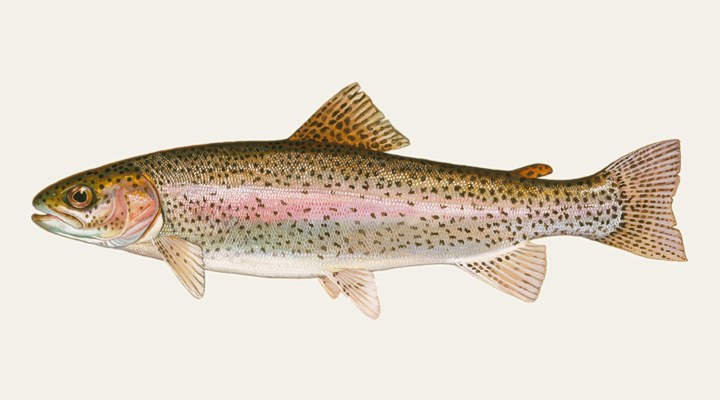
Identification and biology
A steelhead is a rainbow trout that goes to sea. The federal COSEWIC status report describes it as the sea-run form of Oncorhynchus mykiss, growing past a metre and up to 19.5 kilograms, metallic blue on the back and silvery on the sides with black spots, the spawning males with a pink or red band along the side. Unlike the Pacific salmon, a steelhead does not necessarily die after spawning, though repeat spawners are few, under 5% in the Thompson and Chilcotin runs. In BC, winter-run fish enter the rivers from late fall into spring, and summer-run fish enter in summer or fall and spawn the following spring; the interior Fraser runs enter the Fraser from late August to late November. Steelhead also run the tributaries of the Great Lakes in fall and spring.
Where they live through the year
Winter steelhead are the fish of the Vedder, the Capilano, the Squamish and the Vancouver Island rivers from December to April. Summer steelhead move up the Skeena from late summer and spread into its tributaries, the Bulkley, the Kispiox and others, where they are fished through September and October. In Ontario, steelhead run up the Niagara River and the Lake Ontario and Lake Huron tributaries from fall into spring.
The mistakes that cost fish
Keeping a wild steelhead: in BC all wild steelhead must be released, and hatchery steelhead count against an annual province-wide quota of ten, recorded on the licence. Fishing without the steelhead stamp, which is needed to fish for steelhead anywhere in BC even when every fish is released. Fishing too fast: winter steelhead in cold water rarely chase, and a slow presentation on the bottom out-fishes a quick one. Ignoring the classified waters: many steelhead rivers are on the province’s list, and they need a classified waters licence during the classified period, sold to non-residents by the day for a named water.
Reading the report for steelhead
The river gauge is the key: a steelhead river fishes best as it drops and clears after a rise, and a river blown out by rain can be unfishable for days. In winter, the water temperature estimate shows how slow the fish will be; in the fall, the first cold nights often bring the best days on the Bulkley.
Where to fish them in Canada
On this site, steelhead appear on the Vedder, Capilano, Squamish, Cowichan, Skeena, Kitimat and Bulkley pages, and on the Niagara River page for the Great Lakes fish.
Tackle setups
| Situation | Setup | Why it works |
|---|---|---|
| Float fishing | 3.3 to 3.9 m float rod, 5 to 7 kg line, bead, jig, pink worm or roe under a float set just off the bottom | The standard winter method on the south coast rivers |
| Swung fly | Two-handed rod for a 7 or 8 weight line, sink tip, weighted fly swung across the tailout | The classic fall method on the Bulkley and Skeena tributaries |
| Spoon and spinner | 2.7 m rod, 6 kg line, spoon drifted and swung through the run | Covers water when the river is clear |
| Great Lakes tributary | 3.3 m float rod, 3 to 4 kg leader, roe bag or bead | Clear, cold water and pressured fish need finer tackle |
Playbook by water temperature
The plan the daily report picks for steelhead in each band; the water temperature on each page is a seasonal estimate for its type of water and says so.
Hot water (over 27 °C)
Summer fish in the northern rivers hold in the deeper runs; fish the early and late light with dry flies or small spoons.
Warm water (18 to 27 °C)
Fish the riffles and the heads of runs as water drops and clears after a rise.
Cool water (10 to 18 °C)
Fall fish on the move: float fishing with roe, beads or jigs, and swung flies through the tailouts.
Cold water (under 10 °C)
The winter run. Slow and deep: float gear right on the bottom, swing slower, and fish the days after a small rise in water.
The legal season is a separate question
Activity says when the fish bite; the agency says when you may keep one. These are the closures that name steelhead, computed for 2026 from each rule as written and read on the date shown. A province with no row publishes no closure for this species, which is not the same as open all year.
| State | Fishery | 2026 | Rule | Source |
|---|---|---|---|---|
| Ontario | Brown and rainbow trout, Grand River below Paris (extended season) | Closed 2026-01-01 to 2026-04-24 | From Paris to Lake Erie, brown and rainbow trout (steelhead) are open from the fourth Saturday in April to 31 December; below Brantford only one may be kept from 1 October to 31 December. Upstream, around Fergus and Elora, trout must be released and the season ends on 30 September. | Ontario Ministry of Natural Resources, Fishing Regulations Summary, Zone 16, read 2026-09-27 |
| Ontario | Pacific salmon and rainbow trout, Zone 20 (and Zone 19) | Open all year | Pacific salmon and rainbow trout (steelhead) are open all year in Zones 19 and 20; many tributaries have their own seasons and sanctuaries, such as the Ganaraska. | Ontario Ministry of Natural Resources, Fishing Regulations Summary, Zone 20, read 2026-09-27 |
| Ontario | Pacific salmon and rainbow trout, Zone 13 | Open all year | Pacific salmon and rainbow trout are open all year in Zone 13; tributaries in Zone 16, such as the Maitland, have sanctuaries. | Ontario Ministry of Natural Resources, Fishing Regulations Summary, Zone 13, read 2026-09-27 |
| Ontario | Pacific salmon and rainbow trout, Zone 9 | Open all year | Pacific salmon and rainbow trout are open all year in Zone 9; only one rainbow trout may be kept (sport licence). | Ontario Ministry of Natural Resources, Fishing Regulations Summary, Zone 9, read 2026-09-27 |
| British Columbia | Cowichan River summer closure | Closed 2026-07-15 to 2026-08-31 | No fishing 15 July to 31 August. From the weir at Cowichan Lake to Greendale Trestle no fishing 15 November to 15 April; below the Mile 66 trestle no fishing 1 September to 15 November. In 2025 the province brought the summer closure forward to 4 July by in-season order. | Government of British Columbia, 2025-2027 Freshwater Fishing Regulations Synopsis, Region 1, read 2026-09-27 |
| British Columbia | Chilliwack/Vedder, Tamihi Rapids to Vedder Crossing | Closed 2026-05-01 to 2026-06-30 | No fishing from Tamihi Rapids Bridge to Vedder Crossing Bridge 1 May to 30 June; upstream to Slesse Creek 1 April to 30 June. Below Vedder Crossing: fly only and bait ban in May, no fishing in June. | Government of British Columbia, 2025-2027 Freshwater Fishing Regulations Synopsis, Region 2, read 2026-09-27 |
| British Columbia | Capilano River steelhead | Open all year; release only the rest of the year, never kept | Every steelhead on the Capilano is released; bait ban 1 August to 31 October. | Government of British Columbia, 2025-2027 Freshwater Fishing Regulations Synopsis, Region 2, read 2026-09-27 |
| British Columbia | Skeena watershed streams above Cedarvale (Bulkley) | Closed 2026-01-01 to 2026-06-15 | No fishing in any stream of the Skeena watershed upstream of Cedarvale 1 January to 15 June. The Bulkley above the Morice confluence is closed all year; no angling from boats from the Morice to Barrett 15 August to 31 December. | Government of British Columbia, 2025-2027 Freshwater Fishing Regulations Synopsis, Region 6, read 2026-09-27 |
| British Columbia | Steelhead in Region 6 rivers | Closed 2026-05-15 to 2026-06-15 | No fishing for steelhead in rivers and streams 15 May to 15 June. The province says Kitimat River regulations are under review: check the in-season changes page before fishing. | Government of British Columbia, 2025-2027 Freshwater Fishing Regulations Synopsis, Region 6, read 2026-09-27 |
Month by month
Activity for the Canadian year, 1 slow to 5 peak; January is midwinter, with most lakes under ice. Current month highlighted.
Waters we cover for steelhead
14 Canada waters carry steelhead on their species card, each with a daily report.
Common questions
Can I keep a steelhead in BC?
Wild steelhead must be released throughout BC; hatchery steelhead may be kept where the synopsis allows, up to ten a year province-wide. A steelhead stamp is needed to fish for them, whether you keep one or not.
When is steelhead season?
Winter runs from December to April on the south coast; summer runs are fished in the fall on the Skeena system; Great Lakes tributaries in fall and spring.
Is a steelhead a trout or a salmon?
It is the sea-run form of the rainbow trout, the same species, and unlike the Pacific salmon it can survive spawning.
Pages checked
- canada.ca/en/environment-climate-change/services/species-risk-public-registry/co
- www2.gov.bc.ca/gov/content/sports-culture/recreation/fishing-hunting/fishing/rec
- www2.gov.bc.ca/gov/content/sports-culture/recreation/fishing-hunting/fishing/rec
The facts on this page were checked against these pages, from the agencies, park services and operators that manage the water on September 27, 2026; anything we could not verify was taken out.