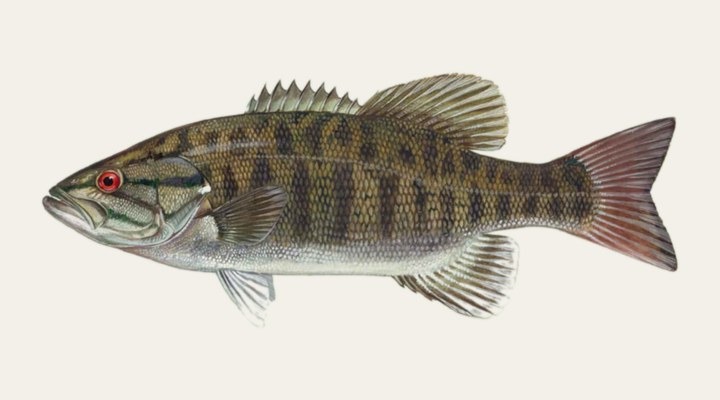
Identification and biology
The smallmouth bass is bronze to olive-brown with dark vertical bars and red eyes, a hard-fighting fish of rock, current and clear water. The upper jaw ends at or before the eye, which separates it from the largemouth. Smallmouth guard their nests in late spring and early summer, which is why Ontario opens bass season only in late June in most zones. The Great Lakes shores, the Bay of Quinte, the St. Lawrence, Lake St. Clair and the Grand River are well-known smallmouth waters.
Where they live through the year
After the season opens, smallmouth are on the rocky shoals, points and current breaks, often in three to eight metres of water; in the heat of summer the bigger fish move deeper; in fall they school on deeper rock and feed heavily. In rivers such as the Grand and the Niagara they hold behind boulders and in the current seams.
The mistakes that cost fish
Fishing for bass before the season opens, when the nesting fish are protected. Fishing too fast in cold water. Ignoring the wind: a wind-blown rocky shore often holds the most active fish. Losing a big smallmouth at the boat because the drag was set too tight for its jumps is the other classic mistake.
Reading the report for smallmouth
Stable weather and a steady barometer make for the best days; a cold front slows them for a day or two. On the Great Lakes, the wind decides where the fish are and where it is safe to fish.
Where to fish them in Canada
On this site, smallmouth bass are on the pages for Long Point Bay, Erieau, Port Glasgow and Wheatley on Lake Erie, Lake St. Clair, the Bay of Quinte, Rice Lake, the St. Lawrence, the Detroit, Niagara and Grand rivers, and Lake Simcoe in summer. The Grand River page carries a live Water Survey of Canada gauge at Brantford, where the middle river is smallmouth water. On the Lake Erie and Lake St. Clair pages, the wind row decides where it is safe to fish, because the shallow lakes build steep waves quickly.
Tackle setups
| Situation | Setup | Why it works |
|---|---|---|
| Tube on the rock | 2 m medium spinning rod, 3.5 kg fluorocarbon or braid with a leader, 7 to 10 cm tube on a 7 to 14 g jighead | Imitates the gobies and crayfish smallmouth feed on |
| Drop shot | 2 m medium-light spinning rod, 3 kg fluorocarbon, small soft plastic above a sinker | Deep or pressured fish in clear water |
| Topwater | 2 m rod, 5 to 7 kg braid, walking bait or popper | Calm mornings and evenings over shallow rock |
| Jerkbait in fall | 2 m rod, 4 to 5 kg fluorocarbon, suspending jerkbait with long pauses | Cold-water smallmouth on the deeper rock |
Playbook by water temperature
The plan the daily report picks for smallmouth bass in each band; the water temperature on each page is a seasonal estimate for its type of water and says so.
Hot water (over 27 °C)
Deep rock and current: tubes and drop shots on the humps and the shoals.
Warm water (18 to 27 °C)
The prime season: tubes, crankbaits and topwater along the rocky points and breaks.
Cool water (10 to 18 °C)
Fall schools on the deeper rock: jerkbaits and hair jigs.
Cold water (under 10 °C)
Closed or out of season in most waters.
Month by month
Activity for the Canadian year, 1 slow to 5 peak; January is midwinter, with most lakes under ice. Current month highlighted.
Waters we cover for smallmouth bass
12 Canada waters carry smallmouth bass on their species card, each with a daily report.
Common questions
When does bass season open in Ontario?
In late June in most zones, after the nesting period; the regulations summary gives the date for each zone.
How do I tell a smallmouth from a largemouth?
On a smallmouth, the upper jaw ends at or before the eye; on a largemouth it extends past the eye.
Where are the best smallmouth waters in Canada?
The Great Lakes shores, Lake St. Clair, the St. Lawrence, the Bay of Quinte and rivers such as the Grand.