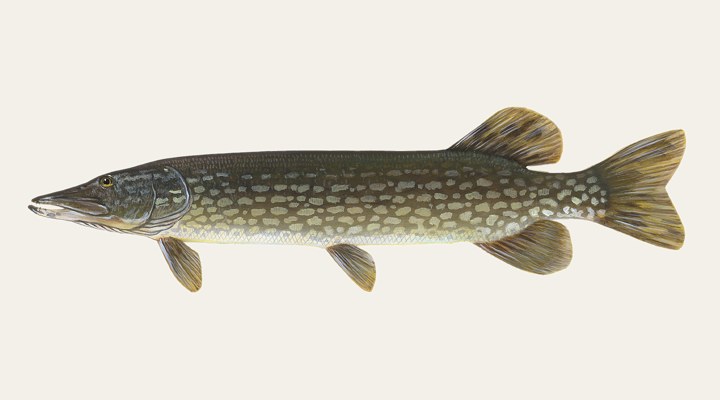
Identification and biology
The northern pike, called jackfish on the prairies, is a long, torpedo-shaped predator with a duck-bill jaw full of teeth, olive-green with rows of pale bean-shaped spots. It lives in almost every lake and slow river from Ontario to Alberta and grows large in cold, deep lakes. Pike spawn in flooded marshes right after the ice goes out, often before the walleye.
Where they live through the year
In spring, pike are in the shallow bays and marshes; in summer, the smaller fish stay in the weeds and the big ones move to deeper, cooler water; in fall they feed heavily in the shallows where the baitfish gather; under the ice they cruise the weed edges and the shallow bays.
The mistakes that cost fish
Fishing without a wire or heavy fluorocarbon leader, and losing fish and lures to the teeth. Handling pike without long pliers and care: the gill rakers and teeth cut, and fish to be released should be handled quickly. Fishing the shallows for big pike in the heat of summer. Retrieving too fast in cold water is another: in spring and late fall, pike often follow a lure and turn away if it does not pause.
Reading the report for pike
Pike bite in almost any weather, but a change in pressure and a windy day often trigger the bigger fish. In winter, the ice is fished with tip-ups where it is safe. Cloudy, breezy days are often the best.
Where to fish them in Canada
On this site, pike are on the pages for Lake of the Woods, Lake Winnipeg, Lake Diefenbaker, Tobin Lake, Pigeon and Sylvan lakes, Lake Simcoe, Long Point Bay, Lake St. Clair, the Bay of Quinte, Rice Lake and the St. Lawrence. The prairie lakes, Diefenbaker and Tobin in particular, are known for big pike as well as walleye, and Lake of the Woods holds pike among its thousands of islands. The Diefenbaker, Tobin, Pigeon, Sylvan and Lake of the Woods pages carry live Water Survey of Canada level gauges, and every page says that no agency certifies the ice for anglers.
Tackle setups
| Situation | Setup | Why it works |
|---|---|---|
| Spoons and spinnerbaits | 2.1 m medium-heavy rod, 9 to 14 kg braid, wire leader, spoon or spinnerbait | Classic pike lures over the weeds |
| Big swimbaits in fall | 2.3 m heavy rod, 18 kg braid, heavy leader, 15 to 20 cm swimbait | Big fish feeding in the shallows before winter |
| Tip-up through the ice | Tip-up with 14 kg line, wire leader and a dead bait | The standard winter method in shallow bays |
| Fly | 2.7 m rod for a 9 weight line, wire bite tippet, large streamer | Sight-fishing in the shallows in spring |
Playbook by water temperature
The plan the daily report picks for northern pike (jackfish) in each band; the water temperature on each page is a seasonal estimate for its type of water and says so.
Hot water (over 27 °C)
Big pike go deep and cool; small ones stay in the weeds. Spoons and spinnerbaits along the deep weed edges.
Warm water (18 to 27 °C)
Spinnerbaits, spoons and jerkbaits over the weed beds and along the points.
Cool water (10 to 18 °C)
The fall feed: big swimbaits and spoons in the shallows where the baitfish gather.
Cold water (under 10 °C)
Under the ice where it is safe: tip-ups with dead bait in the shallow bays.
Month by month
Activity for the Canadian year, 1 slow to 5 peak; January is midwinter, with most lakes under ice. Current month highlighted.
Waters we cover for northern pike (jackfish)
13 Canada waters carry northern pike (jackfish) on their species card, each with a daily report.
Common questions
Is a jackfish a pike?
Yes, jackfish is the common name for northern pike on the prairies.
Do I need a wire leader for pike?
A wire or heavy fluorocarbon leader prevents bite-offs from the teeth.
When is the best time for big pike?
Spring after ice-out and fall, when big fish are in the shallows.