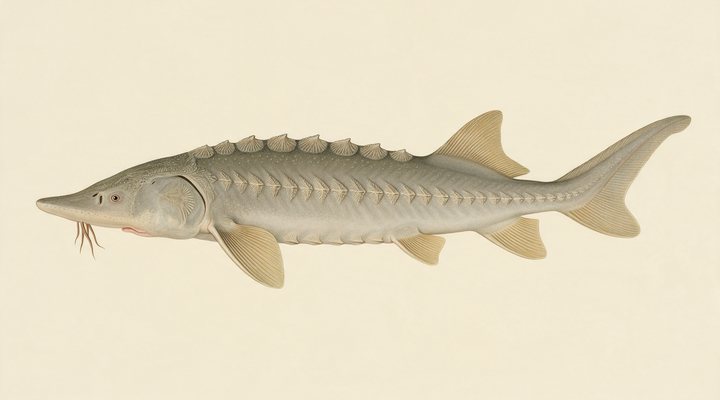
Identification and biology
The white sturgeon is the largest freshwater fish in North America, a living fossil with a shark-like tail, rows of bony plates called scutes along the back and sides, and four barbels in front of a toothless, vacuum-like mouth. In the Fraser River it lives for decades and can grow to several metres. It feeds on the bottom, on fish, eggs and anything the current brings, and follows the salmon runs to feed on eggs and carcasses.
Where they live through the year
The lower Fraser, from the estuary up past Mission, Chilliwack and Hope, is the heart of the fishery. Sturgeon hold in the deep channels, the back eddies and the holes, moving with the salmon runs in late summer and fall, when fishing is often at its best, and holding in the deeper water in winter.
The mistakes that cost fish
Removing a sturgeon from the water: in BC these fish are catch-and-release only, and the synopsis sets out how they must be handled and released. Fishing without the White Sturgeon Conservation Licence. Using gear too light for a fish that can weigh more than a person, which prolongs the fight.
Reading the report for sturgeon
The Fraser gauge at Mission shows the freshet in spring and early summer, when the river is high and hard to fish, and the lower, clearer water of fall and winter, prime sturgeon months. The salmon runs, which DFO tracks, bring the fish in.
Where to fish them in Canada
On this site, white sturgeon are on the Fraser River at Mission page, with the live Water Survey of Canada gauge at Mission, and on the Harrison River page, where the river joins the Fraser. The Mission gauge shows the freshet that makes the river high and brown from May into July, and the lower, clearer water of fall and winter that suits sturgeon fishing. The page for the Fraser explains the White Sturgeon Conservation Licence, which is needed on top of the BC freshwater licence, and the handling rules that keep the fish in the water. Guides run trips from Mission, Chilliwack and the other valley towns.
Tackle setups
| Situation | Setup | Why it works |
|---|---|---|
| Anchored in the channel | 2.4 m heavy rod, 36 to 45 kg braid, heavy leader, barbless circle hook, 170 to 450 g sinker | Holds bait on the bottom in the Fraser current |
| Bait | Salmon roe, eulachon or salmon pieces | Sturgeon follow the salmon runs and feed on eggs and carcasses |
| Back eddy from the bank | 3 m heavy rod, 30 kg line, sliding sinker rig | Fish hold in the slower water off the current |
| Handling | Large rubberised net or a sling; keep the fish in the water | The synopsis rules on handling protect the fish |
Playbook by water temperature
The plan the daily report picks for white sturgeon in each band; the water temperature on each page is a seasonal estimate for its type of water and says so.
Hot water (over 27 °C)
Deep holes and the edges of the main current, with bait on the bottom; keep the fight short in warm water.
Warm water (18 to 27 °C)
Bait on the bottom in the back eddies and deep runs, following the salmon runs.
Cool water (10 to 18 °C)
The salmon runs bring the fish: roe and salmon parts in the deep holes.
Cold water (under 10 °C)
Deep, slow water with bait on the bottom; fewer fish, big fish.
Month by month
Activity for the Canadian year, 1 slow to 5 peak; January is midwinter, with most lakes under ice. Current month highlighted.
Waters we cover for white sturgeon
1 Canada waters carry white sturgeon on their species card, each with a daily report.
Common questions
Can I keep a white sturgeon?
No, Fraser River white sturgeon fishing is catch-and-release only, with a separate conservation licence.
Where can I fish for sturgeon in BC?
The lower Fraser River, from the estuary up past Mission, Chilliwack and Hope.
Do I need a guide for sturgeon?
No, but a guided trip is the simplest way to fish sturgeon with the right gear and handling.