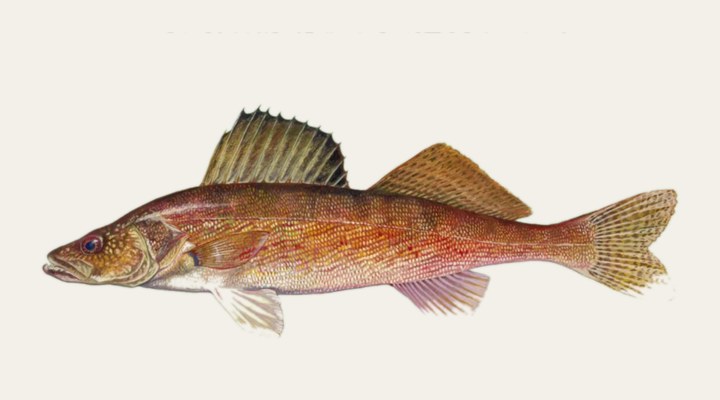
Identification and biology
The walleye, called pickerel in much of Ontario and Manitoba, is Canada’s most popular freshwater fish: olive-gold on the back and sides, white on the belly, with a white tip on the lower lobe of the tail and large glassy eyes that give it its name and its ability to feed in low light. It spawns in spring on rocky shoals and in rivers soon after the ice goes out, which is why most provinces close walleye fishing through the spawn. Lake Winnipeg’s walleye are called greenbacks for their colour; Lake of the Woods, Lake Diefenbaker, Tobin Lake, the Bay of Quinte and Lake Erie are all famous walleye waters.
Where they live through the year
After the spring opener, walleye are on the shallow shoals and in the river mouths; through summer they move to the deeper breaks, reefs and mud flats, feeding at dawn and dusk; in fall they return to the rocks and the rivers and feed heavily before winter. Through the ice, they hold near the bottom over the transitions between shallow and deep water and feed at first and last light. In the Detroit River and the Red River, the spring and fall runs bring big fish close to the cities.
The mistakes that cost fish
Fishing the middle of a bright day in clear water, when walleye are deep and inactive, instead of the low-light hours. Fishing too fast in cold water. Missing the season: the opener and the zone limits differ from province to province and from zone to zone, and some lakes have special rules or a harvest licence.
Reading the report for walleye
Walleye respond to light and pressure: an overcast, windy day with a falling barometer before a front is the classic bite, and the bright, calm day after a front is often slow. The fishing times on each page point to dawn and dusk. On the river pages, the gauge shows the spring and fall rises that move fish.
Where to fish them in Canada
On this site, walleye are on the pages for Lake of the Woods, Lake Winnipeg, the Red River at Selkirk, Lake Diefenbaker, Tobin Lake, Pigeon and Sylvan lakes, the Bay of Quinte, Rice Lake, the Detroit and St. Lawrence rivers and the Lake Erie ports, with the live gauge where there is one.
Tackle setups
| Situation | Setup | Why it works |
|---|---|---|
| Jig and minnow | 1.8 to 2 m medium-light spinning rod, 3.5 to 4.5 kg braid, fluorocarbon leader, 7 to 14 g jig tipped with a minnow | The standard walleye method on rocks, reefs and current breaks |
| Crawler harness | Bottom bouncer and a spinner harness with a nightcrawler, trolled slowly over the flats | Covers water when walleye are scattered in summer |
| Stickbait at night | 2 m rod, 4.5 kg line, shallow-running stickbait cast or trolled along the shoreline | Big walleye move shallow at night in fall |
| Through the ice | Short ice rod, 2.5 to 3.5 kg line, jigging spoon plus a dead-stick minnow nearby | The spoon draws fish, the still minnow gets the bite |
Playbook by water temperature
The plan the daily report picks for walleye (pickerel) in each band; the water temperature on each page is a seasonal estimate for its type of water and says so.
Hot water (over 27 °C)
Fish go deep or feed at night. Troll crawler harnesses and crankbaits along the mud flats and breaks at dawn and dusk.
Warm water (18 to 27 °C)
Jig and minnow along the weed edges, reefs and current breaks; troll the flats when they scatter.
Cool water (10 to 18 °C)
The fall bite: fish move to the rock and the river mouths; jigs and minnows, stickbaits at night.
Cold water (under 10 °C)
Through the ice where it is safe: jigging spoons and a dead-stick minnow near the bottom at first and last light. Open rivers: slow jigs in the deep holes.
Month by month
Activity for the Canadian year, 1 slow to 5 peak; January is midwinter, with most lakes under ice. Current month highlighted.
Waters we cover for walleye (pickerel)
17 Canada waters carry walleye (pickerel) on their species card, each with a daily report.
Common questions
Is a pickerel the same as a walleye?
In Canada, yes: pickerel is the common name for walleye in much of Ontario and Manitoba.
When does walleye season open?
After the spring spawn, on a date set by each province and zone; check the province’s regulations for the water.
What is the best time of day for walleye?
Dawn and dusk, and overcast or windy days, when the light is low.