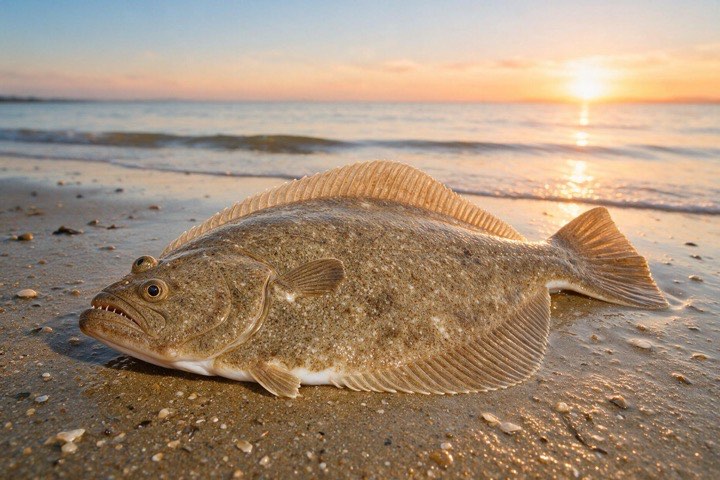
An ambush flatfish
CDFW calls California halibut a visual ambush predator that lies camouflaged in the sediment or swims up off the bottom to feed on schooling northern anchovy and market squid, along with shrimp, crabs, croakers and other small fish. It lives over soft sand and mud, mostly near and inside bays and estuaries in less than about 197 feet of water, though it has been recorded to 1,040 feet. The IGFA notes that although it belongs to the left-eye flounders, nearly half of these halibut have both eyes on the right side.
Range and size
The range runs from northern Washington to southern Baja California, but CDFW says the fish is most common from Bodega Bay to northern Baja and turns up in Humboldt Bay during warm-water events. Females grow faster and larger. CDFW lists the largest reported fish at 60 inches and 72 pounds, with fish over 45 inches rare and usually female; the IGFA all-tackle record is 67 lb 5 oz. Reaching 22 inches and about 4 pounds takes three to five years, and maximum age is 30, though fish older than 15 are rare.
The season
Halibut can be fished all year, but CDFW's survey data put most of the recreational catch between April and October with a summer peak, and fish move deeper in winter. Spawning has been recorded year-round with peaks that shift with latitude, mostly outside estuaries, while bays such as San Francisco Bay serve as nurseries. The state beach guides hosted by California Sea Grant list peak surf months as May to August on the central coast and June to October in Southern California.
How it is fished
Most halibut are caught from boats on hook and line. CDFW describes the typical boat setup as a conventional reel, a three-way swivel with a sinker that taps the soft bottom and a leader with a single J-hook for live bait; treble hooks and trap rigs are used mostly with dead bait. The IGFA calls drifting with live anchovies, shrimp or queenfish the most successful sport method and notes slow trolling also works. From the beach, those guides advise watching for diving birds and marine mammals that mark baitfish and casting there.
Status
CDFW has updated its stock assessment, which treats fish north and south of Point Conception as two stocks; an independent peer review found the northern model not yet adequate for management. Bag limits differ north and south of Point Sur; see the California page before keeping fish.
Tackle setups
| Situation | Setup | Why it works |
|---|---|---|
| Boat drift, live bait | Conventional reel, three-way swivel, sinker heavy enough to tap bottom, leader with single J-hook, live anchovy | The standard California rig CDFW describes |
| Dead bait | Same setup with a trap rig or treble hook, squid or herring | CDFW notes trebles and trap rigs are mostly used with dead bait |
| Slow trolling | Conventional outfit, lure or bait kept near the bottom | Covers sand flats when fish are scattered (IGFA) |
| Surf | 10-12 ft rod rated 2-8 oz in heavy surf, or 7-9 ft rod with a Carolina-rigged grub | The state beach guides' setups; cast where birds show bait |
Playbook by water temperature
High summer (80F+)
California's coastal water rarely reaches this band. In the warmest summer weeks, which are peak catch time (CDFW), drift live anchovies over sand near bay channels and harbor mouths, keeping the sinker tapping bottom.
Active season (65-80F)
Spring and summer bring fish onto shallow sand and the recreational catch climbs from April. Drifting with the tide over sand and hopping swimbaits along the bottom are the usual methods.
Transition (50-65F)
The catch drops after October as halibut move to deeper water (CDFW). Fish deeper channels and nearshore sand and slow the drift.
Winter (under 50F)
November through March is the slow season. Where anglers still fish, dead bait such as squid or herring on a trap rig over deeper bay and nearshore sand is the usual approach.
Month by month
1 = slow, 5 = peak. Current month highlighted.
Best waters for california halibut
4 waters we report on where this species is one of the main fish, each with a daily report.
Common questions
Where do California halibut live?
On sand and mud bottoms near and inside bays and estuaries, mostly in less than about 200 feet of water, and most commonly from Bodega Bay to northern Baja California (CDFW).
What is the best bait for California halibut?
Live anchovy is the standard; the IGFA also lists shrimp and queenfish for drifting, and CDFW notes squid and herring are used as dead bait.
How big do California halibut get?
CDFW's largest reported fish is 72 pounds and 60 inches, and the IGFA all-tackle record is 67 lb 5 oz. Most are far smaller: reaching 22 inches takes three to five years.
Is it the same fish as Pacific halibut?
No. Pacific halibut is a different species (Hippoglossus stenolepis), and the IGFA lists the two separately.
Pages checked
- marinespecies.wildlife.ca.gov/california-halibut/true
- marinespecies.wildlife.ca.gov/california-halibut/the-fishery
- igfa.org/game-fish-database/?search_type=SpeciesID&search_term_1=143
- caseagrant.ucsd.edu/sites/default/files/C.CAsurfbro.pdf
- caseagrant.ucsd.edu/sites/default/files/S.CAsurfbro.pdf
The facts on this page were checked against these pages, from the agencies and research bodies that manage and study this fish on October 6, 2026; anything we could not verify was taken out.