Identification and biology
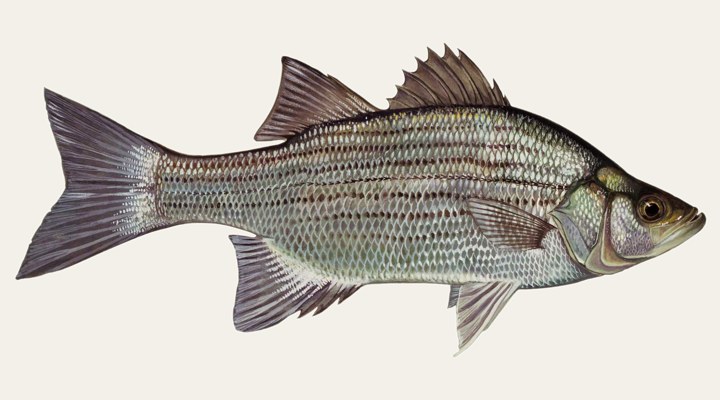
White bass are silvery with several faint, often broken dark lines along the sides and a single tooth patch at the rear of the tongue; the striped bass has two separate patches, two points on the gill cover instead of one and a slimmer body. Missouri gives 9 to 15 inches and a quarter-pound to 1¼ pounds as usual and about 5 pounds as the maximum; Georgia's record is 5 pounds 1 ounce. They grow fast, up to eight or nine inches in the first year according to TPWD, but rarely live beyond four years. They are native to the middle of the country, from the Great Lakes through the Ohio and Mississippi valleys; populations in Missouri's Ozark reservoirs and in South Carolina, starting with Lake Wylie in 1954, came from stocking.
Runs and schools
The year has two fishing peaks. In spring, schools of males move up tributaries as much as a month before the females, and spawning in any one place is done within 5 to 10 days (MDC); in Missouri they enter the streams in March, and South Carolina describes the run in March and April as the water reaches 55°F. Eggs are scattered over gravel or rock in current and stick to the bottom. From summer into fall they feed in schools at dawn and dusk, often near the surface, and Missouri describes compact schools driving shad until the baitfish leap from the water. In big Ozark reservoirs their numbers rise and fall with the gizzard shad they eat.
The mistakes that cost fish
Missing the run: the spawn in a given stretch can be over in about a week, so watch the water temperature rather than the calendar date. Staying put after a school moves on: Missouri notes they gather where food is plentiful and move when it is gone. And skipping the night bite: Texas Parks and Wildlife reports good success bottom fishing with live bait after dark.
Tackle setups
| Situation | Setup | Why it works |
|---|---|---|
| Spring run | Light spinning rod with small jigs or spinners worked through the current | Matches the small baitfish in the streams the spawners run up |
| Surface schools | Spoons or spinners cast to feeding fish | TPWD notes successful anglers often fish the surface this way once a school is found |
| Night bottom fishing | Live bait on the bottom | TPWD reports it can produce well |
Playbook by water temperature
High summer (80F+)
Fish at dawn and dusk when schools push shad to the surface; cast spoons or spinners to the edge of the activity.
Active season (65-80F)
Summer and early fall schooling season over open water; follow the shad, and try live bait on the bottom at night.
Transition (50-65F)
The spring run happens in this band: tributaries, shoals and the upper ends of reservoirs as the water reaches about 55°F.
Winter (under 50F)
Fish are in deeper pools of reservoirs and rivers and feed less; locate schools with electronics before fishing.
Month by month
1 = slow, 5 = peak. Current month highlighted.
Best waters for white bass
215 waters we report on where this species is one of the main fish, each with a daily report.
Sam Rayburn Reservoir
Lake Fork
Lake Texoma
Lake Palestine
Toledo Bend Reservoir
Lake Livingston
Lake Tawakoni
Lake Buchanan
Lake Allatoona
Lake Erie
Devils Lake
Milford Lake
Richland-Chambers Reservoir
Lake Amistad
Falcon Lake
Possum Kingdom Lake
Greers Ferry Lake
Bull Shoals Lake
Chickamauga Lake
Shasta Lake
Kentucky Lake
Table Rock Lake
Truman Lake
Stockton Lake
Mark Twain Lake
Lake Eufaula
Broken Bow Lake
Douglas Lake
Watts Bar Lake
Kerr Lake (Buggs Island)
Jordan Lake
Falls Lake
High Rock Lake
Clarks Hill Lake
Lake Sinclair
Weiss Lake
Wheeler Lake
Rend Lake
Lake Shelbyville
Carlyle Lake
Lake Winnebago
Lake Oahe
Lake McConaughy
Roosevelt Lake
Lake Berryessa
Raystown Lake
Lake Tohopekaliga
Lake Istokpoga
Choke Canyon Reservoir
Lake Travis
Lake Ray Roberts
Cedar Creek Lake
DeGray Lake
Lake LBJ
Lake Somerville
Lake Lavon
Lake Lewisville
Lake Limestone
Granger Lake
Lake Athens
Belton Lake
Lake Waco
Lake O' the Pines
Lake Bridgeport
Lake Brownwood
Pueblo Reservoir
Aurora Reservoir
Wolf River
Lake Keowee
Clinton Lake
Smithville Lake
Caddo Lake
Lake Barkley
Big Stone Lake
Rathbun Lake
Grenada Lake
Kaw Lake
Benbrook Lake
Eagle Mountain Lake
Lake Ray Hubbard
Bartlett Lake
Lake Tyler
O.H. Ivie Lake
Lake Talquin
Hillsdale Lake
Waubay Lake
Melvern Lake
Perry Lake
Lake Meredith
Lake Bob Sandlin
Bois d'Arc Lake
Fort Gibson Lake
Millwood Lake
Taylorsville Lake
Buckeye Lake
Saguaro Lake
Keystone Lake
Lake Houston
Grapevine Lake
Joe Pool Lake
Lake Casitas
Spirit Lake
Indian Lake
Lake Thompson
Bitter Lake
Upper Red Lake
Willard Bay
St. Johns River
Lake Kissimmee
Potholes Reservoir
Petenwell Lake
Marion Reservoir
Lake Hefner
Lake Francis Case
Nickajack Lake
Neuse River
Lake Poygan
Lake Nasworthy
Lake Fort Phantom Hill
Caney Lake
Lake Greeson
Lake Harris
Orange Lake
Pomona Lake
Lake MacBride
Nimrod Lake
Lake Worth
Lake Aquilla
Bardwell Lake
Lake Cypress Springs
Salt River
Lake Blackshear
El Dorado Lake
Millerton Lake
Vermilion River
Inks Lake
Brazos River
Boyd Lake
Oologah Lake
Lake Dardanelle
Lake Lowell
Thurmond Lake
Green River Lake
Kanopolis Lake
Cheat Lake
Pomme de Terre Lake
Boysen Reservoir
Wilson Lake
Grand Lake o the Cherokees
Badin Lake
Arkabutla Lake
Lake Chicot
Lake Murray
Canyon Lake
Medina Lake
Cedar Bluff Reservoir
Glen Elder Reservoir
Harlan County Lake
Conchas Lake
Lake Ashtabula
Tygart Lake
Stonewall Jackson Lake
Merritt Reservoir
Calamus Reservoir
Cave Run Lake
Herrington Lake
Lake Sharpe
Blue Marsh Lake
Liberty Reservoir
Wright Patman Lake
Ute Reservoir
Cochiti Lake
Lums Pond
Lake Tschida
Union Lake
Coralville Lake
Rye Patch Reservoir
Lahontan Reservoir
Sherman Reservoir
Nolin River Lake
East Okoboji Lake
Storm Lake
Saylorville Lake
Red Rock Lake
Geist Reservoir
Salamonie Lake
Cagles Mill Lake
Lake Springfield
Lewis and Clark Lake
Lake Nacimiento
Lake Hodges
San Carlos Lake
Lake Marble Falls
Tenkiller Ferry Lake
Robert S Kerr Reservoir
Barren River Lake
Jamestown Reservoir
Belle Fourche Reservoir
Branched Oak Lake
Caesar Creek Lake
Sheyenne River
Cedar River
Silver Lake
Broad River
Ouachita River
Verdigris River
Loup River
Killens Pond
Noxontown Pond
Eagle Lake
Lake Poinsett
Enders Reservoir
Laurel River Lake
Toms River
Lake Freeman
Common questions
When is the white bass run?
In early spring. In Missouri fish enter the tributaries in March and stay until mid or late April; in South Carolina the run is March and April, as the water reaches about 55°F.
How do I tell a white bass from a striped bass or hybrid?
Check the tongue: a white bass has a single tooth patch, a striper two separate ones, and hybrids two patches close together or a single one. White bass also seldom pass 3 to 5 pounds.
Are white bass good to eat?
Texas Parks and Wildlife calls them superb table fare.
Pages checked
- tpwd.texas.gov/huntwild/wild/species/wtb
- mdc.mo.gov/discover-nature/field-guide/white-bass
- dnr.sc.gov/fish/species/whitebass.html
- georgiawildlife.com/fishing/recordprogram
The facts on this page were checked against these pages, from the agencies and research bodies that manage and study this fish on October 6, 2026; anything we could not verify was taken out.