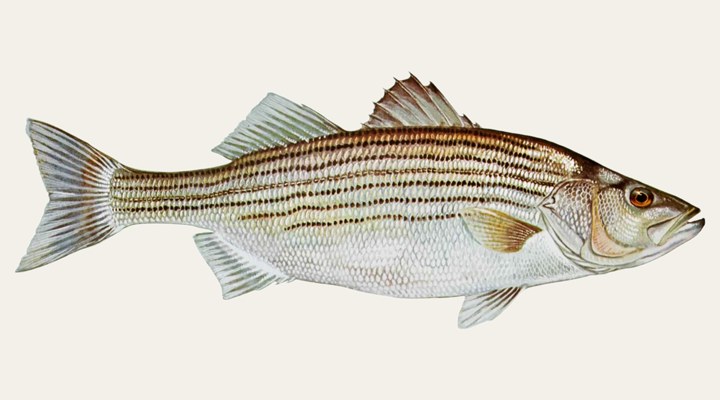
From the coast to the reservoirs
NOAA Fisheries gives the native range as the Atlantic seaboard from Canada's St. Lawrence River south to Florida's St. Johns River and the Gulf from Florida to Louisiana, with introduced fish now on the West Coast from Mexico to British Columbia. Coastal fish are anadromous, living in salt water and running up rivers to spawn. In the 1940s, construction of the Santee-Cooper dams in South Carolina trapped striped bass that went on to reproduce in fresh water, and South Carolina DNR's hatchery work at the Dennis Wildlife Center led to striper fisheries in reservoirs across the country. Missouri reports that adults spread through a reservoir from fall to spring but gather near the thermocline in summer, looking for cool, well-oxygenated water.
Spawning and why most lakes are stocked
Stripers spawn in spring in flowing water: Oklahoma puts the trigger at 55 to 70°F with a peak near 65°F, and South Carolina at 60 to 70°F. The semi-buoyant eggs have to stay suspended in current until they hatch, and Texas Parks and Wildlife says at least 50 miles of stream is generally needed. That is why most reservoir populations are kept up by stocking. The exceptions the agencies name include Lake Texoma (TPWD and ODWC), Keystone Lake and the Arkansas River Navigation System (ODWC), and the Santee-Cooper lakes with the Congaree and Wateree rivers above them (SCDNR).
Atlantic coast management
On the Atlantic coast the coastal migratory stock is managed, from Maine through North Carolina, by the Atlantic States Marine Fisheries Commission under Amendment 7 to its fishery management plan. NOAA Fisheries, citing the 2024 assessment, lists the stock as overfished but not subject to overfishing. Coastal size and bag limits change often and differ by state and by water body, so check the current rules with the state before keeping a fish.
Tackle setups
| Situation | Setup | Why it works |
|---|---|---|
| Lures for open-water schools | Medium to medium-heavy rod with spoons, slabs, swimbaits, curly-tail grubs, jerkbaits or lipless crankbaits in silver, white or chartreuse | ODWC lists these as top lures; TPWD notes silver spoons imitate the shad stripers eat |
| Live bait | Shad netted from the same lake, on a hook below a swivel and slip weight, let down to the depth where fish are marked | Shad and herring are the main inland food (MDC, SCDNR) |
| Deep summer fish | Deep-running lures or trolled baits near the thermocline | MDC reports summer stripers gathering in cool water near the thermocline |
| Surface feeding | Topwater plugs when fish boil on top | ODWC's advice for schools pushing bait to the surface |
Playbook by water temperature
High summer (80F+)
Inland stripers seek the cool, oxygenated band near the thermocline; fish live bait or deep lures at that depth at first and last light.
Active season (65-80F)
Use electronics to find shad schools in open water, and watch for birds working over bait.
Transition (50-65F)
Spring and fall are the shoreline seasons: ODWC points to windblown points, riprap and dams during the May shad spawn and the pre-winter feed.
Winter (under 50F)
From fall to spring stripers range through the whole reservoir (MDC); follow the bait and fish slowly when the water is coldest.
Month by month
1 = slow, 5 = peak. Current month highlighted.
Best waters for striped bass
131 waters we report on where this species is one of the main fish, each with a daily report.
Lake Texoma
Lake Palestine
Toledo Bend Reservoir
Lake Livingston
Lake Tawakoni
Lake Hartwell
Lake Lanier
Lake Allatoona
Lake Murray
Lake Whitney
Possum Kingdom Lake
Lake Ouachita
Lake Cumberland
Lake Mead
Elephant Butte Lake
Lake Powell
Cape Hatteras
Virginia Beach
Sandy Hook
Montauk
Truman Lake
Beaver Lake
Norfork Lake
Norris Lake
Watts Bar Lake
Smith Mountain Lake
Lake Anna
Kerr Lake (Buggs Island)
Lake Norman
Lake Marion
Lake Moultrie
Clarks Hill Lake
Lake Oconee
Lewis Smith Lake
Rend Lake
Raystown Lake
Lake Travis
Cedar Creek Lake
Lake Lavon
Lake Granbury
Lake Waco
Lake Pleasant
California Delta
Boone Lake
Lake Greenwood
Lake Russell
Ocean City
Cape May
Barnegat
Fire Island
Cape Cod Canal
Plum Island
Hampton
Indian River Inlet
Narragansett
Lake Hamilton
Kaw Lake
Carters Lake
Cherokee Lake
Lake Gaston
Silverwood Lake
Rappahannock River
Lake Wateree
Wilson Lake
Lake Martin
Keystone Lake
Wilmington
Chesapeake Bay (Annapolis)
Long Island Sound
Sooner Lake
Claytor Lake
Nickajack Lake
Lake Wallenpaupack
Cedar Lake
Lake Fort Phantom Hill
Lay Lake
New Hogan Lake
Lake Nottely
Horsetooth Reservoir
Inks Lake
York River
Thurmond Lake
Logan Martin Lake
Lake Mohave
Wilson Lake
Lake Nockamixon
Susquehanna Flats
Chickahominy Lake
Badin Lake
Lake Harding
Neely Henry Lake
Skiatook Lake
Canyon Lake
Nanticoke River
Calamus Reservoir
Assateague
Tims Ford Lake
Rehoboth Bay
Delaware Bay
Block Island
Point Judith
Manasquan Reservoir
Great Bay
Bluestone Lake
Lake Hickory
Pamlico Sound
Santee River
Broadkill River
Ninigret Pond
San Luis Reservoir
Sakonnet River
Branched Oak Lake
Bankhead Lake
Lake Tobesofkee
Roanoke River
Cape Fear River
Tar River
Choptank River
Buzzards Bay
Los Vaqueros Reservoir
Wickford Harbor
Flint River
Tallapoosa River
Raritan Bay
Lake Ferguson
Thames River
Tangier Sound
Greenwich Bay
Raritan River
Marthas Vineyard
Casco Bay
Common questions
How big do freshwater striped bass get?
Missouri gives 5 to 20 pounds as typical. Texas Parks and Wildlife reports 67.5 pounds as the largest from inland waters, and South Carolina DNR puts the top near 60 pounds in fresh water and 120 pounds in salt water.
Do stripers reproduce in lakes?
Only where a long, free-flowing river feeds the lake, because the eggs must drift in current to hatch. Texoma, Keystone, the Arkansas River system and the Santee-Cooper lakes are named examples; most other lakes are stocked.
Who manages coastal striped bass?
The Atlantic States Marine Fisheries Commission, with the states, for the Atlantic coastal stock from Maine through North Carolina; NOAA Fisheries reports on the stock under federal law.
Pages checked
- tpwd.texas.gov/huntwild/wild/species/str
- mdc.mo.gov/discover-nature/field-guide/striped-bass
- dnr.sc.gov/fish/species/stripedbass.html
- wildlifedepartment.com/outdoorok/ooj/striped-hybrid-striped-bass-angler-guide-to
- fisheries.noaa.gov/species/atlantic-striped-bass
- asmfc.org/species/atlantic-striped-bass
The facts on this page were checked against these pages, from the agencies and research bodies that manage and study this fish on October 6, 2026; anything we could not verify was taken out.