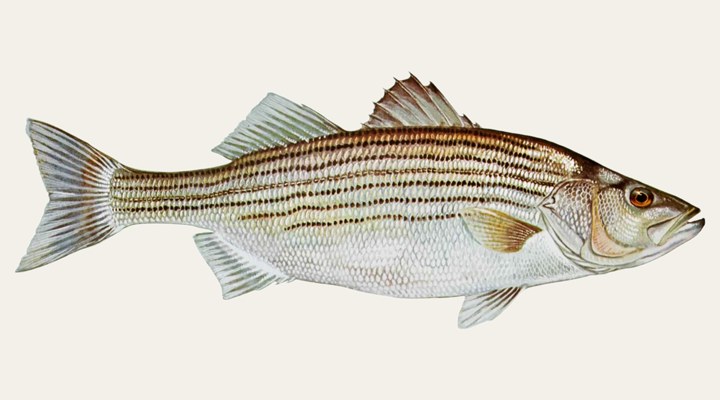
What a hybrid is
South Carolina DNR developed the cross in the mid-1960s at its Dennis Wildlife Center in Moncks Corner, using striped bass females and white bass males, looking for a fish that would survive stocking at a small size better than young stripers. Oklahoma and Iowa describe the same cross. Mississippi's agency describes the reverse cross, a white bass female with a striped bass male, so both combinations are in use. The fish has the arched back and deep body of a white bass and the darker, bolder stripes of a striper, and its lines are usually broken. Mississippi says hybrids tolerate warm water better than stripers, and Oklahoma calls them a put, grow and take fish for lakes with plenty of shad but poor striped bass habitat.
Growth and stocking
Oklahoma reports hybrids reaching six or seven pounds by age three and 18 to 20 pounds by eight or nine; Mississippi gives 5 to 10 pounds as usual, and Iowa says they seldom pass 10 pounds even though its state record is 19 pounds 10 ounces from Saylorville Reservoir. Georgia's record is 25 pounds 8 ounces from Lake Chatuge. Iowa first stocked them in 1981 at Saylorville to control gizzard shad, Oklahoma began at Sooner Lake in 1977, and in South Carolina the main fisheries are lakes Hartwell and Thurmond on the Savannah River. Both sexes mature, and hybrids run upstream with spawning stripers and white bass, but Oklahoma has not observed natural reproduction and South Carolina calls it questionable, so populations depend on stocking.
The mistakes that cost fish
Fishing structure without bait: Iowa DNR's first step is to find the shad, around timber, creek channels, current seams and windblown shores with a mud line. Fishing the wrong hours in summer: Iowa finds the best summer action at sunrise and sunset or on cloudy days. And mislabeling the catch: where stripers, hybrids and white bass share a lake, limits often differ by species, so learn the tongue-tooth and stripe differences before keeping fish.
Tackle setups
| Situation | Setup | Why it works |
|---|---|---|
| Casting to schools | Medium to medium-heavy spinning or casting rod, line in the 6 to 14 lb range that Iowa and Oklahoma suggest, with lipless crankbaits, jigs or swimbaits | Matches shad-sized lures and reaches fish breaking the surface |
| Surface feeding | Poppers, walking baits or prop baits | Oklahoma suggests switching to topwater when fish boil on top |
| Live bait | Minnow or shad on a small hook, 12-inch leader below a swivel and a slip weight, or under a slip float | Oklahoma's rig for flats, channel drop-offs and ledges |
| Trolling | Crankbaits behind the boat, planer boards to spread lines | Iowa and Mississippi both use it to find deeper or scattered schools |
Playbook by water temperature
High summer (80F+)
Fish the first and last light, or cloudy days, when shad rise; otherwise use electronics to find bait schools and troll or fish live bait at that depth.
Active season (65-80F)
Look for shad on flats with timber near creek channels and on windblown points; cast jigs and swimbaits where fish break the surface.
Transition (50-65F)
In spring, windblown shorelines, riprap and dams during the shad spawn (May in Oklahoma); in fall, the pre-winter feed on the same kind of banks.
Winter (under 50F)
None of the agency pages checked describes a winter pattern; the practical approach is to fish slowly at whatever depth the electronics show shad.
Month by month
1 = slow, 5 = peak. Current month highlighted.
Best waters for hybrid striped bass
80 waters we report on where this species is one of the main fish, each with a daily report.
Lake Conroe
Lake Texoma
Lake Palestine
Lake Livingston
Lake Tawakoni
Lake of the Ozarks
Richland-Chambers Reservoir
Possum Kingdom Lake
Greers Ferry Lake
Truman Lake
Broken Bow Lake
Rend Lake
Lake Monroe
Patoka Lake
Lake McConaughy
Cedar Creek Lake
Percy Priest Lake
Lake Somerville
Lake Lewisville
Belton Lake
Lake Waco
Lake Bridgeport
Boone Lake
Kaw Lake
Benbrook Lake
Lake Ray Hubbard
Lake Chatuge
Sooner Lake
Shabbona Lake
Claytor Lake
Cedar Lake
Lake Nasworthy
Lake Fort Phantom Hill
Lay Lake
Otter Creek Reservoir
Pomona Lake
Lake MacBride
Lake Wanahoo
Bardwell Lake
Horsetooth Reservoir
Chatuge Lake
El Dorado Lake
Stillhouse Hollow Lake
Lake Thunderbird
Oologah Lake
Brookville Lake
New River
Kanopolis Lake
Grand Lake o the Cherokees
Demopolis Lake
Skiatook Lake
Medina Lake
Cedar Bluff Reservoir
Harlan County Lake
Lake Ogallala
John Martin Reservoir
Calamus Reservoir
Herrington Lake
Occoquan Reservoir
Lake Hopatcong
Manasquan Reservoir
Coralville Lake
Lahontan Reservoir
Saylorville Lake
Red Rock Lake
Clinton Lake
Rough River Lake
Barren River Lake
Grayson Lake
South Fork Reservoir
Branched Oak Lake
Hoover Reservoir
Neosho River
Bankhead Lake
Lake Tobesofkee
Cedar River
Spruce Run Reservoir
Enders Reservoir
Raritan River
Wabash River
Common questions
Do hybrid striped bass reproduce?
Not in any meaningful way. Both sexes mature and some show spawning behavior, but Oklahoma has not observed natural reproduction and South Carolina calls it questionable, so fisheries are kept going by stocking.
How do I tell a hybrid from a striped bass?
Missouri's field guide notes a striper has a narrow body, less than a third as deep as it is long, unbroken stripes and two separate tooth patches on the tongue; a hybrid is deeper-bodied with broken lines and two tooth patches set close together. South Carolina adds that stripers often top 20 pounds, while hybrids rarely exceed 10.
How big do hybrid striped bass get?
Usually 5 to 10 pounds. Iowa's state record is 19 pounds 10 ounces and Georgia's is 25 pounds 8 ounces.
Pages checked
- dnr.sc.gov/fish/species/hybridbass.html
- wildlifedepartment.com/outdoorok/ooj/striped-hybrid-striped-bass-angler-guide-to
- mdwfp.com/fishing-boating/fish-id-guide/hybrid-striped-bass
- iowadnr.gov/things-do/fishing/iowa-fish-species/hybrid-striped-bass
- mdc.mo.gov/discover-nature/field-guide/striped-bass
- georgiawildlife.com/fishing/recordprogram
The facts on this page were checked against these pages, from the agencies and research bodies that manage and study this fish on October 6, 2026; anything we could not verify was taken out.