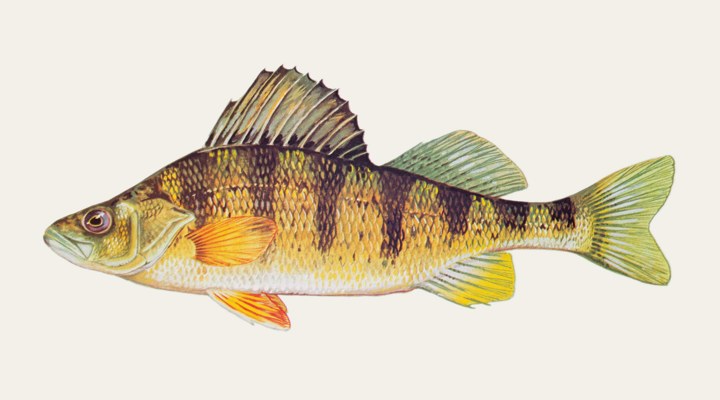
Identification and biology
Perca flavescens has yellow to brassy sides crossed by seven dark vertical bars, two separate dorsal fins and no canine teeth (Michigan and Iowa DNRs). Its native range runs from Nova Scotia west to Great Slave Lake and south through the Great Lakes and Mississippi basins to Ohio, Illinois and Nebraska, with Atlantic-slope populations south to South Carolina, and USGS records stockings well beyond that. Michigan DNR gives an average adult of 4 to 10 inches and 4 to 10 ounces; Vermont Fish & Wildlife reports 8- to 12-inch fish as common and lives of eight to ten years. Growth depends on how many perch share the food: Michigan notes that crowded lakes produce stunted fish that may never pass six inches.
Spawning and diet
Perch spawn shortly after ice-out, in April or early May in Wisconsin, at water temperatures of about 45 to 52°F; Vermont gives 44 to 54°F and Iowa 45 to 55°F. They build no nest. Females lay long, ribbon-like gelatinous strands of eggs over weeds, roots, brush and sand bars, and Iowa DNR notes a single female may be followed by 15 to 25 males. Adults eat insect larvae, crayfish and other invertebrates, fish eggs and small fish, and in Iowa's natural lakes midge larvae and mayflies make up much of the diet. Walleye, northern pike, muskellunge and bass all prey on them.
Where the schools go through the year
Michigan DNR describes perch as schooling fish of fairly shallow water near shore, rarely taken deeper than 30 feet, holding shallower in spring and fall than in midsummer. They move toward shore to feed in the morning and evening, feed through the day in spring and fall, rest on the bottom at night and stay active under the ice all winter. Iowa and Vermont both note that the larger fish use deeper, more open water while small ones stay near shore, and Vermont adds that schools sort themselves by size. Michigan says perch prefer water of 66 to 70°F and often follow the 68°F layer as it moves with the seasons.
The mistakes that cost fish
Staying put after the bites stop: Wisconsin DNR's advice is to try a spot a few times and keep moving until a school turns up. Fishing too big: perch eat minnows, worms and insect larvae, so small hooks and small baits match what they are looking for. And sorting through little fish in one place waiting for big ones, when Vermont notes that perch school by size; a change of depth or area is the better bet for larger fish.
Temperature range
Preferred range and spawning temperatures as published by the agencies listed under Pages checked; where agencies disagree, the text names each figure. See the full temperature guide.
Tackle setups
| Situation | Setup | Why it works |
|---|---|---|
| Open water, near bottom | Light spinning rod and light line, small hooks, live minnows or worms fished just off the bottom | Perch feed mostly near the bottom with a slow, deliberate bite (Wisconsin DNR) |
| Searching flats and weed edges | Small jig tipped with bait, or a small soft plastic, moved until fish are found | Schools roam, so covering water finds them faster than waiting |
| Ice | Short, sensitive jigging rod, small jig or spoon tipped with live bait | Wisconsin DNR describes a short, whippy jigging rod for winter perch |
Playbook by water temperature
High summer (80F+)
Perch avoid the warmest water: Michigan DNR finds them deeper in summer than in spring and fall, though rarely past 30 feet, and moving toward shore to feed in the morning and evening, so fish those hours.
Active season (65-80F)
Michigan DNR gives 66-70°F as the water perch prefer, so this band is the heart of the open-water season: drift or slowly work weed edges and flats with small baits near the bottom until a school turns up.
Transition (50-65F)
Spring and fall: perch hold shallower and, by Michigan DNR's account, feed through the day, so shoreline weed edges, flats and the shallows near spawning areas are worth searching.
Winter (under 50F)
Ice season. Perch stay active under the ice in both shallow and deeper water, so small jigs or spoons tipped with live bait over known winter areas are the usual approach.
Month by month
1 = slow, 5 = peak. Current month highlighted.
Best waters for yellow perch
152 waters we report on where this species is one of the main fish, each with a daily report.
Lake St. Clair
Mille Lacs Lake
Lake Erie
Devils Lake
Clear Lake
Oneida Lake
Lake Champlain
Lake Winnebago
Leech Lake
Lake McConaughy
Flathead Lake
Blue Mesa Reservoir
Banks Lake
Raystown Lake
Presque Isle Bay
Cayuga Lake
Lake Vermilion
Lake Pend Oreille
Canyon Ferry Lake
Pyramid Lake
Cass Lake
Lake Winnibigoshish
Sebago Lake
Lake Okoboji
Flaming Gorge Reservoir
Shawano Lake
Pymatuning Reservoir
Lake Pepin
Rainy Lake
Fox Chain O’Lakes
Lake Michigan (Chicago)
Fresno Reservoir
Mosquito Lake
Chautauqua Lake
Lake Minnetonka
Rappahannock River
Lake Gogebic
Deer Creek Reservoir
Bighorn Lake
Gull Lake
Houghton Lake
Lake Arthur
Navajo Lake
Saginaw Bay
Green Bay
Chatfield Reservoir
Show Low Lake
Shabbona Lake
Rufus Woods Lake
Pineview Reservoir
Petenwell Lake
Higgins Lake
Deep Creek Lake
Blackfoot Reservoir
Lake Wallenpaupack
Huron River
Oswego River
Grindstone Lake
Lake Bemidji
Hamlin Lake
Lake Burton
Starvation Reservoir
Wind Lake
Kabetogama Lake
Lake Onalaska
Vermilion River
Holter Lake
Boyd Lake
Lake George
New River
Thurmond Lake
Rangeley Lake
Mooselookmeguntic Lake
Moosehead Lake
Seneca Lake
Keuka Lake
Canandaigua Lake
Great Sacandaga Lake
Saranac Lake
Otsego Lake
Cheat Lake
Torch Lake
Upper Klamath Lake
Coeur d Alene Lake
Priest Lake
Summersville Lake
Bay Springs Lake
Lake Ogallala
Glendo Reservoir
John Martin Reservoir
Heron Lake
American Falls Reservoir
Cascade Reservoir
Lake Ashtabula
Lake Wawasee
Quabbin Reservoir
Bantam Lake
Loch Raven Reservoir
Lake Moomaw
Fremont Lake
Magic Reservoir
Anderson Ranch Reservoir
Lucky Peak Reservoir
Brownlee Reservoir
Lake Tschida
Lake Audubon
Lake Waramaug
Mansfield Hollow Lake
Somerset Reservoir
Waterbury Reservoir
Angostura Reservoir
Onota Lake
Webster Lake
Storm Lake
Grand Lake St Marys
Lake Wisconsin
Lake Puckaway
Manistique River
Tahquamenon River
Little Bay de Noc
Lake Washington
Lake Sammamish
Lake Roosevelt
Fish Lake
Lake Metigoshe
San Luis Reservoir
Lake Darling
Swartswood Lake
Gardner Lake
Highland Lake
Moses Lake
Payette River
Bighorn Lake
Ocean Lake
Hiwassee River
Pipestem Reservoir
Eagle Nest Lake
Spruce Run Reservoir
Wachusett Reservoir
Ossipee Lake
Lake Lillinonah
Otter Creek
Lake Bomoseen
Sheridan Lake
Lake Poinsett
Flat River Reservoir
Umbagog Lake
Lake Zoar
Coventry Lake
Sparks Marina
Lake Ilo
Sylvan Lake
Common questions
What is the best bait for yellow perch?
Wisconsin DNR lists minnows, insect larvae, plankton and worms among their preferred foods and describes a slow, deliberate bite near the bottom, so a small minnow or worm fished close to bottom is the standard approach.
When do yellow perch spawn?
Shortly after ice-out, usually April to early May in the northern states, once water reaches the mid-40s to low 50s °F. Wisconsin gives 45 to 52°F; Vermont and Iowa give slightly wider ranges.
How big do yellow perch get?
Michigan DNR puts the average adult at 4 to 10 inches, and Vermont says 8- to 12-inch fish are common. Iowa DNR gives the world record as a 4 lb 3 oz fish taken in 1865 from Crosswicks Creek, New Jersey; Vermont's state record is 2 lb 6 oz from Caspian Lake in 2015.
Can you catch yellow perch through the ice?
Yes. Michigan DNR notes that perch, unlike many Great Lakes species, remain active all winter under the ice in both shallow and deeper water.
Pages checked
- dnr.wisconsin.gov/topic/Fishing/species/yperch.html
- programs.iowadnr.gov/lakemanagement/FishIowa/FishDetails/YEP
- michigan.gov/dnr/education/michigan-species/fish-species/yellow-perch
- vtfishandwildlife.com/learn-more/vermont-critters/fish/yellow-perch
- nas.er.usgs.gov/queries/FactSheet.aspx?speciesID=820
The facts on this page were checked against these pages, from the agencies and research bodies that manage and study this fish on October 6, 2026; anything we could not verify was taken out.