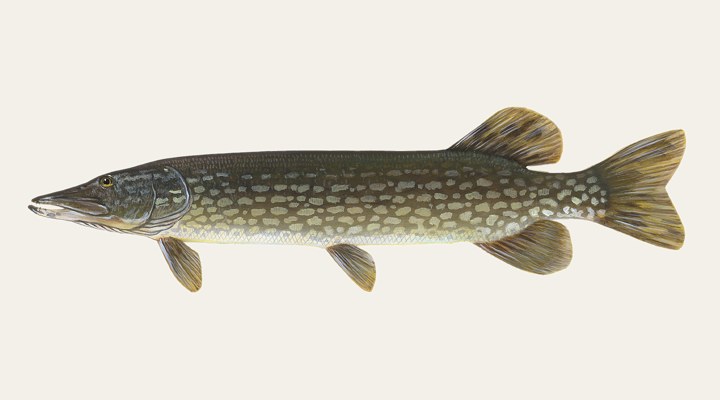
Identification and biology
Pike have a single dorsal fin set far back near the tail, jaws full of sharp teeth, and rows of light yellow or gold spots on a darker green or gray body; Missouri adds a row of five sensory pores on each side of the underside of the jaw. Females grow larger and live longer than males. Alaska's Department of Fish and Game gives lengths to 4 feet, weights to 40 pounds and a lifespan of 20 or more years, with 20-pound fish common in some Alaska waters. Young pike eat insects and small crustaceans and switch to fish at about two inches; big adults also take small mammals and waterfowl.
Range and the spawn
Pike ring the northern hemisphere. In the US they are native to Alaska's Interior, north and west and to the upper Midwest, including Wisconsin and most of Iowa; Missouri sits at the southern edge of the range, and its stocked populations have mostly not sustained themselves. In southcentral Alaska, around Anchorage, the Mat-Su Valley and the Kenai Peninsula, illegally stocked pike are treated as invasive, and ADF&G runs eradication programs to protect salmon and rainbow trout. Spawning comes right after ice-out in flooded, vegetated shallows; Wisconsin DNR reports late March to early April at 34 to 40°F, while New York Sea Grant's fact sheet gives 44 to 56°F. The eggs stick to vegetation and get no parental care.
The mistakes that cost fish
Fishing the wrong cover: Iowa DNR finds pike along weed lines and through vegetation in 3 to 6 feet of water for much of the year, even though they can use deep water. Fishing the warmest hours of summer: Iowa calls pike a cool-water species that is more active in cool months or the cooler parts of summer days. And landing a pike without a leader or long pliers, given the number of teeth along the jaws, tongue and roof of the mouth that ADF&G describes.
Tackle setups
| Situation | Setup | Why it works |
|---|---|---|
| Casting spoons and spinners | Medium-heavy spinning or casting rod with a wire or heavy fluorocarbon leader, spoons or spinners in red, white or silver | Wisconsin and Iowa both name spoons; the leader protects against bite-offs |
| Live bait | Live fish under a float | Wisconsin DNR notes pike prefer live fish baits |
| Ice fishing | Tip-ups with live bait | Wisconsin and Iowa both describe pike as a favorite tip-up target |
Playbook by water temperature
High summer (80F+)
Pike slow down in warm water; Iowa DNR's advice is to fish the cooler parts of the day, and the deeper edge of the weeds is worth a try.
Active season (65-80F)
Work weed lines and vegetation in shallow water with spoons, spinners and live bait; pike bite well in daylight.
Transition (50-65F)
The best band for pike: right after ice-out they move into flooded vegetated shallows to spawn, and they feed actively again as the water cools in fall.
Winter (under 50F)
Ice season: tip-ups with live bait near weed beds; where water stays open, slow live-bait presentations.
Month by month
1 = slow, 5 = peak. Current month highlighted.
Best waters for northern pike
168 waters we report on where this species is one of the main fish, each with a daily report.
Lake St. Clair
Mille Lacs Lake
Lake Geneva
Devils Lake
Milford Lake
Oneida Lake
Lake Champlain
Stockton Lake
Lake Shelbyville
Carlyle Lake
Leech Lake
Lake of the Woods
Lake Sakakawea
Lake Oahe
Lake McConaughy
Flathead Lake
Blue Mesa Reservoir
Cayuga Lake
Lake Vermilion
Lake Pend Oreille
Pueblo Reservoir
Aurora Reservoir
Canyon Ferry Lake
Pyramid Lake
Cass Lake
Lake Winnibigoshish
Clinton Lake
Smithville Lake
Candlewood Lake
Sebago Lake
Lake Okoboji
Flaming Gorge Reservoir
Shawano Lake
Pymatuning Reservoir
Lake Pepin
Rainy Lake
Big Stone Lake
Rathbun Lake
Fox Chain O’Lakes
Fresno Reservoir
Mosquito Lake
Delavan Lake
Watauga Lake
Muskegon River
Hillsdale Lake
Pewaukee Lake
Lake Mendota
Castle Rock Lake
Lake Gogebic
Waubay Lake
Melvern Lake
Perry Lake
Lake Meredith
Deer Creek Reservoir
Bighorn Lake
Spirit Lake
Gull Lake
Houghton Lake
Indian Lake
Navajo Lake
Lake Thompson
Bitter Lake
Chippewa Flowage
Upper Red Lake
Turtle-Flambeau Flowage
South Holston Lake
Chatfield Reservoir
Willard Bay
Show Low Lake
Potholes Reservoir
Petenwell Lake
Marion Reservoir
Lake Hefner
Lake Francis Case
Higgins Lake
Deep Creek Lake
Jordanelle Reservoir
Lake Wallenpaupack
Huron River
Oswego River
Oconto River
Grindstone Lake
Lake Poygan
Lake Bemidji
Hamlin Lake
Fool Hollow Lake
Riffe Lake
Lake Merwin
Lake Wanahoo
Lake Wissota
Wind Lake
Fox Lake
Kabetogama Lake
Lake George
Elevenmile Canyon Reservoir
Seneca Lake
Keuka Lake
Owasco Lake
Great Sacandaga Lake
Saranac Lake
Coeur d Alene Lake
Priest Lake
Boysen Reservoir
Seminoe Reservoir
Glen Elder Reservoir
Vallecito Reservoir
Heron Lake
Worden Pond
Lake Ashtabula
Lake Wawasee
Bantam Lake
Merritt Reservoir
Calamus Reservoir
Beltzville Lake
Loch Raven Reservoir
Philpott Lake
Cochiti Lake
Fremont Lake
Lake Tschida
Lake Audubon
Mansfield Hollow Lake
Rye Patch Reservoir
Angostura Reservoir
Sherman Reservoir
Onota Lake
East Okoboji Lake
Saylorville Lake
Lake Wisconsin
Lake Puckaway
Big Green Lake
Lac Courte Oreilles
Manistique River
Tahquamenon River
Lake Washington
Lake Metigoshe
Missouri River
Lewis and Clark Lake
Lake Darling
Jamestown Reservoir
Swartswood Lake
Comins Lake
Pactola Reservoir
Belle Fourche Reservoir
Saint Croix River
Chippewa River
Big Sioux River
Sheyenne River
Cedar River
Kankakee River
Mohawk River
Kickapoo River
Upper Iowa River
Pipestem Reservoir
Eagle Nest Lake
Loup River
Spruce Run Reservoir
Lake Lillinonah
Otter Creek
Lake Bomoseen
Sheridan Lake
Lake Poinsett
Enders Reservoir
Flat River Reservoir
Umbagog Lake
Red River of the North
Lake Ilo
Stafford Pond
Sylvan Lake
Common questions
When do northern pike spawn?
Right after ice-out. In Wisconsin that is late March to early April, at water temperatures of 34 to 40°F.
What is the best bait for northern pike?
Live fish and wobbling spoons, according to Wisconsin DNR. Iowa DNR adds bright red, white or silver lures, and live bait on tip-ups through the ice.
Are northern pike invasive?
Not where they are native, but in southcentral Alaska, around Anchorage, the Mat-Su Valley and the Kenai Peninsula, ADF&G treats illegally introduced pike as invasive and works to remove them because they harm salmon and trout.
Pages checked
- dnr.wisconsin.gov/topic/Fishing/species/npike.html
- mdc.mo.gov/discover-nature/field-guide/northern-pike
- adfg.alaska.gov/index.cfm?adfg=northernpike.main
- iowadnr.gov/things-do/fishing/iowa-fish-species/northern-pike
- seagrant.sunysb.edu/glsportfish/pdfs/FishFactSheets/FishHabFactSheet-WalleyeHabi
The facts on this page were checked against these pages, from the agencies and research bodies that manage and study this fish on October 6, 2026; anything we could not verify was taken out.