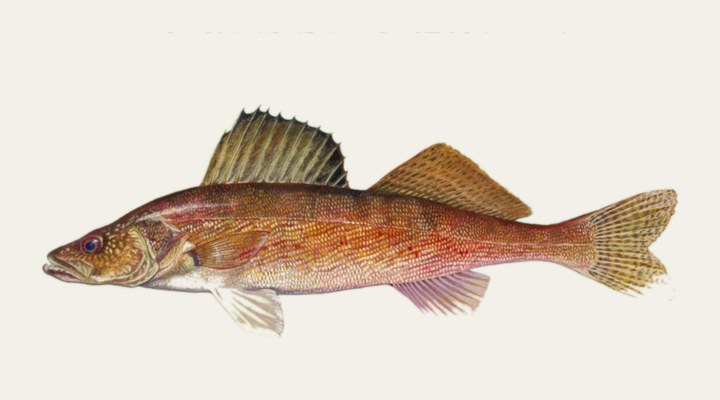
Identification and biology
Walleye have two separate dorsal fins with a dark blotch at the base of the last few spines, a white tip on the lower lobe of the tail, and large canine teeth. The cloudy, reflective look of the eye comes from an adaptation for seeing in low light (MDC). Missouri gives an adult size of 12 to 28 inches and half a pound to 8 pounds, though larger fish occur. Adults eat mainly fish, with mayflies important through life. Native from the Rockies to the Appalachians and north into Canada, walleye have been stocked well beyond that range; Iowa keeps most of its lake fisheries going with stocking, and Texas Parks and Wildlife says summer heat limits them in much of Texas, though they do well in north Texas lakes such as Meredith.
Light, depth and the spawn
In clear water walleye stay deep by day and move into the shallows at night, Wisconsin DNR explains, while in murkier water they can be caught all day. They are among the first fish to spawn in spring: Wisconsin reports the migration beginning soon after ice-out at 38 to 44°F and spawning peaking at 42 to 50°F, Iowa gives 42 to 54°F, usually in early April, and Texas gives 45 to 50°F. Eggs are scattered at night over gravel, rubble, rocky shorelines, reefs and dam riprap, with no parental care. New York Sea Grant's habitat fact sheet describes adults preferring water from the low 30s to the high 60s °F through the year and staying mostly in less than 30 feet.
The mistakes that cost fish
Fishing too far above the bottom: Iowa DNR says to set a slip bobber so the bait rides within a foot of bottom and to use a jig just heavy enough to touch it. Using the wrong bait for the season: Iowa suggests minnows from late fall through early spring and nightcrawlers or leeches from late spring to early fall. And quitting after the spawn: Iowa notes fishing gets hard for a couple of weeks while fish recover, but the stretch from late fall to freeze-up gives some of its best walleye fishing, including trophies over 10 pounds in deep, low-current wintering areas.
Tackle setups
| Situation | Setup | Why it works |
|---|---|---|
| Jig fishing | Sensitive medium or medium-light spinning rod, 6-8 lb line, jig tipped with a minnow, leech, nightcrawler or twister tail | Iowa DNR's standard; 1/8 oz suits most water, heavier only for current, depth or wind |
| Live-bait rigs | Three-way rig or slip bobber with live bait | Iowa recommends them when walleye are inactive, and trolling a three-way rig to find schools |
| Crankbaits | Medium casting rod with 8-10 lb line, casting or trolling crankbaits | Covers water for active fish; Iowa suggests natural colors in clear water, bright ones in stained water |
Playbook by water temperature
High summer (80F+)
Water this warm is above what New York Sea Grant describes as the walleye's preferred range, and Texas reports summer heat limits them; fish deeper, cooler water and low-light hours.
Active season (65-80F)
Summer pattern: nightcrawlers and leeches on rigs or jigs near bottom, trolled crankbaits to find scattered fish, and the shallows after dark in clear lakes.
Transition (50-65F)
Spring: post-spawn fish scatter and can be slow for a couple of weeks. Fall: one of the best windows, with minnows on jigs and three-way rigs as the water cools toward ice-up.
Winter (under 50F)
Spawning runs begin soon after ice-out in the high 30s to mid 40s °F; before that, slow presentations with live bait in deep, low-current wintering areas and below dams.
The legal season is a separate question
Everything above is about the fish. When you are allowed to keep one is a different matter entirely, set state by state, and in several states the possession season is shut for months while the water stays open for catch-and-release. Those dates are not on this page on purpose: they belong with the agency that sets them, alongside the sizes and limits that come with them.
Month by month
1 = slow, 5 = peak. Current month highlighted.
Best waters for walleye
280 waters we report on where this species is one of the main fish, each with a daily report.
Lake Hartwell
Lake Guntersville
Lake St. Clair
Mille Lacs Lake
Lake Geneva
Lake Erie
Devils Lake
Milford Lake
Greers Ferry Lake
Dale Hollow Lake
Oneida Lake
Lake Powell
Lake Champlain
Truman Lake
Stockton Lake
Mark Twain Lake
Broken Bow Lake
Norfork Lake
Center Hill Lake
Norris Lake
Douglas Lake
Watts Bar Lake
Clarks Hill Lake
Lake Shelbyville
Carlyle Lake
Patoka Lake
Lake Winnebago
Leech Lake
Lake of the Woods
Lake Sakakawea
Lake Oahe
Lake McConaughy
Fort Peck Lake
Flathead Lake
Blue Mesa Reservoir
Banks Lake
Raystown Lake
Cayuga Lake
DeGray Lake
Lake Vermilion
Lake Pend Oreille
Pueblo Reservoir
Aurora Reservoir
Canyon Ferry Lake
Pyramid Lake
Cass Lake
Lake Winnibigoshish
Wolf River
Maumee River
Clinton Lake
Smithville Lake
Potomac River
Lake Okoboji
New River Gorge
Columbia River
Shawano Lake
Pymatuning Reservoir
Lake Pepin
Rainy Lake
Big Stone Lake
Rathbun Lake
Kaw Lake
Fox Chain O’Lakes
James River
Fresno Reservoir
Mosquito Lake
Delavan Lake
Muskegon River
Lake Chatuge
Hillsdale Lake
Chautauqua Lake
Carters Lake
Lake Minnetonka
Detroit River
Pewaukee Lake
Lake Mendota
Castle Rock Lake
Lake Gogebic
Waubay Lake
Melvern Lake
Perry Lake
Lake Meredith
Deer Creek Reservoir
Bighorn Lake
St. Clair River
Keystone Lake
Spirit Lake
Gull Lake
Houghton Lake
Indian Lake
Lake Arthur
Navajo Lake
Lake Thompson
Bitter Lake
Chippewa Flowage
Saginaw Bay
Green Bay
Upper Red Lake
Turtle-Flambeau Flowage
Chatfield Reservoir
Willard Bay
Sooner Lake
Show Low Lake
Shabbona Lake
Rufus Woods Lake
Potholes Reservoir
Petenwell Lake
Marion Reservoir
Lake Hefner
Lake Francis Case
Fox River
Deep Creek Lake
Claytor Lake
Lake Wallenpaupack
Huron River
Oswego River
Oconto River
Otisco Lake
Lake Waconia
Lake Poygan
Lake Bemidji
Hamlin Lake
Blue Ridge Lake
Fool Hollow Lake
Mississippi River Pool 9
Starvation Reservoir
Pomona Lake
Lake MacBride
Lake Wanahoo
Lake Wissota
Wind Lake
Horsetooth Reservoir
Fox Lake
Green Lake
Kabetogama Lake
Lake Onalaska
El Dorado Lake
Vermilion River
Apache Lake
Holter Lake
Boyd Lake
Lake Thunderbird
Oologah Lake
Delaware River
New River
Shenandoah River
Thurmond Lake
Berlin Lake
Kanopolis Lake
Owasco Lake
Great Sacandaga Lake
Otsego Lake
Cheat Lake
Pomme de Terre Lake
Coeur d Alene Lake
Summersville Lake
Juniata River
Boysen Reservoir
Wilson Lake
Lake Nockamixon
Skiatook Lake
Lake Murray
Cedar Bluff Reservoir
Glen Elder Reservoir
Pathfinder Reservoir
Glendo Reservoir
Vallecito Reservoir
Ridgway Reservoir
John Martin Reservoir
Conchas Lake
Cascade Reservoir
Lake Ashtabula
Lake Wawasee
Tippecanoe River
Connecticut River
Elk River
Tygart Lake
Lake Memphremagog
White River
Merritt Reservoir
Calamus Reservoir
Lake Sharpe
Occoquan Reservoir
Ute Reservoir
Abiquiu Lake
Cochiti Lake
Trinidad Lake
Fremont Lake
Lake Tschida
Lake Audubon
Lake Hopatcong
Coralville Lake
Clear Lake
Rye Patch Reservoir
Lahontan Reservoir
Angostura Reservoir
Sherman Reservoir
Niobrara River
Bluestone Lake
Nolin River Lake
East Okoboji Lake
Storm Lake
Saylorville Lake
Salamonie Lake
Mississinewa Lake
Cagles Mill Lake
Clinton Lake
Lake Springfield
Kinkaid Lake
Grand Lake St Marys
Salt Fork Lake
Lake Wisconsin
Lake Puckaway
Big Green Lake
Lac Courte Oreilles
Namekagon River
Menominee River
Escanaba River
Manistique River
Tahquamenon River
Little Bay de Noc
Lake Roosevelt
Lake Metigoshe
Missouri River
Lewis and Clark Lake
Tygart Valley River
Tenkiller Ferry Lake
Barren River Lake
Lake Darling
Jamestown Reservoir
Greenwood Lake
Swartswood Lake
Gardner Lake
Belle Fourche Reservoir
Branched Oak Lake
Allegheny River
Lake Charlevoix
Saint Croix River
Chippewa River
Noxon Rapids Reservoir
Moses Lake
Current River
Gasconade River
Eleven Point River
Buffalo River
Mulberry River
Neosho River
Big Sioux River
Sheyenne River
Missisquoi River
Greenbrier River
Licking River
Cottonwood River
Cedar River
Kankakee River
Mohawk River
Merrimack River
Willamette River
Bighorn Lake
Ocean Lake
Kickapoo River
Turkey River
Upper Iowa River
Pine Creek
Pipestem Reservoir
Sugar Creek
Blue River
Loup River
Sheridan Lake
Lake Poinsett
Platte River
Enders Reservoir
Kanawha River
Laurel River Lake
Flat River Reservoir
Lake Zoar
Coventry Lake
Wabash River
Red River of the North
Sylvan Lake
Common questions
What is the record walleye?
Tennessee lists a 25-pound fish caught by Mabry Harper at Old Hickory Reservoir on August 3, 1960, and marks it as a world record; Texas Parks and Wildlife also cites 25 pounds as the all-tackle world record.
When do walleye spawn?
Early spring, right after ice-out, with peak spawning at about 42 to 50°F in Wisconsin (mid-April to early May there) and usually early April in Iowa.
What time of day is best for walleye?
Low light. Wisconsin DNR says walleye in clear lakes move shallow at night, and Iowa suggests fishing near spawning areas at night when walleye are more active.
Pages checked
- tpwd.texas.gov/huntwild/wild/species/walleye
- mdc.mo.gov/discover-nature/field-guide/walleye
- dnr.wisconsin.gov/topic/Fishing/species/walleye.html
- iowadnr.gov/things-do/fishing/iowa-fish-species/walleye
- seagrant.sunysb.edu/glsportfish/pdfs/FishFactSheets/FishHabFactSheet-WalleyeHabi
- tn.gov/twra/fishing/awards-fish-records-photos.html
The facts on this page were checked against these pages, from the agencies and research bodies that manage and study this fish on October 6, 2026; anything we could not verify was taken out.