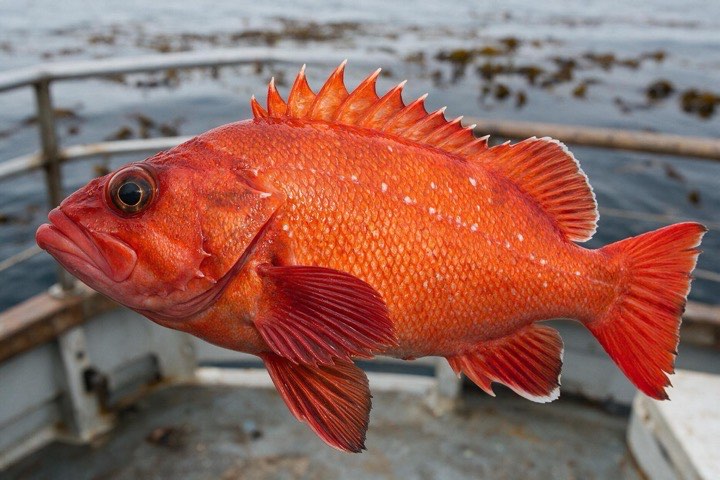
A group, not a fish
CDFW counts about 60 rockfish species among the more than 90 groundfish in the federal Groundfish Fishery Management Plan, managed jointly by NOAA Fisheries, the Pacific Fishery Management Council and California, Oregon and Washington. ODFW says Oregon anglers commonly catch over 25 species, many hard to tell apart. Identification matters because some are off limits: ODFW currently prohibits keeping yelloweye and quillback rockfish, and yelloweye in Puget Sound are listed as threatened under the Endangered Species Act (WDFW).
Long lives, slow recovery
Rockfish mature late and live long, which is why the rules are strict. WDFW lists black rockfish living at least 56 years, blue rockfish at least 44 and yelloweye at least 118, with some estimates near 147; in one British Columbia study half of yelloweye were mature only at 19 to 22 years of age.
Where they hold
Habitat differs by species (ODFW). Black rockfish live over rocky reefs mostly shallower than 180 feet and along jetties and estuary structure, and their schools sometimes rise to the surface. Blue rockfish suspend in large schools well off the bottom over rock, and their small mouths favor smaller jigs and flies. Vermilion and China rockfish stay close to rocky bottom, and canary rockfish school over reefs and pinnacles, the larger adults farther offshore. Black rockfish range from the Aleutians to northern Baja (WDFW), so the shore and jetty fishery runs the length of the coast.
Barotrauma and descending devices
A rockfish reeled up from depth often has an over-expanded swim bladder, with bulging eyes or the stomach pushed out of the mouth. CDFW and WDFW advise against venting (puncturing) and recommend returning the fish to depth with a descending device. CDFW reports that descending cut mortality by as much as 62 percent depending on depth, and it counts fish caught deeper than 180 feet and released at the surface as dead. Federal rules (50 CFR 660.360) require every vessel in the recreational groundfish fishery off California, Oregon or Washington to carry a working descending device ready for use.
How anglers fish for them
ODFW notes rockfish take bait and lures readily: rubber-tailed leadhead jigs, metal jigs, shrimp flies and baited hooks. Find suspended schools on the sounder and fish through them for midwater species, and keep the offering near the rocks for bottom-hugging fish. WDFW suggests a single circle hook with bait to cut down on deep hooking.
Tackle setups
| Situation | Setup | Why it works |
|---|---|---|
| Shrimp flies over a school | Medium-heavy rod, braided line, shrimp-fly dropper rig above a jig or sinker | ODFW lists shrimp flies among the common rockfish lures |
| Leadhead jig | Medium spinning or casting rod, rubber-tailed leadhead | A standard lure that fishes both midwater and near bottom |
| Bait | Single circle hook, squid or fish strip | WDFW recommends circle hooks for release-friendly bait fishing |
| Jetty and shore | Spinning rod, small leadhead and soft plastic | Black rockfish are common along jetties and rocky structure (ODFW) |
| Releasing fish | Weighted descending device on a spare line | Required aboard in the federal recreational groundfish fishery; returns fish to depth |
Playbook by water temperature
High summer (80F+)
Does not apply: nearshore water on the Pacific coast rarely reaches 80°F.
Active season (65-80F)
Only warm-water periods in Southern California reach this band. Work kelp edges and shallow reefs with leadheads and shrimp flies, and descend any fish you release.
Transition (50-65F)
Much of the open season along the coast falls in this band. Fish through suspended schools of black, blue and other midwater rockfish, and closer to the rocks for vermilion, copper and China rockfish.
Winter (under 50F)
Winter water off Oregon and Washington can drop below 50°F, and many areas have seasonal or depth closures, so check the state's current groundfish rules. Where open, shore and jetty anglers still target black rockfish.
Month by month
1 = slow, 5 = peak. Current month highlighted.
Best waters for rockfish (pacific)
11 waters we report on where this species is one of the main fish, each with a daily report.
Pacifica
Newport Beach
Oceanside
Westport
Monterey Bay
Bodega Bay
Coos Bay
Sitka
Kodiak
Seward
Ketchikan
Common questions
When is rockfish season?
It depends on state, management area and depth, and CDFW notes seasons can change mid-year if catch limits are approached. Check CDFW, ODFW or WDFW before each trip; the state pages on this site link to them.
Do I need a descending device?
Yes on any vessel in the federal recreational groundfish fishery off California, Oregon or Washington (50 CFR 660.360). WDFW requires one rigged and ready on recreational vessels targeting bottomfish and halibut in all Washington marine areas, and California has required one aboard since 2024 when taking federal groundfish.
Can you catch rockfish from shore?
Yes. ODFW says black rockfish are common along jetties and structure in estuaries, and small leadheads with soft plastics are the usual lures from the rocks.
Pages checked
- wildlife.ca.gov/Conservation/Marine/Groundfish
- wildlife.ca.gov/Conservation/Marine/Groundfish/Barotrauma
- myodfw.com/fishing/species/rockfish
- wdfw.wa.gov/species-habitats/species/sebastes-melanops
- wdfw.wa.gov/species-habitats/species/sebastes-ruberrimus
- wdfw.wa.gov/species-habitats/species/sebastes-mystinus
- wdfw.wa.gov/fishing/bottomfish/rockfish/mortality.html
- ecfr.gov/api/renderer/v1/content/enhanced/current/title-50?part=660§ion=660.
The facts on this page were checked against these pages, from the agencies and research bodies that manage and study this fish on October 6, 2026; anything we could not verify was taken out.