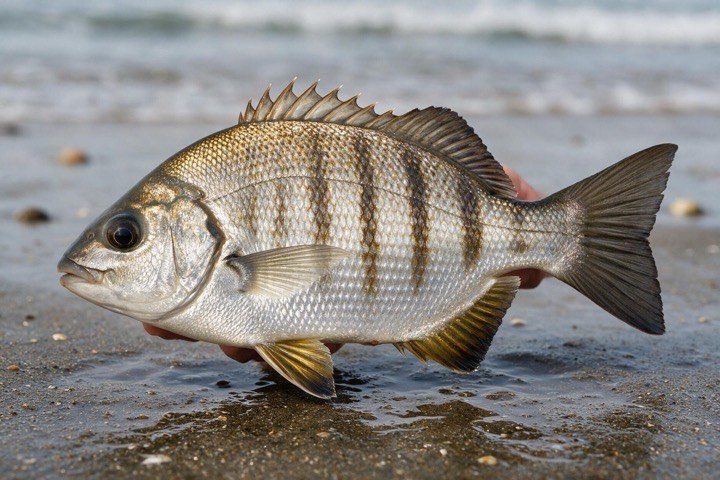
Two fish on one beach
CDFW manages barred surfperch (Amphistichus argenteus) and redtail surfperch (A. rhodoterus) together. Both live in the surf of open sandy beaches and in bays and estuaries. Barred range from northern California into Baja; redtail range from Vancouver Island to Avila Beach but are scarce south of San Mateo County, so most beach perch north of the Bay Area are redtails. CDFW survey data ranked barred surfperch the top fish kept by California shore anglers in 2015-2017, with redtail third. ODFW and WDFW describe redtails schooling in the surf and along jetties in Oregon and Washington.
Live-bearers
Surfperch give birth to free-swimming young 2 to 3 inches long. CDFW reports that both species mate in winter after male ripeness peaks in fall (November for central-coast barred, October for northern redtail), carry the young for three to six months and give birth in spring and summer, sometimes near river mouths and estuaries. A female carries from under ten to about 100 young depending on her size. CDFW estimates maximum age at 9 to 10 years in California; WDFW lists redtails to 14 years and about 16 inches.
Reading the beach
California's beach-fishing guides (published by the state Department of Fish and Game and hosted by California Sea Grant) give the timing: early morning or the hour before dusk, an incoming high tide that knocks invertebrates out of the sand bars, and mild to moderate surf. Cast to the edges of bars and drop-offs, to channels where fish travel, and near sand crab beds; Pacific mole crabs (sand crabs), amphipods and worms make up most of the diet (CDFW). On Oregon beaches ODFW finds redtails mostly between the second and fourth line of breakers, near deeper holes and eroding sand.
Rigs and baits
For light bait or Carolina-rigged grubs, the beach guides suggest a 7- to 9-foot rod, 6- to 12-pound line and a 1/2- to 1-ounce egg sinker sized to the surf, moving up to a 10- to 12-foot rod when the surf is heavy. ODFW describes a small hook (#4 to #6) on a leader about two feet below a 1- to 2-ounce sinker, baited with sand or kelp worms, sand shrimp, clam necks or mussel; some anglers fly fish shrimp patterns.
Tackle setups
| Situation | Setup | Why it works |
|---|---|---|
| Light surf, Carolina rig | 7-9 ft rod, 6-12 lb line, 1/2-1 oz egg sinker, small grub or bait | The state beach guides' setup for perch on most days |
| Heavy surf | 10-12 ft rod rated 2-8 oz, 20-30 lb line | Holds bottom and reaches the outer trough in big surf (state beach guides) |
| Oregon bait rig | #4-#6 hook 24-30 in below a 1-2 oz sinker, 8-10 lb line, sand shrimp, clam neck, mussel or worms | ODFW's description of a common redtail rig |
| Fly | 9-11 ft rod, 6-8 weight, sink-tip or shooting head, shrimp patterns | The beach guides and ODFW both note fly fishing in the surf |
Playbook by water temperature
High summer (80F+)
Pacific surf rarely reaches this band; in the warmest months, which fall outside the beach guides' peak tables, fish early morning or the hour before dusk on an incoming tide.
Active season (65-80F)
Late summer into fall, barred surfperch males ripen and fish move inshore to mate; CDFW sees higher catches tied to those movements. Work troughs and channels on the incoming tide.
Transition (50-65F)
Fall through spring is the peak on both the central (October to June) and southern (September to May) California coasts, per the state beach guides. Fish sand crabs, worms or Carolina-rigged grubs near crab beds and bar edges.
Winter (under 50F)
Winter is mating season and still within the peak window; choose days of mild to moderate surf. On Oregon and Washington beaches, ODFW lists clam necks, sand shrimp and mussels as redtail baits.
Month by month
1 = slow, 5 = peak. Current month highlighted.
Best waters for surfperch
8 waters we report on where this species is one of the main fish, each with a daily report.
Common questions
What is the best bait for surfperch?
Sand crabs (Pacific mole crabs) are a main food (CDFW), and the beach guides suggest casting near sand crab beds. ODFW lists sand and kelp worms, sand shrimp, clam necks and mussels, and small grubs on a Carolina rig also work.
When is the best time to fish for surfperch?
The state beach guides hosted by California Sea Grant list October through June as peak months on the central coast and September through May in Southern California. Within a day, early morning, the hour before dusk and the incoming high tide fish best.
How big do surfperch get?
CDFW cites an IGFA-verified barred surfperch world record of 4 lb 12 oz and 19.5 inches, caught in 2016; the largest redtail reported is 16 inches and about 4 pounds.
Do surfperch lay eggs?
No. They carry their young for three to six months and give birth in spring and summer to fully formed fish 2 to 3 inches long (CDFW).
Pages checked
- marinespecies.wildlife.ca.gov/barred-surfperch-and-redtail-surfperch/true
- marinespecies.wildlife.ca.gov/barred-surfperch-and-redtail-surfperch/the-species
- caseagrant.ucsd.edu/sites/default/files/C.CAsurfbro.pdf
- caseagrant.ucsd.edu/sites/default/files/S.CAsurfbro.pdf
- myodfw.com/fishing/species/redtail-surfperch
- wdfw.wa.gov/species-habitats/species/amphistichus-rhodoterus
The facts on this page were checked against these pages, from the agencies and research bodies that manage and study this fish on October 6, 2026; anything we could not verify was taken out.