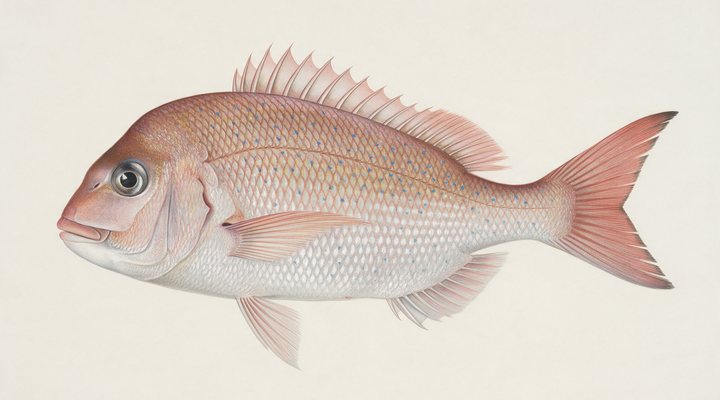
Identification and biology
The Australian snapper is the pink snapper of the south, Chrysophrys auratus, the same fish New Zealand calls snapper and Western Australia calls pinkie when small: silver-pink with a scatter of blue spots on the flanks, a deep body, a strong tail and, in the big old fish, a bony hump on the forehead that gives the southern “old man snapper” its name. It is a long-lived fish that grows slowly once it is past a couple of kilograms, which is why every southern state manages it hard and why South Australia has closed most of its waters to snapper fishing since 2019. It lives on reef, rubble and broken ground from the shallows out to the shelf, and in spring the adults move into the bays and gulfs to spawn.
Where they live through the year
Spring is the season the south waits for: from October the schools move into Port Phillip and Western Port, into the South Australian gulfs where fishing is allowed, into Cockburn Sound and the sounds of the west coast where the rules permit, and hold over the inshore reef and the mud of the bays through early summer. Through summer and autumn they spread along the reef and rubble in ten to forty metres, feeding at dawn and dusk and at night, and the pier and rock fish of the bays are the juveniles. In winter the adults are offshore on the deeper reef, and the calm days are the ones to go. On the east coast north of Sydney and in southern Queensland the pattern shifts to winter, when snapper come inshore to the reefs off the headlands and the beaches.
The mistakes that cost fish
Anchoring on top of the reef instead of up-current of it, so the berley drifts away from the fish rather than through them. Fishing too heavy: a lightly weighted bait or a soft plastic drifting down the berley trail draws more bites than a paternoster on the bottom in the same water. Leaving at the wrong time, because the snapper of the bays feed on the change of light and on the tide change, and the boat that packs up at nine has missed the morning it came for. And fishing the spring run in a state or a zone where the fishery is closed: South Australia’s closure and Queensland’s winter closure are on the state hubs, computed for this year, and the rules are the agency’s, not ours.
Reading the report for snapper
The pressure row matters more for snapper than for most bay fish: the day before a front, with the barometer easing and a north-westerly warming the bay, is the classic Port Phillip snapper day, and the post-front bluebird morning is the classic hard one. The wind row decides whether the bay is fishable at all, and the tide panel on the coastal pages gives the change to be anchored for. The species card on each water rates the month; the state hub’s closed-seasons table says whether you may keep one.
Tackle setups
| Situation | Setup | Why it works |
|---|---|---|
| Bay snapper at anchor | 2.1 m rod rated 6 to 10 kg, 10 to 15 kg braid, 15 to 20 kg fluorocarbon leader, running sinker just heavy enough to hold | The light lead lets the bait drift naturally down the berley trail |
| Soft plastics on the drop | 2.1 m spin rod rated 4 to 8 kg, 8 kg braid, 10 to 12 kg leader, 12 to 18 cm paddle tail on a 10 to 20 g jighead | Clear water and spooky fish: the plastic falls like a wounded bait |
| Offshore reef | 1.8 m rod rated 10 to 15 kg, 20 kg braid, paternoster with two hooks and a 100 to 200 g sinker | Deep water and current need weight to reach the reef |
| Land-based at night | 3 to 3.6 m rod, 10 kg line, lightly weighted whole pilchard or squid | The rocks and the pier lights hold snapper after dark on the calm nights |
Playbook by water temperature
The plan the daily report picks for snapper in each band; the water temperature on each page is a seasonal estimate for its type of water and says so.
Hot water (over 27 °C)
Dawn and dusk on the shallow reef edges with soft plastics or lightly weighted baits; middays, the deeper marks in 20 to 40 metres.
Warm water (18 to 27 °C)
The spring and early summer run: anchor up-current of a reef or rubble patch, berley steadily and fish pilchard, squid or a 5 to 7 inch plastic on the drop.
Cool water (10 to 18 °C)
Fish are thinner inshore. Work the deeper structure and the channel edges with baits on the bottom, and pick the tide change.
Cold water (under 10 °C)
Offshore reef on the calm days, slow and deep. Inshore, the odd fish on a big bait at night around the pier lights.
The legal season is a separate question
Activity says when the fish bite; the agency says when you may keep one. These are the closures that name snapper, computed for 2026 from each rule as written and read on the date shown. A state with no row publishes no closure for this species, which is not the same as open all year.
| State | Fishery | 2026 | Rule | Source |
|---|---|---|---|---|
| Queensland | Snapper and pearl perch, east coast | Closed 2026-07-15 to 2026-08-15 | Closed 15 July to 15 August in east coast tidal waters. | Queensland Department of Primary Industries, closed seasons in tidal waters, read 2026-09-23 |
| South Australia | Snapper | Closed until 2027-06-30 | Closed in the West Coast, Spencer Gulf and Gulf St Vincent/Kangaroo Island zones until 30 June 2027; open only in the South-East zone. No catch and release in the closed zones. | PIRSA, snapper management, read 2026-09-23 |
Month by month
Activity for the southern year, 1 slow to 5 peak; January is midsummer. Current month highlighted.
Waters we cover for snapper
54 Australia waters carry snapper on their species card, each with a daily report.
Victoria
Common questions
When is snapper season in Port Phillip?
The run into the bay starts in October and holds through early summer; the species card on the Port Phillip page rates each month. Victoria has no closed season for snapper.
Can I fish for snapper in South Australia?
Only in the South-East fishing zone until 30 June 2027, as PIRSA publishes; the West Coast, Spencer Gulf and Gulf St Vincent/Kangaroo Island zones are closed, and catch and release is not allowed there. The South Australia hub shows the rule.
What is the best bait for snapper?
Fresh: pilchard, squid, a fillet of slimy mackerel or a whole garfish, fished lightly weighted in a berley trail; and a soft plastic of twelve to eighteen centimetres on the drop where the water is clear.