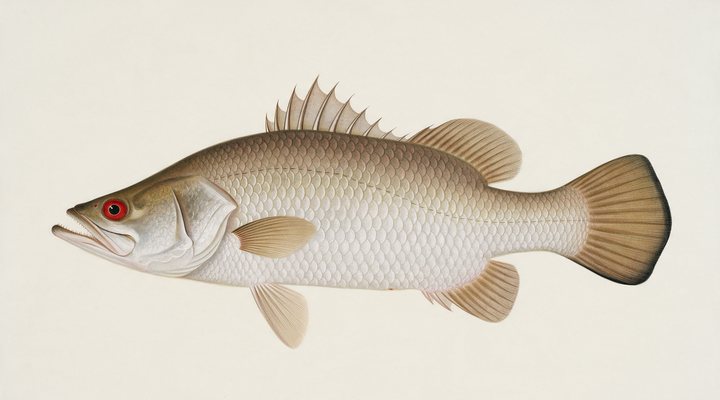
Identification and biology
Barramundi, Lates calcarifer, is the fish of the north: silver-bronze in the salt and dark bronze in the fresh, a big humped back, a concave forehead, a huge mouth and the pink eye that shines in a torch beam, and a jumping, head-shaking fight that made it the most sought fish in the tropics. It is a protandrous hermaphrodite: barramundi start life as males and the big fish are females, which is why the agencies protect the large ones with maximum sizes and the spawning ones with closed seasons. Wild fish spawn at the river mouths in the wet season and the juveniles grow up in the freshwater swamps and creeks; stocked fish in the impoundments of Queensland and the Territory cannot breed and grow to metre-plus sizes in dams that the states exempt from the closed season.
Where they live through the year
The barramundi year runs with the wet and the dry. The build-up, from October, is the hot, humid, storm-charged pre-wet when the fish feed hard at the creek mouths and the rock bars; in Queensland the east coast closed season starts in November and the Gulf’s in October to protect the spawning that follows. The wet floods the rivers and the floodplains. The run-off, from about March to May, drains the floodplain back into the rivers through every creek mouth and colour change, and the fish stack up under them: this is the season the Daly, the Mary of the Territory and the Gulf rivers are famous for. The dry, from June, is cooler and clearer, with the fish along the snags and the rock bars in the warmest hours and the impoundments fishing through it.
The mistakes that cost fish
Fishing the closed season, or targeting barramundi for release inside it, which the Queensland rules forbid because the stress of capture can stop a fish spawning; the state hubs show the dates for this year, computed from the rule. Fishing the wrong stage of the tide at a creek mouth: the last of the run-out and the first of the run-in are when the bait is pushed and the fish feed. Working a lure too fast in cool water, when a suspending hardbody or a slowly rolled plastic gets the bite. And forgetting that every northern water has crocodiles, which the pages say on every entity of the tropics.
Reading the report for barramundi
Pressure is the barramundi number: a falling barometer before a storm is the classic bite of the build-up, and the report’s rule adds a point for it. The tide panel gives the run at the creek mouths, the rain row shows the wet arriving and, on the run-off, the water temperature estimate places the river in the band the fish feed in. The species card rates the month and the state hub says whether the season is open; the impoundment pages say they are exempt.
Tackle setups
| Situation | Setup | Why it works |
|---|---|---|
| Snags and rock bars | 1.8 to 2 m baitcast rod rated 8 to 12 kg, 20 to 30 kg braid, 40 to 60 kg leader, 100 to 150 mm hardbody | The fish is hooked beside timber; the leader has to survive the first jump |
| Impoundment plastics | 2.1 m spin rod rated 8 to 12 kg, 20 kg braid, 40 kg leader, 120 to 150 mm paddle tail on a weedless hook | Big stocked fish in weed and timber, at night and at first light |
| Creek mouth on the run-off | 1.8 m baitcast rod rated 6 to 10 kg, 20 kg braid, 30 kg leader, 90 to 120 mm suspending hardbody or prawn imitation | The colour change at the mouth on the falling tide, cast up into the drain |
Playbook by water temperature
The plan the daily report picks for barramundi in each band; the water temperature on each page is a seasonal estimate for its type of water and says so.
Hot water (over 27 °C)
Dawn, dusk and the run-off drains and creek mouths on the falling tide; hardbodies and soft vibes cast tight to snags and rock bars.
Warm water (18 to 27 °C)
Work the colour changes and the snags on the run-out; larger swimbaits and slow-rolled plastics in the impoundments.
Cool water (10 to 18 °C)
The dry-season lull. Fish the warmest hours over the shallow flats and the rock bars, slower and smaller.
Cold water (under 10 °C)
Sluggish; the southern edge of their range shuts down. Live bait sat on the bottom in the deepest holes of the day.
The legal season is a separate question
Activity says when the fish bite; the agency says when you may keep one. These are the closures that name barramundi, computed for 2026 from each rule as written and read on the date shown. A state with no row publishes no closure for this species, which is not the same as open all year.
| State | Fishery | 2026 | Rule | Source |
|---|---|---|---|---|
| Queensland | Barramundi, east coast | Closed 2026-11-01 to 2027-01-31 | Closed 1 November to 31 January on the east coast, tidal and fresh, except in the stocked dams the Queensland Government lists. No catch and release in the closure. | Queensland Department of Primary Industries, closed seasons in tidal waters, read 2026-09-23 |
| Queensland | Barramundi, Gulf of Carpentaria | Closed 2026-10-07 to 2027-01-31 | Closed 7 October to 31 January in the Gulf of Carpentaria, tidal and fresh. No catch and release in the closure. | Queensland Department of Primary Industries, closed seasons in tidal waters, read 2026-09-23 |
Month by month
Activity for the southern year, 1 slow to 5 peak; January is midsummer. Current month highlighted.
Waters we cover for barramundi
96 Australia waters carry barramundi on their species card, each with a daily report.
Queensland
Northern Territory
Common questions
When is barramundi closed season in Queensland?
East coast 1 November to 31 January; Gulf of Carpentaria 7 October to 31 January, with stocked impoundments exempt as the Queensland Government lists them. The Queensland hub shows the dates for this year and every barramundi water shows its own status.
Is there a closed season for barramundi in the Northern Territory?
The Territory publishes possession limits and closed areas rather than a closed season; this site has not verified a season rule for the Territory and shows none on its pages.
What is the best lure for barramundi?
A suspending hardbody of 100 to 150 mm worked slowly along the snags and the rock bars, a soft plastic paddle tail or prawn imitation on a weedless hook in the timber, a surface lure at night; live mullet or cherabin where bait is allowed.