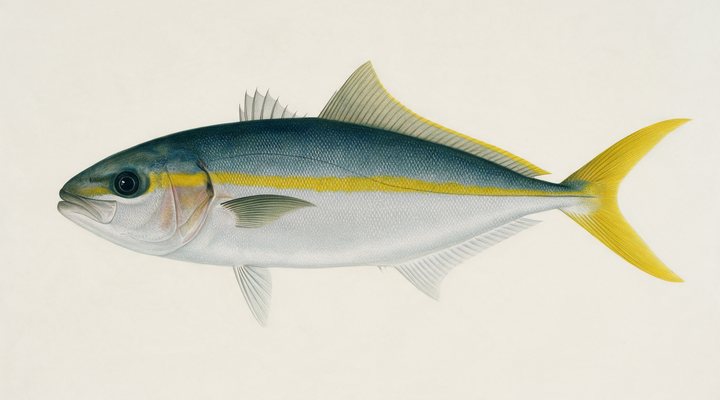
Identification and biology
The yellowtail kingfish, Seriola lalandi, is the sportfish of the temperate coast: green-bronze above, silver below, a yellow stripe along the flank and a yellow, forked tail that drives one of the strongest first runs of any inshore fish. Kingfish hunt in packs around headlands, islands, reef edges, bommies, wharves and anything that breaks the current, feeding on squid, garfish, yellowtail and slimy mackerel, and they follow warm water: the summer and autumn push of the East Australian Current down the New South Wales coast brings them to Sydney, Jervis Bay and Montague Island, and the warm months bring them into Port Phillip Heads, the South Australian gulfs and the sounds and islands of Western Australia. Minimum sizes apply in every state and differ; the big fish are old.
Where they live through the year
On the east coast kingfish are a summer and autumn fish inshore, from December to April at the headlands, the harbour markers and the islands, with the biggest fish holding on the deeper reef and the current lines; in winter they are fewer and deeper. In South Australia the fish of Coffin Bay, the top of Spencer Gulf at Port Augusta and Whyalla and the Kangaroo Island reefs run through summer and autumn. In Western Australia the Rottnest and the south-west reefs hold them through the warm months. The Sydney Harbour and Pittwater fish around the channel markers are the ones most people meet first.
The mistakes that cost fish
Fishing too light near structure: a kingfish hooked beside a marker or a bommie goes straight back to it, and the leader and the drag decide the outcome in the first ten seconds. Trolling or casting without live bait when the fish are shut down; a live squid or yellowtail under a balloon or slow-trolled has converted more stubborn kings than any lure. Ignoring the current: kingfish sit where the current hits the structure, and the boat has to be positioned for it. And keeping an undersize fish, when the minimum is there to let the fish reach maturity.
Reading the report for kingfish
The wind row decides whether the headlands and the islands are reachable, and a settled day with a steady current is what kingfish weather looks like. The water temperature estimate matters more for this species than for most: warm water is the switch. The tide panel gives the change at the markers and the wharves. The species card rates the month; the calendar shows the southern summer and autumn as the season.
Tackle setups
| Situation | Setup | Why it works |
|---|---|---|
| Live bait at the markers | 2.1 m rod rated 10 to 15 kg, 20 to 24 kg braid, 30 to 40 kg leader, 6/0 to 8/0 live-bait hook | The first run goes for the structure; the leader and the drag decide it |
| Stickbaits and poppers | 2.4 m spin rod rated 15 to 24 kg, 30 kg braid, 40 to 60 kg leader, 120 to 160 mm stickbait | Surface fishing at the headlands and the islands when the fish are up |
| Knife jigs | 1.9 m jig rod rated 15 to 24 kg, 24 kg braid, 40 kg leader, 100 to 200 g jig | The deeper reef and the current lines; the jig gets down and works fast |
Playbook by water temperature
The plan the daily report picks for yellowtail kingfish in each band; the water temperature on each page is a seasonal estimate for its type of water and says so.
Hot water (over 27 °C)
Live baits or stickbaits around the headlands, markers and bait schools at first light; downrig a live yellowtail over the reefs once the sun is up.
Warm water (18 to 27 °C)
Prime. Cast stickbaits and poppers at surface activity, jig the deeper reefs, and keep a live bait out under a balloon.
Cool water (10 to 18 °C)
The fish thin out as the current cools; jig the deeper offshore marks and work the harbours on the warmer afternoons.
Cold water (under 10 °C)
A rare winter fish; deep jigging on the offshore reefs on the calm days only.
Month by month
Activity for the southern year, 1 slow to 5 peak; January is midsummer. Current month highlighted.
Waters we cover for yellowtail kingfish
34 Australia waters carry yellowtail kingfish on their species card, each with a daily report.
New South Wales
Common questions
When is kingfish season in Sydney?
Summer and autumn, roughly December to April, when the East Australian Current warms the coast; the harbour markers, the headlands and the islands hold them. The species card on the Sydney page rates the month.
What is the best bait for kingfish?
A live squid first, then a live yellowtail or slimy mackerel, slow-trolled or fished under a balloon near structure; stickbaits, poppers and knife jigs when the fish are active.
Is there a size limit for kingfish?
Yes, in every state covered here, and the figures differ; the agency page linked from each water has the current one.