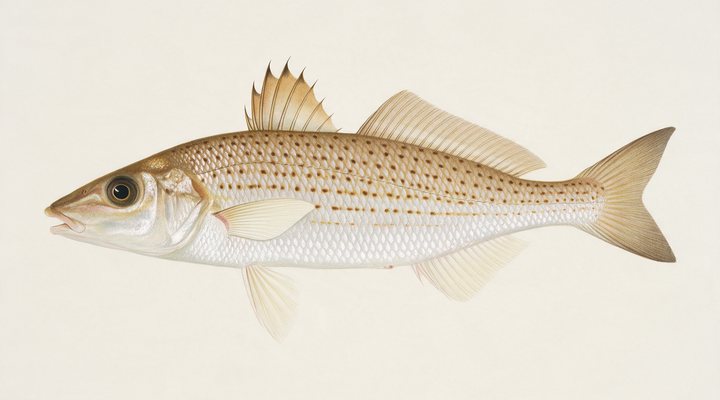
Identification and biology
King George whiting is the whiting of the south, Sillaginodes punctatus, a long, slender, silver fish with a pattern of rusty spots along the flanks and a small mouth built for sucking worms, shellfish and shrimp out of sand and weed. It is the most prized table fish of South Australia, a mainstay of Victoria’s Port Phillip and Western Port and of Western Australia’s south-west, and it grows slowly enough that the states set minimum sizes that differ between them. It lives over sand patches among weed and broken bottom in a few metres of water as a juvenile and moves to deeper reef and sand as it grows, and the big fish of Kangaroo Island and the west coast of Eyre Peninsula are the ones people travel for.
Where they live through the year
In South Australia the whiting are on the shallow sand holes in the weed from late spring through summer and autumn, and the gulfs and the west coast bays fish from December into May. In Port Phillip and Western Port the run is spring and summer, when the schools move onto the inshore weed and sand in two to eight metres and the boats anchor along the edges. In Western Australia the south-west bays, from Cockburn Sound down to the estuaries of the south coast, fish through the warmer months. In winter the fish are deeper and fewer inshore, and the southern pier fishing turns to garfish and squid.
The mistakes that cost fish
Anchoring on the weed instead of beside it: whiting feed on the sand between the weed, and the boat has to sit over a sand hole or a sand edge with the berley going down. Fishing too big a hook and too big a bait for a small mouth; a long-shank hook and a small piece of pipi, squid or worm is what they take. Staying put when the bite dies: whiting are where the bait is and a move of fifty metres often finds the school again. And keeping fish under the size, because the minimum differs by state and is easy to get wrong across a border.
Reading the report for whiting
The wind row decides whether the bay is comfortable at anchor, and the tide panel gives the making tide the whiting feed on over the sand. Pressure matters less than for snapper; a settled, sunny day with a light breeze is fine whiting weather. The species card on each water rates the month; the calendar shows the southern summer as the season and the year-round southern bays as the place.
Tackle setups
| Situation | Setup | Why it works |
|---|---|---|
| Bay whiting at anchor | 2.1 m rod rated 2 to 4 kg, 4 kg braid, 4 to 5 kg fluorocarbon leader, paternoster with two long-shank hooks, 20 to 40 g sinker | Two baits on the sand, light enough to feel the tap |
| Pier and jetty | 2.4 to 3 m rod rated 2 to 4 kg, 4 kg mono, small running sinker, long-shank hook, pipi or squid | The sand patches beside the pier weed hold whiting through the warm months |
| Drifting the deeper sand | 1.8 m rod rated 3 to 6 kg, 6 kg braid, paternoster, 60 to 80 g sinker | Kangaroo Island and the west coast: deeper water and bigger fish |
Playbook by water temperature
The plan the daily report picks for king george whiting in each band; the water temperature on each page is a seasonal estimate for its type of water and says so.
Hot water (over 27 °C)
Anchor over sand holes in the weed at first light with pipi, squid strip or worm on a small hook and a paternoster rig; move if nothing happens in twenty minutes.
Warm water (18 to 27 °C)
Peak season. Berley lightly, fish the sand holes on the making tide, and stay mobile: whiting are where the bait is, not where they were last week.
Cool water (10 to 18 °C)
Deeper sand patches and the middle of the day; slower bites, bigger fish.
Cold water (under 10 °C)
A winter fishery in the deeper gulf water on the calm days; light gear, fresh bait, tide change.
Month by month
Activity for the southern year, 1 slow to 5 peak; January is midsummer. Current month highlighted.
Waters we cover for king george whiting
70 Australia waters carry king george whiting on their species card, each with a daily report.
Victoria
Common questions
Where is the best King George whiting fishing?
South Australia’s gulfs, Kangaroo Island and the west coast of Eyre Peninsula for size; Port Phillip and Western Port for the spring and summer run; the south-west bays of Western Australia. The species hub lists every water we cover for them.
What bait is best for King George whiting?
Pipi (cockle), squid strip, and beach worm on a long-shank hook, fished on a paternoster or a running sinker over a sand hole in the weed with berley.
Is there a closed season for King George whiting?
None of the states covered here publishes a closed season for whiting, but size and bag limits apply and differ between states; every water page links the agency’s page.