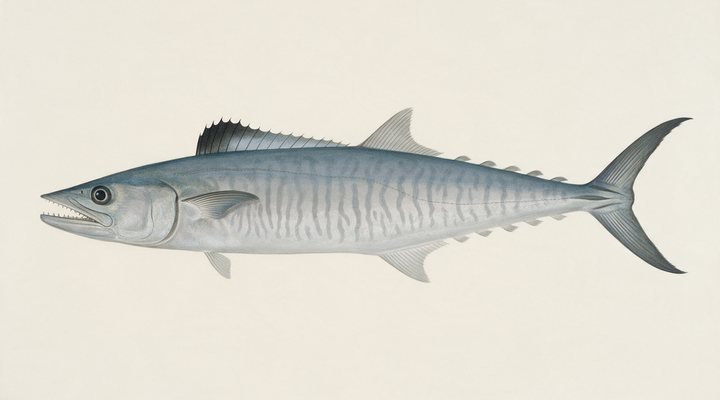
Identification and biology
The narrow-barred Spanish mackerel, Scomberomorus commerson, is the long silver torpedo of the tropical and warm-temperate coast: a row of wavy vertical bars along the flank, a mouth of razor teeth, a tail built for speed and a first run that empties a reel. It ranges from the Kimberley across the top of the continent and down the east coast to New South Wales, where it is a summer visitor on the warm current, and it feeds on pilchards, garfish, herring and squid around headlands, islands, reefs, shoals and the current lines between them. Queensland manages it hard after its stock assessment, with a reduced bag limit and closed seasons on the east coast that follow the new moon in the north and fixed dates in the south; the state hub shows this year’s dates.
Where they live through the year
In north Queensland and the Territory the mackerel season is the dry, from about May to October, when the water clears and the schools hold on the headlands, the shoals and the island passages of the Whitsundays, Townsville, Cairns and the Gulf; in the build-up they thin out. On the central and southern Queensland coast, from Mackay to the Gold Coast, the run is late winter through summer along the reefs and bait grounds, and in New South Wales the fish arrive with the warm water in summer and hold off the northern headlands and the reefs to about Sydney into autumn. In Western Australia the north-west, from Exmouth to Broome, fishes through the dry, and the Perth reefs see the odd fish in a warm summer.
The mistakes that cost fish
Trolling without a wire trace, which loses the lure and the fish to the teeth; and trolling too slowly, when a gar rigged on a chin weight or a deep diver at a fast walk is what the fish chase. Fishing the wrong tide at a headland: mackerel feed on the current, and the run of the tide over the shoal or past the point is the session. Ignoring the closed seasons on the Queensland east coast, which differ between the northern and the southern zones; the state hub computes them for this year. And, on the table, not bleeding and icing a fish that spoils faster than most.
Reading the report for mackerel
The wind row is the first thing to read, because the south-easterly trade wind closes the reef and the headlands for days at a time through the dry; the calm mornings are the mackerel mornings. The tide panel gives the run at the headlands and the passages. The water temperature estimate matters in New South Wales, where the fish come with the warm water. The species card rates the month; the state hub says whether the season is open in the zone the water sits in.
Tackle setups
| Situation | Setup | Why it works |
|---|---|---|
| Trolling gar or pilchard | 1.8 m rod rated 15 to 24 kg, 24 kg mono or braid, 40 to 60 kg single-strand wire trace, ganged hooks | Speed and teeth: the wire keeps the rig and the boat speed triggers the strike |
| Casting metals | 2.4 m spin rod rated 10 to 15 kg, 20 kg braid, wire or 80 kg mono trace, 40 to 80 g slug | Surface-feeding schools at the headlands and the bait grounds |
| Float-lining live bait | 2.1 m rod rated 10 to 15 kg, 15 to 20 kg line, wire trace, live yellowtail or pilchard under a float | The current line off the point with a berley trail |
Playbook by water temperature
The plan the daily report picks for spanish mackerel in each band; the water temperature on each page is a seasonal estimate for its type of water and says so.
Hot water (over 27 °C)
Troll rigged garfish or lures over the reef edges and shoals at first light; float-line a live bait through the middle of the day.
Warm water (18 to 27 °C)
Prime. Trolled baits and hardbodies over structure on the tide change, or high-speed metals cast at surface schools.
Cool water (10 to 18 °C)
The northern run. Anchor and float-line pilchards or live baits over the shoals with a wire trace.
Cold water (under 10 °C)
Only in the far north; the southern fish have moved on. Deeper reefs, slower trolling.
Month by month
Activity for the southern year, 1 slow to 5 peak; January is midsummer. Current month highlighted.
Waters we cover for spanish mackerel
35 Australia waters carry spanish mackerel on their species card, each with a daily report.
Queensland
Common questions
When is Spanish mackerel season in Queensland?
The northern zone, north of latitude 22 degrees, closes for two periods each spring aligned with the new moon; the southern zone closes 1 to 21 February and 1 to 21 March. The Queensland hub shows this year’s dates and the source; outside the closures the species card rates the month.
What is the best lure for Spanish mackerel?
A rigged garfish or a whole pilchard trolled on a wire trace, a deep-diving minnow of 150 to 200 mm trolled fast, or a 40 to 80 g metal cast and retrieved at speed when the fish are on the surface.
Do I need wire for Spanish mackerel?
Yes, or a very heavy monofilament trace: the teeth cut anything lighter. A short single-strand wire of 40 to 60 kg is the usual rig.