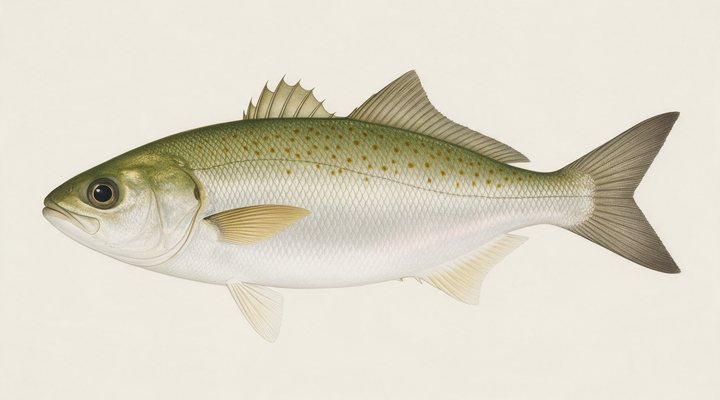
Identification and biology
The Australian salmon is not a salmon at all but a perch-like schooling fish, Arripis trutta on the east coast and Arripis truttaceus in the west, silver-green with a scatter of dark spots on the back, a forked tail and a habit of running the southern beaches in schools that turn the water dark. It is the everyday fish of the cooler coast from New South Wales round the south to Western Australia and Tasmania: a hard fighter, an easy fish for a family on a beach, and a fish whose flesh is better bled and iced at once than most anglers give it credit for. It spawns in the west and the south in late winter and spring, and the schools move along the coast with the seasons.
Where they live through the year
In winter and spring the salmon are on the surf beaches, the rock platforms and the bay edges of Victoria, South Australia, Tasmania and the southern coast of Western Australia, and on the New South Wales south coast beaches; the schools work the gutters at dawn and dusk and often through the day when the sea is up. Through summer they are still on the beaches of the far south and in Tasmania, and the small “salmon trout” fill the estuaries and the bay shallows everywhere. In Western Australia the autumn run along the south-west beaches, from the south coast up past Perth, is the biggest event of the salmon year and the schools can be seen from the cliffs.
The mistakes that cost fish
Casting where the school was rather than where it is going: salmon move along a beach and the angler who walks with them stays on fish. Fishing a metal too slowly, when a fast retrieve is what triggers the school, or fishing bait without a running sinker to keep it in the gutter. Keeping more than the bag or under the size, which differ by state. And, for the table, not bleeding and icing the fish on the sand, which is the difference between a good fish and a poor one.
Reading the report for salmon
The wind and the swell decide it: a moderate sea that stirs the gutters and a wind that does not close the beach. The fishing-times module shows the dawn and dusk windows and the tide; the rising tide into the change of light is the beach session. The species card rates the month; the calendar shows winter and spring in the south-east and the autumn run in the west.
Tackle setups
| Situation | Setup | Why it works |
|---|---|---|
| Beach metals | 3 to 3.6 m spin rod rated 6 to 10 kg, 10 to 15 kg braid, 15 kg leader, 30 to 40 g slug | Distance to the gutter and a fast retrieve through the school |
| Bait in the gutter | 3.6 m rod rated 6 to 10 kg, 8 kg mono, running sinker or paternoster with surf popper, pilchard or pipi | The bait held in the gutter as the tide rises into dusk |
| Bay and estuary salmon trout | 2.1 m spin rod rated 2 to 4 kg, 4 kg braid, 6 kg leader, 10 to 15 g metal or small plastic | The small fish of summer in the bays: light gear and fast retrieves |
Playbook by water temperature
The plan the daily report picks for australian salmon in each band; the water temperature on each page is a seasonal estimate for its type of water and says so.
Hot water (over 27 °C)
Early morning in the beach gutters with metals and pilchards before the schools push wide.
Warm water (18 to 27 °C)
Look for birds and surface splashes along the beaches and in the bays; cast metals, plastics or ganged pilchards into the school.
Cool water (10 to 18 °C)
The main season. Beach gutters, rock platforms and bay edges on the rising tide; metals, surf poppers and bait all work.
Cold water (under 10 °C)
Peak on the southern beaches. Big schools on the moving tide; fish the deeper gutters through the middle of the day.
Month by month
Activity for the southern year, 1 slow to 5 peak; January is midsummer. Current month highlighted.
Waters we cover for australian salmon
88 Australia waters carry australian salmon on their species card, each with a daily report.
New South Wales
Victoria
Common questions
Is the Australian salmon a real salmon?
No. It is an Arripis, a perch-like schooling fish of the southern coast; the name came from early settlers. It is a hard-fighting sport fish and a fair table fish if bled and iced at once.
When is the salmon run in Western Australia?
Autumn, when the schools move along the south-west beaches from the south coast up past Perth; the species card on the south-west water pages rates the month.
What lure for Australian salmon?
A 20 to 40 g metal slug retrieved fast through the gutter, a surf popper on a paternoster behind a sinker, or a pilchard on ganged hooks on a running sinker.