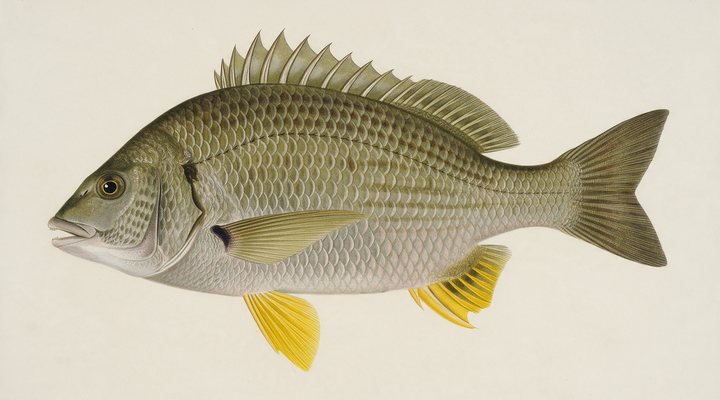
Identification and biology
Australia has two bream that matter to anglers: the yellowfin bream of the east coast, silver with yellow fins and a dark edge to the tail, and the black bream of the southern estuaries from the Victorian coast round to Western Australia, darker and deeper in the body. Both are slow-growing and long-lived, which is why a forty-centimetre fish is old and why the states set minimum sizes on them; both live their whole lives around structure, rock walls, jetty piles, oyster racks, snags, pontoons and mangrove roots, feeding on crabs, prawns, worms, shellfish and small fish. Black bream can spend their whole lives inside one estuary; yellowfin bream move to the estuary mouths and the surf to spawn in winter.
Where they live through the year
Summer and autumn are the estuary months: the fish are spread through the middle and upper reaches, on the flats at dawn, under the pontoons at midday and along the rock walls on the rising tide. In winter the yellowfin bream school toward the estuary mouths, the breakwalls and the surf beaches to spawn, and the biggest of the year are taken from the walls and the rocks then. Black bream in the southern estuaries move upstream with the winter freshes and spawn in the brackish reaches in spring. In the coastal lakes that open only when they fill, the bream grow big in the still water and the fishing changes the day the entrance is breached.
The mistakes that cost fish
Fishing too heavy and too fast. Bream inspect a lure closer than any other estuary fish; a 2 kg leader out-fishes a 5 kg one almost everywhere, and a lure that pauses draws the bite a lure that swims straight through does not. Ignoring the tide: the walls and the flats fish on the rise, the drop-offs on the fall, and the change is when the school moves. Fishing the same structure at the same water level every trip, when a fresh after rain moves the fish down and colours the water for days.
Reading the report for bream
The tide panel on the coastal pages is the first thing to read for bream, for direction more than for minute; the rain row second, because a fresh moves them. Pressure matters less than for the bay fish, and a light wind on a partly cloudy day is the bream angler’s friend. The species card on each water rates the month; the calendar shows when the estuary and when the mouth is the place.
Tackle setups
| Situation | Setup | Why it works |
|---|---|---|
| Lures around structure | 2 to 2.1 m spin rod rated 1 to 3 kg, 3 to 4 kg braid, 2 to 3 kg fluorocarbon leader, 35 to 50 mm hardbody or 50 mm plastic on a 1.5 to 3 g jighead | Light leader and a slow retrieve: bream look before they bite |
| Bait on the walls | 2.4 m rod rated 2 to 4 kg, 3 kg mono straight through, small hook and the lightest sinker that holds | An unweighted or lightly weighted bait drifts into the fish naturally |
| Winter at the mouth | 3 m rod rated 3 to 6 kg, 5 kg line, running sinker, whole pilchard or a strip of mullet | The big spawning fish sit in the current of the entrance and want a bait held there |
| Blades in deep water | 2.1 m spin rod rated 2 to 4 kg, 4 kg braid, 3 kg leader, 5 to 7 g blade | The drop-offs and the deep walls in the cool months, hopped slowly |
Playbook by water temperature
The plan the daily report picks for bream in each band; the water temperature on each page is a seasonal estimate for its type of water and says so.
Hot water (over 27 °C)
First and last light around the shallow flats and the rock walls with small hardbodies and light plastics; midday, the shade under pontoons and jetties.
Warm water (18 to 27 °C)
Prime bream weather. Cast small vibes, crankbaits and 2 to 3 inch plastics at every piece of structure on the rising tide.
Cool water (10 to 18 °C)
Slow the retrieve right down: blades and lightly weighted plastics along the deeper rock walls and drop-offs, or unweighted bait drifted into the snags.
Cold water (under 10 °C)
The winter school-up near the estuary mouths. Baits on the bottom in the deeper holes, and patience: the bite comes in short bursts.
Month by month
Activity for the southern year, 1 slow to 5 peak; January is midsummer. Current month highlighted.
Waters we cover for bream
107 Australia waters carry bream on their species card, each with a daily report.
New South Wales
Queensland
Victoria
Common questions
What is the difference between yellowfin bream and black bream?
Yellowfin bream live on the east coast and have yellow fins; black bream live in the southern estuaries from Victoria to Western Australia and are darker. They are different species with different spawning habits and the agencies set different rules for them.
When do bream spawn?
Yellowfin bream spawn in winter at the estuary mouths and in the surf; black bream spawn in spring in the brackish upper reaches. Neither has a closed season in the states covered here, but sizes and bag limits apply and are linked from every water page.
What is the best lure for bream?
A small hardbody of 35 to 50 mm worked slowly around structure, a 50 to 65 mm soft plastic on a light jighead, or a small blade in the deeper water. Fresh bait, prawn, nipper or worm, unweighted into the snags, still out-fishes lures on many days.