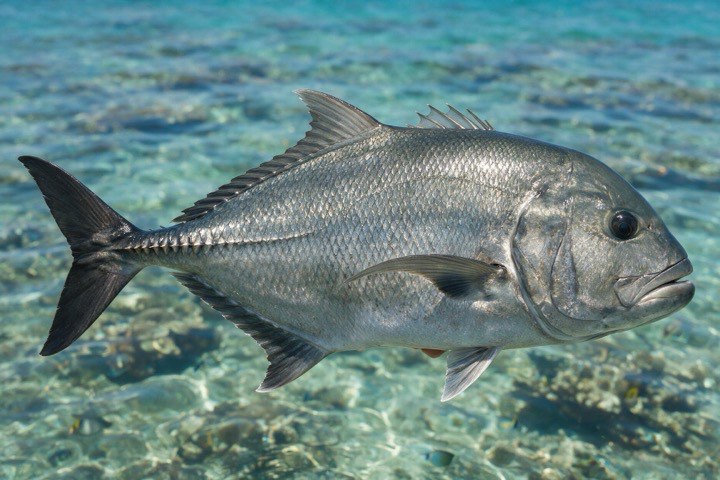
Ulua
The IGFA describes giant trevally as the largest of eight Caranx species in the Indo-Pacific, growing past 130 pounds, with an all-tackle record of 160 lb 7 oz. It ranges from East Africa across the Indian and central Pacific Oceans to Hawaii and the Marquesas, and the IGFA calls it the most common trevally in Hawaiian waters. A steep head, a lateral line armored with scutes toward the tail and a small patch of scales on an otherwise bare breast separate it from the bigeye trevally.
Home ranges
Acoustic tracking of 166 ulua across Hawaii over 14 years (University of Hawaii thesis) found moderate to high site fidelity, home ranges typically about 2.4 to 3.4 miles across, depths from the surface to about 794 feet, and no sign of fish crossing the deep channels between islands. A USGS analysis of DAR's volunteer Ulua and Papio Tagging Project suggests older fish shift to offshore habitat, where anglers reach them less often, and that much about the species' status in Hawaii is still unknown.
How it is fished
The IGFA says adults favor rocky shores and outer reef drop-offs and feed most actively at night, with Hawaiian anglers reporting the darkest nights as best. Surf and still fishing with live or cut bait, drifting, and trolling baits and lures all take them. In Hawaii, night bait fishing from shoreline ledges, including the slide-bait method that sends a live bait down a line already anchored by its sinker, is a long-standing shore practice; from boats, anglers cast large surface lures along reef edges.
Licenses and rules in Hawaii
Nonresidents aged 15 and older need Hawaii's Nonresident Recreational Marine Fishing License for ocean fishing, required since May 2, 2024 under HAR 13-74-11; residents fish free with no registration (DAR). Hawaii also sets a minimum size and bag limit for ulua and pāpio, the name used for the smaller fish; read DAR's marine fish rules before keeping one.
Tackle setups
| Situation | Setup | Why it works |
|---|---|---|
| Shore bait at night | Long surf rod, heavy line, live or cut bait on a slide-bait or sinker rig from a ledge | Matches when adults feed most (IGFA) |
| Popping from a boat | Heavy spinning outfit, braided line, heavy leader, large popper or stickbait | Surface lures worked along reef edges and drop-offs |
| Casting small lures | Medium-heavy spinning rod, small poppers, plugs or jigs | Covers shoreline and reef edges for smaller jacks (pāpio) |
| Trolling | Conventional outfit, lures or baits along reef edges | The IGFA lists trolling among the effective methods |
Playbook by water temperature
High summer (80F+)
Fish summer the way you fish the rest of the year: concentrate on night and low-light hours along drop-offs and rocky points, when the IGFA says adults feed most.
Active season (65-80F)
This band covers Hawaii's water for most of the year. Work rocky shorelines and outer reef drop-offs with bait at night or surface lures at first light; tracking shows ulua keep to small home ranges.
Transition (50-65F)
Does not apply in Hawaii, where nearshore water stays warmer than this all year.
Winter (under 50F)
Does not apply: giant trevally are tropical reef fish.
Month by month
1 = slow, 5 = peak. Current month highlighted.
Best waters for giant trevally (ulua)
12 waters we report on where this species is one of the main fish, each with a daily report.
Kona
Kaneohe Bay
Hilo Bay
Maalaea Bay
Hanalei Bay
Kailua Bay
Waianae Coast
Waimea Bay
Nawiliwili Bay
Kaunakakai
Kewalo Basin
Kahului Harbor
Common questions
Do visitors need a fishing license in Hawaii?
Yes, for ocean fishing if you are a nonresident aged 15 or older: Hawaii has required a Nonresident Recreational Marine Fishing License since May 2, 2024, sold online through DAR. Residents need none, and active-duty military stationed in the state and their families are exempt.
How big do giant trevally get?
The IGFA says they grow over 130 pounds, and its all-tackle record stands at 160 lb 7 oz.
When do ulua feed?
Mostly at night, according to the IGFA, which adds that Hawaiian anglers find the darkest nights most productive.
Do ulua move between islands?
University of Hawaii tracking found no evidence of ulua crossing the deep channels between islands; most stayed within home ranges a few miles across.
Pages checked
- igfa.org/game-fish-database/?search_type=SpeciesID&search_term_1=249
- scholarspace.manoa.hawaii.edu/items/2ec77453-ae7e-424c-a07d-a1930bd59bc8/full
- usgs.gov/publications/what-can-volunteer-angler-tagging-data-tell-us-about-statu
- dlnr.hawaii.gov/dar/fishing/fishing-regulations
- dlnr.hawaii.gov/dar/files/2025/01/NRMFL-FAQs.pdf
- dlnr.hawaii.gov/dar/fishing/fishing-regulations/marine-fishes-and-vertebrates
The facts on this page were checked against these pages, from the agencies and research bodies that manage and study this fish on October 6, 2026; anything we could not verify was taken out.