Fast growth, short life
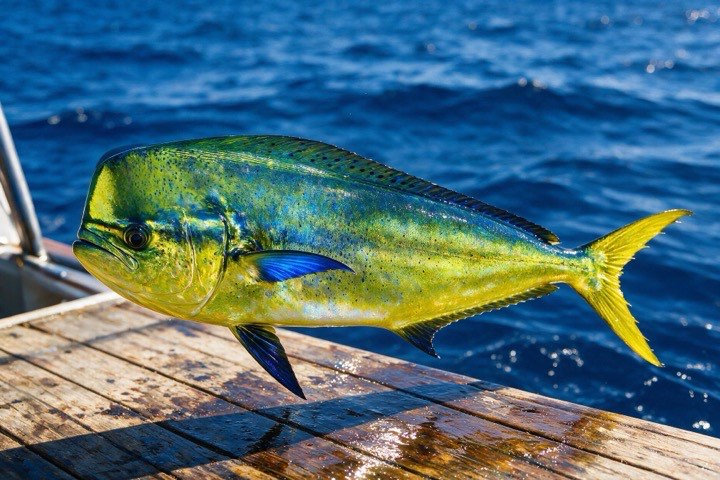
NOAA Fisheries calls mahi one of the fastest-growing fish in the ocean: over 4 feet in the first year and over 6 feet by age four. They reach almost 7 feet and 88 pounds, live up to 5 years and can reproduce at 4 to 5 months old, spawning every 2 to 3 days during the season. The IGFA all-tackle record is 87 pounds. Mature males (bulls) have a high, nearly vertical forehead and females (cows) a rounded one.
Floating cover
In the Atlantic and Caribbean, mahi spawn under floating Sargassum, and NOAA says females and smaller males stay near natural and artificial floating objects while larger males prefer open water. Juveniles school; older fish are more often alone. The South Atlantic council notes Sargassum is both cover and a food source, holding the small fish, crabs and shrimp mahi eat.
Spawning and seasons
Spawning depends on latitude. The SAFMC reports fish from the Florida Current spawning from November through July and fish in the Gulf Stream off North Carolina active in June and July. In the Pacific, NOAA says spawning may run year-round and adults travel seasonally as water temperature changes.
How anglers fish for them
The IGFA lists trolling surface baits (flying fish, mullet, ballyhoo, squid or strips) or lures, live bait and casting as the main methods, and notes that keeping the first hooked fish in the water usually holds the school beside the boat for others to cast to. Weedlines, floating debris and current edges, where bait collects, are where crews look first.
Management and catch
In the South Atlantic, NOAA Fisheries and the South Atlantic Fishery Management Council manage mahi under the Dolphin and Wahoo plan; in Hawaii and the Pacific islands, NOAA and the Western Pacific council. The Atlantic and Gulf fishery has historically been recreational, with 8.2 million pounds landed by anglers in 2024, and anglers in the US Pacific Islands harvested 2.1 million pounds the same year (NOAA). Federal and state rules set the limits; check them before a trip.
Tackle setups
| Situation | Setup | Why it works |
|---|---|---|
| Trolling | Conventional outfit, rigged ballyhoo, mullet, squid or strip baits, or small trolling lures | Covers water until fish show (IGFA) |
| Pitching to a school | Spinning rod, cut or live bait, circle hook | Once a school is beside the boat, cast baits to fish holding near the hooked one |
| Casting to cover | Spinning rod, small jigs or surface lures | Fish holding under weedlines and debris often take a cast lure |
Playbook by water temperature
High summer (80F+)
Warm surface water is mahi water. Run weedlines, rips and floating debris, troll baits along the edges and keep a hooked fish in the water to hold a school.
Active season (65-80F)
This band covers much of the season off the Southeast and in the Gulf. Search Sargassum lines and current edges, where bait collects.
Transition (50-65F)
As water cools, adults move with temperature (NOAA) and the fishing shifts to warmer offshore water and lower latitudes.
Winter (under 50F)
Does not apply: mahi live in tropical and subtropical surface water.
Month by month
1 = slow, 5 = peak. Current month highlighted.
Best waters for mahi-mahi (dorado)
10 waters we report on where this species is one of the main fish, each with a daily report.
Kona
Kaneohe Bay
Maalaea Bay
Hanalei Bay
Waianae Coast
Waimea Bay
Nawiliwili Bay
Kaunakakai
Kewalo Basin
Kahului Harbor
Common questions
Are mahi-mahi and dolphinfish the same fish?
Yes. The IGFA lists Coryphaena hippurus as dolphinfish, also called dolphin, mahi mahi and dorado; it is unrelated to the marine mammal, and 'dolphinfish' keeps the two apart.
How fast do mahi grow?
NOAA says over 4 feet in their first year and over 6 feet in four years, and they live only up to about 5 years.
How can you tell a bull from a cow?
Mature males have a steep, square forehead and females a rounded head (NOAA, IGFA); the IGFA adds that males grow larger.
Pages checked
- fisheries.noaa.gov/species/atlantic-mahi-mahi
- fisheries.noaa.gov/species/pacific-mahimahi
- safmc.net/species/dolphin
- igfa.org/game-fish-database/?search_type=SpeciesID&search_term_1=69
The facts on this page were checked against these pages, from the agencies and research bodies that manage and study this fish on October 6, 2026; anything we could not verify was taken out.