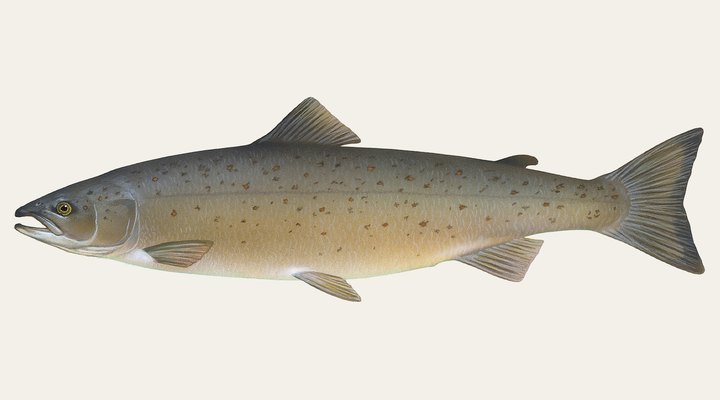
Identification and origins
Landlocked and sea-run Atlantic salmon are one species, Salmo salar, and Vermont Fish & Wildlife says there is no physical difference between them. Adults are silvery with a slightly forked tail and small X-shaped marks on the back and upper sides, and spawning males grow a hooked jaw, or kype (Maine IFW). Before 1868 they lived in only four Maine river basins: the St. Croix with West Grand Lake, the Union with Green Lake, the Penobscot with Sebec Lake and the Presumpscot with Sebago Lake. Vermont says they may also be native to Lake Champlain; elsewhere, as in Vermont's lakes, the fisheries depend largely on stocking.
Size and growth
Maine IFW gives an average of 16 to 18 inches and 1 to 1.5 pounds, with 3- to 5-pound fish not uncommon, and says growth is best in clear lakes with plenty of smelt and few competitors for them, such as lake trout (togue in Maine). Most fish anglers catch are two to four years old, and Vermont notes the oldest on record, from Maine, was 13. When salmon outgrow their smelt supply, Maine cuts stocking or encourages harvest, because too many salmon produce smaller fish.
Through the year
In spring and fall they feed near the surface and close to shore, where Maine IFW says fly fishing, casting and trolling with smelt imitations all work. In June, July and August they go down to about 30 to 60 feet, and the method becomes trolling with lead-core line or a downrigger. Maine says they prefer water below 65°F. In winter they are caught through the ice, mostly within the first 15 feet below it. Wild fish spawn in lake inlets and outlets from mid-October to late November.
Sea-run salmon are federally protected
The Gulf of Maine population of sea-run Atlantic salmon is federally endangered, and Maine IFW notes that it is illegal to fish for or possess wild sea-run Atlantic salmon. That is why some Maine rivers that hold landlocked salmon also carry rules meant to protect returning sea-run adults; read the rules for the river before you fish.
The mistakes that cost fish
Fishing the surface in summer, when Maine IFW places salmon at 30 to 60 feet. Fishing deep under the ice, when Maine's advice is to work the first 15 feet below it. And holding a jumping fish on a tight line: Maine notes they live up to the nickname "leaping landlocked", so keep the drag smooth and give line when one jumps.
Tackle setups
| Situation | Setup | Why it works |
|---|---|---|
| Spring and fall trolling | Medium-light rod, streamer flies or smelt-imitating lures run near the surface | Maine IFW calls streamers and smelt imitations very effective when salmon are shallow |
| Summer depth | Lead-core line or downrigger, copper, gold or silver lures | Maine IFW's method for fish at 30 to 60 feet |
| Fly rod | 6- or 7-weight, floating or sink-tip line, smelt streamers; dry flies and nymphs in rivers | Maine IFW says fly casting is the preferred method in rivers |
| Ice | Smelt or other bait, or jigs, within 15 feet below the ice | Where Maine IFW says winter salmon should be targeted |
Playbook by water temperature
High summer (80F+)
Surface water this warm is far above the 65°F Maine IFW gives as their upper preference; salmon are deep, so troll lead core or downriggers at 30 to 60 feet.
Active season (65-80F)
Early summer as lakes stratify: salmon leave the surface for deeper water, so fish early in the day or switch to deep trolling.
Transition (50-65F)
Spring after ice-out and the fall cool-down are the surface seasons, with fish near shore and at stream mouths feeding on smelt: troll or cast streamers and smelt imitations.
Winter (under 50F)
Right after ice-out salmon are near the surface; through the ice, Maine IFW advises fishing the first 15 feet below it. Wild fish spawn in tributaries from mid-October to late November.
The legal season is a separate question
Everything above is about the fish. When you are allowed to keep one is a different matter entirely, set state by state, and in several states the possession season is shut for months while the water stays open for catch-and-release. Those dates are not on this page on purpose: they belong with the agency that sets them, alongside the sizes and limits that come with them.
Month by month
1 = slow, 5 = peak. Current month highlighted.
Best waters for landlocked salmon
37 waters we report on where this species is one of the main fish, each with a daily report.
Sebago Lake
Lake Merwin
Lake George
Rangeley Lake
Mooselookmeguntic Lake
Moosehead Lake
Grand Lake Stream
West Branch Penobscot River
Rapid River
Kennebec River
Lake Winnipesaukee
Lake Willoughby
Clyde River
Seneca Lake
Keuka Lake
Great Sacandaga Lake
Otsego Lake
Trinity Lake
Quabbin Reservoir
Swift River
Squam Lake
Newfound Lake
Lake Memphremagog
Seymour Lake
Lake Sunapee
Bullards Bar Reservoir
Winooski River
Kennebago Lake
Penobscot River
Wachusett Reservoir
First Connecticut Lake
Ossipee Lake
Chesuncook Lake
Lake Winnisquam
East Grand Lake
Merrymeeting Lake
Damariscotta Lake
Common questions
Are landlocked salmon the same as Atlantic salmon?
Yes, both are Salmo salar. Landlocked fish complete their life in fresh water and feed mainly on rainbow smelt; sea-run fish go to the ocean, and the Gulf of Maine sea-run population is federally endangered.
When is the best time to fish for landlocked salmon?
Spring and fall, when Maine IFW says they feed near the surface and close to shore. In summer they go down to 30 to 60 feet and deep trolling is the main method; in winter they are caught through the ice.
What lures work for landlocked salmon?
Streamer flies and smelt-like lures, according to Maine IFW, with copper, gold or silver lures when trolling deep. On the Finger Lakes, NYSDEC notes that flat-lining near the surface works for salmon in fall and winter.
Where are landlocked salmon native?
In four Maine river basins (St. Croix, Union, Penobscot and Presumpscot), per Maine IFW, and possibly Lake Champlain, according to Vermont. Maine now has salmon fisheries in more than 300 lakes.
Pages checked
- maine.gov/ifw/fish-wildlife/fisheries/species-information/landlocked-salmon.html
- vtfishandwildlife.com/learn-more/vermont-critters/fish/land-locked-salmon
- nas.er.usgs.gov/queries/FactSheet.aspx?speciesID=926
- dec.ny.gov/things-to-do/freshwater-fishing/places-to-fish/finger-lakes/fishing
The facts on this page were checked against these pages, from the agencies and research bodies that manage and study this fish on October 6, 2026; anything we could not verify was taken out.