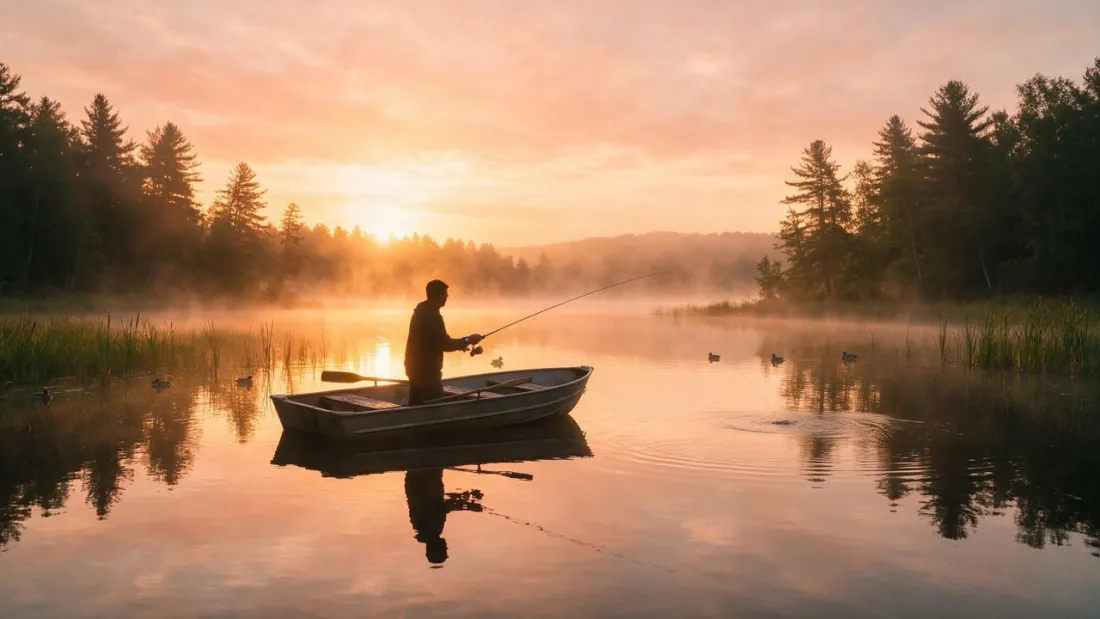
What decides most days
In a 13-year study of creel records on Escanaba Lake, Wisconsin, the factors that best predicted whether walleye and muskellunge anglers caught fish were about the anglers: whether they had a guide, what bait they used, and how much of the population had already been caught. Among natural factors, light, air temperature, wind and the moon all had measurable effects. The hour you fish matters, but so do where you fish and how.
Low light
For walleye at Escanaba Lake, the odds of success rose with conditions that cut light: the time of day and lower solar radiation. The Wisconsin DNR notes that in clear water walleye usually stay deep by day and move into the shallows at night, and recommends early morning and evening for largemouth bass in the warm months. In late spring, after a run of warm sunny days, the Indiana DNR suggests early morning, late afternoon and even nighttime.
Midday and the cold months
When the water is cold, the warm part of the day comes into its own. The Indiana DNR recommends mid to late afternoon in winter, late afternoon or evening in early May so the day's heat can warm the shallows, and afternoon or early evening in mid to late fall, when the water is warmest. At Escanaba Lake, muskellunge catches rose with air temperature.
Night
Night suits some species more than others. The Wisconsin DNR describes walleye in clear lakes moving shallow after dark, and in the large muskellunge catch study the night catch was higher around the full moon than around the new moon.
Water that moves on a schedule
On the coast, the South Carolina DNR's spotted seatrout guide says fishing is better almost everywhere while the tide is moving than at slack. Below dams, the release schedule sets the clock: Arkansas Game and Fish Commission reports describe wading windows on the upper river in the morning and lower down later in the day as each release travels downstream. Where water moves on a timetable, read the tide table or the generation schedule before you pick your hours.
Solunar windows
The lunar effects measured in catch records are small. Muskellunge catches peaked around the full and new moon at about 5% above a random day, and walleye trips at Escanaba Lake were 10 to 12% more likely to succeed when the moon passed overhead or underfoot during the trip. That makes the windows a reasonable tiebreaker between two similar hours and a weak reason to change a plan.
The solunar windows: real, modest, and last in the hierarchy.
What our reports print
Each water page includes a bite planner with an hour-by-hour bar from 5 a.m. to 9 p.m. It is a rule of thumb rather than a measurement: bars peak within an hour of sunrise and sunset, dip at midday (further on days in the hot band), and the whole day is raised or lowered with the 1-5 score. The page also prints the day's solunar windows for that water's coordinates and, on coastal waters, the predicted tides. Use them together with the guidance above.
Common questions
What is the best time of day to fish?
It depends on the species and the season. Agency advice favors early morning and evening in warm months, for largemouth bass for example, and the warmest afternoon hours in cold months. For walleye, the Escanaba Lake creel study found low light improved the odds.
Are solunar tables worth following?
As a tiebreaker. Large catch studies found lunar effects of roughly 5 to 12%, smaller than the effect of the angler's own choices of place, bait and approach.
Pages checked
- journals.plos.org/plosone/article?id=10.1371/journal.pone.0257882
- journals.plos.org/plosone/article?id=10.1371/journal.pone.0098046
- in.gov/dnr/fish-and-wildlife/education-programs/learn-to-fish/fishing-tips-and-v
- dnr.wisconsin.gov/topic/Fishing/species/lmbass.html
- dnr.wisconsin.gov/topic/Fishing/species/walleye.html
- dnr.sc.gov/marine/mrri/insh_fish/seatrout.pdf
- agfc.com/news/arkansas-wildlife-fishing-report-92
The facts on this page were checked against these pages, from the agencies, scientific bodies and studies that cover the subject on October 6, 2026; anything we could not verify was taken out.