Temperature sets the timing
Spawning follows water temperature more closely than the calendar, which is why agencies give a temperature as well as a range of dates: in Wisconsin, for example, largemouth bass spawn anywhere from late April to early July depending on when the water warms. The figures below come from the Wisconsin DNR's species pages unless noted; states farther south publish their own dates and temperatures. Our water pages show an estimated seasonal temperature, not a measured one, so for timing a spawn a thermometer in the water is the better guide.
Spawning temperatures (solid) and preferred ranges (light) as published by the agencies cited on each species page.
Black bass
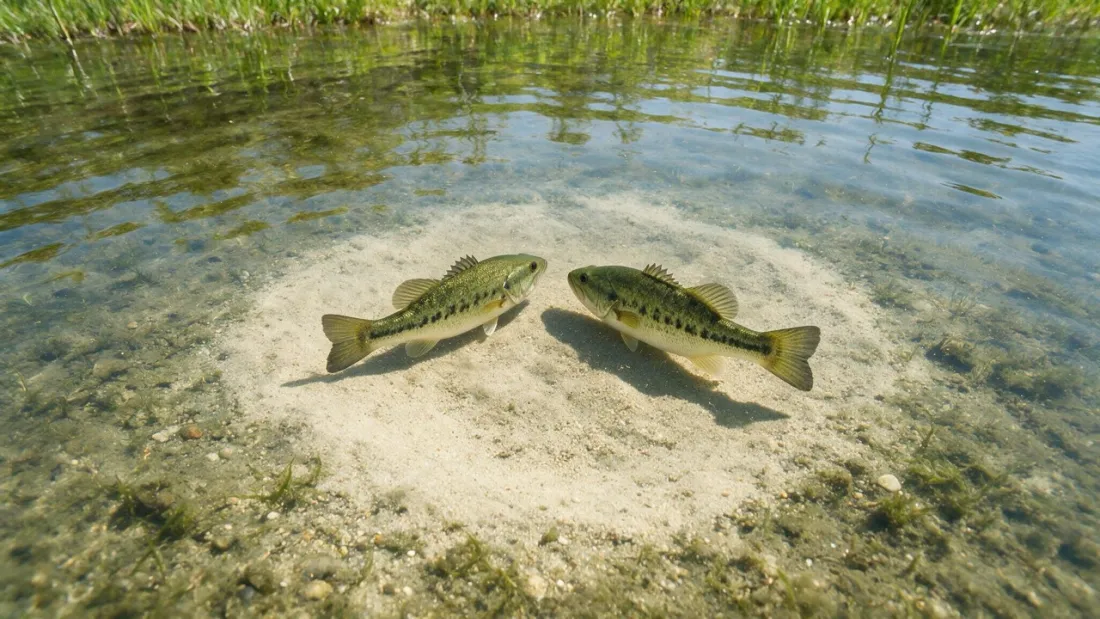
Largemouth bass begin choosing nest sites at about 60F and lay eggs at 62 to 65F, usually on sand or gravel, though they will nest on soft bottoms where roots or twigs give them something firm. Smallmouth bass usually spawn at 62 to 64F, have been recorded spawning at 53F, and in southern Wisconsin spawn from mid-May through June. A smallmouth male may build several practice nests before settling on a clean, round gravel bed. In both species the male guards the nest.
Crappie and bluegill
Black crappie spawn in May and June in Wisconsin, later in a cold year, with favorable temperatures of 64 to 68F; the male sweeps a nest in sand or fine gravel and guards the eggs and young. Bluegill spawn from late May to early August, peaking in June, at 67 to 80F, with males hollowing nests on sand or gravel bars and defending them against all comers, other male sunfish most of all.
Walleye, pike and muskie
Northern pike spawn first, as the ice breaks up, at 34 to 40F, with 36 to 37F preferred, scattering eggs on vegetation in flooded areas. Walleye begin moving to spawn soon after ice-out at 38 to 44F, and spawning peaks at 42 to 50F; they build no nest and give no care. Muskellunge spawn from mid-April to mid-May, best at about 55F within a range of 49 to 60F, again with no parental care. None of the three guards its eggs; check your state's rules for spring seasons before you fish for them.
Trout redds
Brown trout in Arkansas's tailwaters spawn in fall and winter, and the Arkansas Game and Fish Commission asks anglers to watch where they wade. A redd, the trout's nest, is a clean oval of small to medium gravel about 2 to 3 feet across, usually lighter in color than the gravel around it. Walking through one can do serious damage, and pulling a large brown off a redd it is guarding stresses the fish and lets predators, including other trout, get at the nest. Below Bull Shoals Dam, Arkansas closes its catch-and-release area to fishing from November 1 to January 31 for that reason.
Fishing the spawn with care
Bass, crappie and bluegill males guard their nests, and the reasoning Arkansas applies to trout redds carries over: a guarding fish taken off the nest leaves the eggs exposed. Where it is legal to fish for nesting fish, land them quickly and release them close to where they were caught. Stay off gravel bars where trout are spawning, and read your state's regulations, which in some waters close or restrict fishing during the spawn.
Common questions
What temperature do bass spawn at?
In Wisconsin DNR figures, largemouth bass lay eggs at 62 to 65F after choosing nest sites around 60F, and smallmouth bass usually spawn at 62 to 64F, occasionally as cool as 53F.
When do walleye spawn?
Walleye start moving to spawning areas soon after ice-out, at 38 to 44F, and spawning peaks when the water reaches 42 to 50F, according to the Wisconsin DNR.
Should you fish for spawning fish?
Follow your state's regulations, which close or restrict some waters during the spawn. Where it is legal, release nest-guarding fish quickly near the nest, and avoid wading through trout redds.
Pages checked
- dnr.wisconsin.gov/topic/Fishing/species/lmbass.html
- dnr.wisconsin.gov/topic/Fishing/species/smbass.html
- dnr.wisconsin.gov/topic/fishing/species/bcrappie.html
- dnr.wisconsin.gov/topic/Fishing/species/bluegill.html
- dnr.wisconsin.gov/topic/Fishing/species/walleye.html
- dnr.wisconsin.gov/topic/fishing/species/npike.html
- dnr.wisconsin.gov/topic/Fishing/species/musky.html
- agfc.com/news/dont-tread-on-the-redd
The facts on this page were checked against these pages, from the agencies, scientific bodies and studies that cover the subject on October 6, 2026; anything we could not verify was taken out.