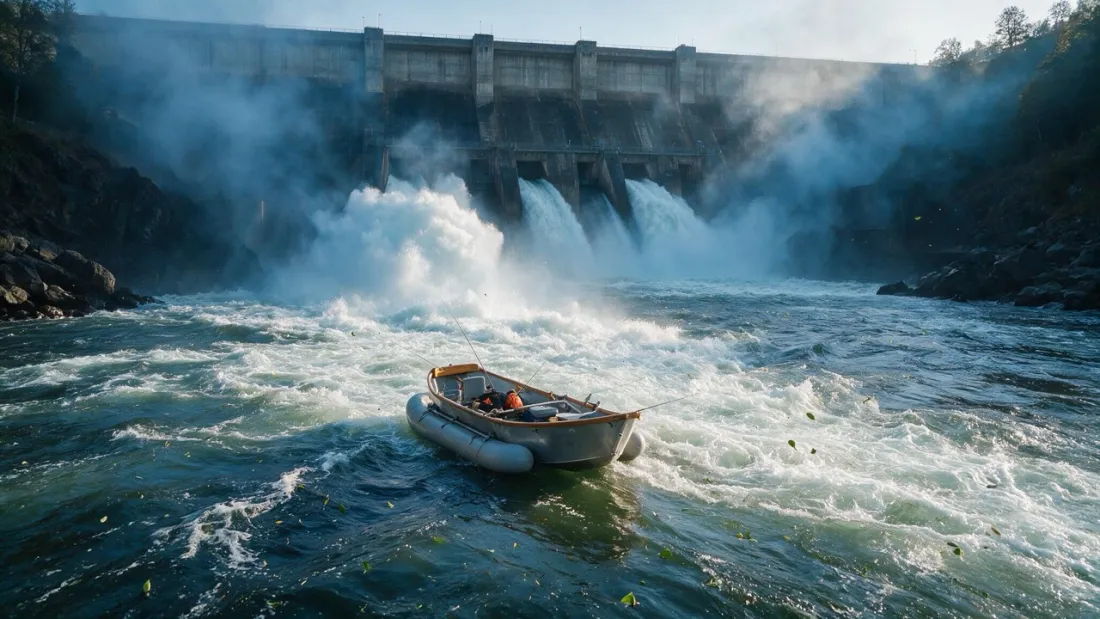
What a release does to the river below
When a dam's gates open or its turbines start, the Arkansas Game and Fish Commission warns, water that looked almost flat can rise dramatically and quickly. Releases often come from the bottom of the lake, so they are cold: the National Park Service says water leaving Buford Dam in Georgia is about 50F, and the Arkansas commission says its tailwater trout areas run 50 to 60 degrees even in summer. The same stretch can change character completely. On Lake Taneycomo below Table Rock Dam, the Missouri Department of Conservation describes the first mile and a half as deep, swift water during heavy generation and a chain of shallow, slow pools with short riffles when the turbines are off.
Where the schedules are posted
Each operator publishes its own. The Southwestern Power Administration posts a current-day generation schedule, online and by phone, for the Corps of Engineers dams it markets power from, including Greers Ferry Dam on Arkansas's Little Red River; it warns that the megawatts, and so the release, can change as power demand rises or falls, and that the Corps may release water for reasons other than power. Tennessee's boater safety course points to TVA's lake-level pages for planned releases at TVA dams and to the Corps' Nashville District for Corps dams. The Park Service publishes a phone line and website for the Buford Dam schedule. Where one of our water pages has a USGS gauge, its 30-day chart plots one reading per day, which shows the trend over weeks rather than each release; the station page linked in the page's sources block has the detailed readings. The schedule tells you what is planned, and the gauge shows what actually happened.
A generation pulse on the gauge: the water rises fast when the turbines start and falls when they stop.
Low water: the wading window
With the turbines off, the Missouri Department of Conservation notes, nearly everyone on upper Taneycomo wades or fishes from the bank, and boating becomes difficult and hazardous in the shallow pools. The catch is that the release still travels downstream after it starts. In an Arkansas Game and Fish Commission report, a Little Red River guide timed the water reaching Cow Shoals about an hour after generation began, Winkley Shoal about three and a half hours after, and Libby Shoal four to four and a half hours after, and warned against wading far downstream of your exit and having to fight back upstream once the water comes up. Know where you will get out before you step in.
The rise: why trout feed on it
Below Glen Canyon Dam, a USGS study found that the twofold daily swing in flows from hydropower raised the drift of scuds and snails more than tenfold. A related Utah State University study on the same river found drifting invertebrate biomass was highest on the rising limb of each release, fell back before the peak ended, and that brown and rainbow trout had fuller stomachs after peak flows. The Missouri Department of Conservation lists scuds, sowbugs and midge larvae as the main invertebrates in Taneycomo. That is the biological case for fishing the first part of a rise, but only from a position you can leave without crossing rising water.
High water: from the bank or a boat
During heavy generation on Taneycomo, the Missouri Department of Conservation limits safe fishing to the shoreline and drifting in boats. For boaters, Tennessee's boater safety course advises never anchoring below a dam and never anchoring from the stern, because a surge can pull the boat under before the anchor comes up; wearing a buckled life jacket; and keeping the main motor in working order and running even while drift fishing, since water can boil up suddenly. The Arkansas Game and Fish Commission adds that anyone swept into the current should keep their feet pointed downstream to fend off rocks and branches.
Safety: the water is on a switch
The Tennessee course puts the hazard plainly: a hydroelectric dam can discharge large volumes of water within seconds, and if a siren sounds or strobe lights flash you should move to a safer area immediately. Many areas just above and below dams are restricted, and some marked areas require life jackets to be worn; on the Chattahoochee, the Park Service requires a Coast Guard-approved life jacket while wading between Buford Dam and the GA 20 bridge. Schedules can change, so check the schedule and the gauge, and treat any rise as real even when it has not been announced. The Park Service also notes that the river can rise quickly when it is not raining where you stand, and that in water near 50F exhaustion or unconsciousness can set in within 30 minutes.
Planning around the releases
Release patterns follow power demand and water management. The Arkansas Game and Fish Commission notes that in the heat of summer the current below its dams may run all day to meet air-conditioning demand, and its weekly reports describe how a fixed daily release opens wading water on the upper river in the morning and lower down later in the day as the pulse passes. Check the schedule the evening before and again before you leave, read the gauge when you arrive, and choose your stretch and your exits to match.
Common questions
What does generation mean at a dam?
It means water is running through the turbines to make electricity. The river below rises, often quickly, and the released water is usually cold because it comes from deep in the lake.
Is it safe to wade below a dam?
Only with the schedule checked, an exit planned and a life jacket where required. Schedules can change, a dam can release large volumes within seconds, and if a siren or strobe goes off you should leave the water at once.
How long before rising water reaches me?
It depends on your distance from the dam. On Arkansas's Little Red River, a guide reported the release reaching shoals about one hour, three and a half hours and four hours or more downstream, so a delay is not a reason to stay in the river.
Pages checked
- agfc.com/news/prepare-for-the-cold-at-tailwater-trout-locations-this-summer
- agfc.com/news/arkansas-wildlife-fishing-report-92
- nps.gov/chat/planyourvisit/things2know.htm
- energy.gov/swpa/generation-schedules
- boat-ed.com/tennessee/studyGuide/Boating-Near-Dams...Beware!/10104402_52012
- mdc.mo.gov/fishing/fishing-prospects/reports/lake-taneycomo-prospect-report
- pubs.usgs.gov/publication/70058881
- qanr.usu.edu/research/namc/projects/past/double-peak
The facts on this page were checked against these pages, from the agencies, scientific bodies and studies that cover the subject on October 6, 2026; anything we could not verify was taken out.