What the agencies list
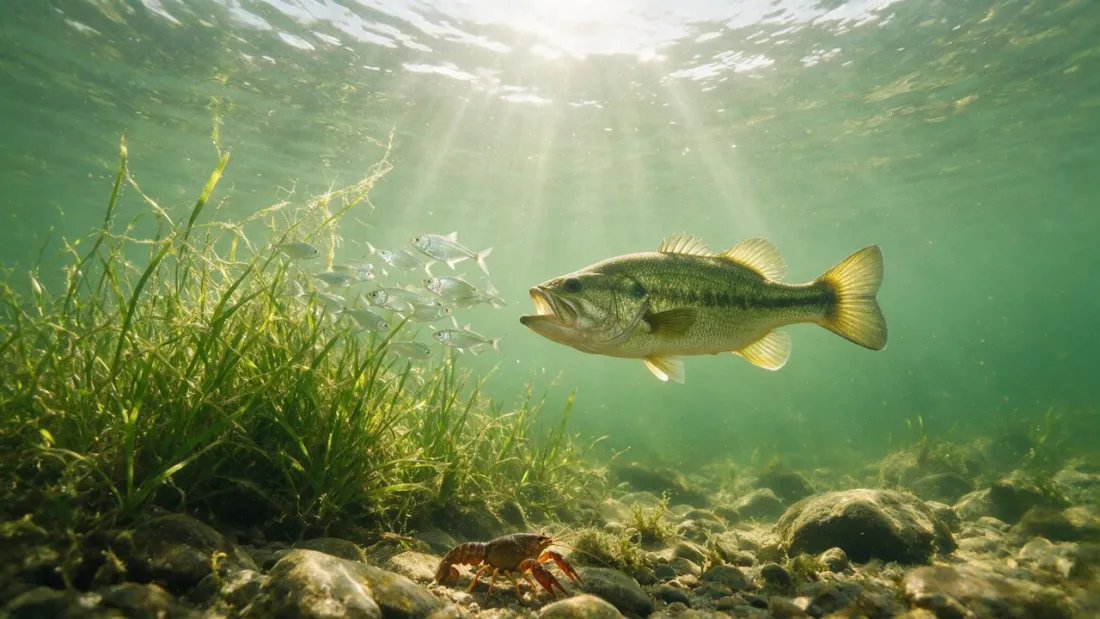
Texas Parks and Wildlife describes young largemouth bass eating zooplankton and insect larvae until they reach about 2 inches, when they turn predator; adults eat almost nothing but other fish and large invertebrates such as crayfish, and big bass eat smaller ones. The Indiana DNR lists fish, crayfish and large insects for adults. Alabama's wildlife agency notes that in stocked ponds largemouth prey on bluegill and redear sunfish, while in natural waters they take shad, minnows, smaller sunfish, crayfish and amphibians. For smallmouth bass, the Wisconsin DNR calls the crayfish their favorite food.
Cold water
The Indiana DNR notes that fish move slowly in cold water but still need to eat, and its cold-water advice follows from that: a jerkbait twitched now and then, or a fluttering crankbait or spoon, can imitate a dying baitfish, and if that fails, smaller lures on light line retrieved slowly. Threadfin shad, which Texas and Alabama say have been widely introduced as forage in reservoirs, are sensitive to cold: Texas Parks and Wildlife reports die-offs below 45F, and Alabama's agency notes they often die off in winter and late summer.
Spawning season
Agencies put the largemouth spawn at about 60F in Texas, 63 to 68F in Alabama, around 65F in Indiana, and 62 to 65F for egg-laying in Wisconsin. Males build and guard the nests, and Texas Parks and Wildlife notes the male stays with the young after they hatch. The Wisconsin DNR describes largemouth defending the nest against intruders.
The shad spawn
Texas Parks and Wildlife says threadfin shad begin spawning when the water reaches about 70F and may continue into summer. Alabama's agency, citing work in Missouri, describes spawning from dawn to sunrise, and Texas notes threadfin usually stay in the top 5 feet of water. Where threadfin live, the spawn concentrates small baitfish near the surface around first light in late spring.
Fall
The Indiana DNR describes largemouth and smallmouth bass, along with other predators, chasing baitfish in the shallows in fall, and suggests lures that look like minnows and shad. Its timing advice is morning and evening in early fall, then afternoon and early evening later in the season, when the water is warmest.
Common questions
What do bass eat the most?
State agencies list fish and crayfish as the main food of adult largemouth bass, with shad, minnows and sunfish among the fish. Smallmouth bass favor crayfish, according to the Wisconsin DNR.
What should I throw for bass in cold water?
The Indiana DNR suggests an occasional twitch of a jerkbait or a fluttering spoon to imitate a dying baitfish, then smaller lures on light line retrieved slowly if that does not work.
When do threadfin shad spawn?
Texas Parks and Wildlife says spawning begins when the water reaches about 70F and can continue into summer, and Alabama's agency describes it happening from dawn to sunrise along the shoreline.
Pages checked
- tpwd.texas.gov/huntwild/wild/species/lmb
- in.gov/dnr/fish-and-wildlife/fishing/largemouth-bass
- outdooralabama.com/black-bass/largemouth-bass
- dnr.wisconsin.gov/topic/Fishing/species/smbass.html
- dnr.wisconsin.gov/topic/Fishing/species/lmbass.html
- tpwd.texas.gov/huntwild/wild/species/threadfinshad
- outdooralabama.com/other-species/threadfin-shad
- in.gov/dnr/fish-and-wildlife/education-programs/learn-to-fish/fishing-tips-and-v
The facts on this page were checked against these pages, from the agencies, scientific bodies and studies that cover the subject on October 6, 2026; anything we could not verify was taken out.