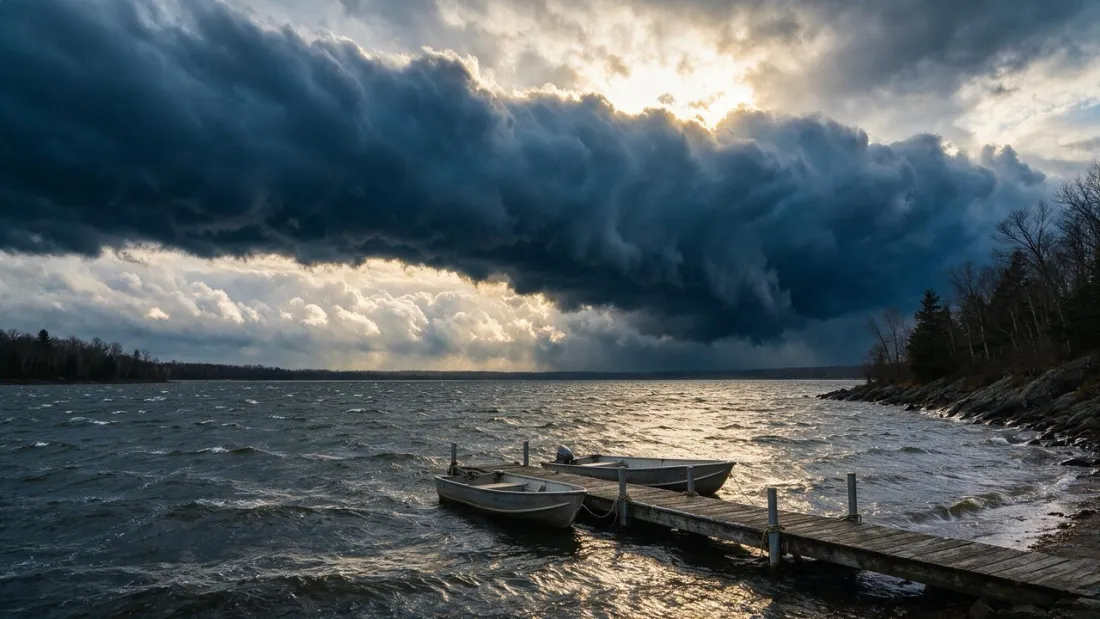
What a cold front brings
A cold front is the leading edge of a colder air mass pushing out a warmer one, and NOAA notes that "cold" is relative: in summer the air behind one can still be 90F if the air ahead was 95F. NOAA's description of a typical passage runs like this: a line of thunderstorms sweeps through just ahead of the front, and after the rain ends the wind shifts to the northwest, the temperature falls and the sky clears. Because cold fronts extend from low-pressure systems, the barometer tends to fall as the system approaches and rise once the front has gone by.
The frontal cycle in one pressure curve: the fall ahead, the sharp rise, then the return to normal.
Before the front
The Indiana DNR's advice to anglers is that fishing before a cold front is a good time to catch fish, and that the low light of a rainy day often spurs fish activity. Our own score adds a point when pressure falls by more than 1.5 hPa between 6 a.m. and 6 p.m., unless the chance of rain is 60% or more. The weather ahead of a front is also the most dangerous part of it: the storms NOAA describes ride just ahead of the front, and the National Park Service's rule on the water is to get out when lightning starts.
After the front
Behind the front come clearer skies, a northwest wind and cooler air. Our score takes a point away when pressure rises by more than 1.5 hPa under a sky less than 30% clouded. For the cold water that often follows, the Indiana DNR suggests retrieving slowly and, if flashier lures are not working, switching to smaller lures on light line, such as small hair or soft-plastic jigs, or live bait under a small bobber. Its winter advice is to fish from mid to late afternoon, once the sun has had time to warm the shallows.
What the research shows
Anglers widely report a slow bite after a front, but it has been hard to measure. The authors of a 13-year study of creel records on Escanaba Lake, Wisconsin, wrote that they knew of no published evidence that storm fronts change catch rates; in their own data, the pressure trend and rainfall that mark frontal weather carried little weight for walleye or muskellunge, while light, air temperature and wind did matter, and muskellunge catches were higher on calmer days. So adjust to the conditions you can see, the wind, the light and the water temperature, rather than to the front as such.
Planning a trip around a front
If your dates are flexible, the days before a front are the ones agency advice and our score both favor, as long as the storm forecast lets you be on the water safely. On the clear, cooler days after it, slow down and fish the warmest hours. Our water pages score the next seven days with the same rules, so you can see which day of the week the forecast favors before you commit; later days rest on a longer-range forecast and deserve less trust.
Common questions
Why is fishing often slow after a cold front?
Anglers widely report it, but studies have struggled to measure it: a 13-year Wisconsin creel study found the pressure and rain that mark fronts carried little weight. What changes for certain is the weather, with clear skies, a wind shift and cooler air, so slower and smaller presentations are the usual adjustment.
Is it good to fish before a cold front?
The Indiana DNR advises that fishing before a cold front is a good time to catch fish, and our score adds a point for falling pressure when heavy rain is not expected. Leave the water if lightning appears.
Pages checked
- noaa.gov/jetstream/wxmaps
- in.gov/dnr/fish-and-wildlife/education-programs/learn-to-fish/fishing-tips-and-v
- journals.plos.org/plosone/article?id=10.1371/journal.pone.0257882
- nps.gov/chat/planyourvisit/safety.htm
The facts on this page were checked against these pages, from the agencies, scientific bodies and studies that cover the subject on October 6, 2026; anything we could not verify was taken out.