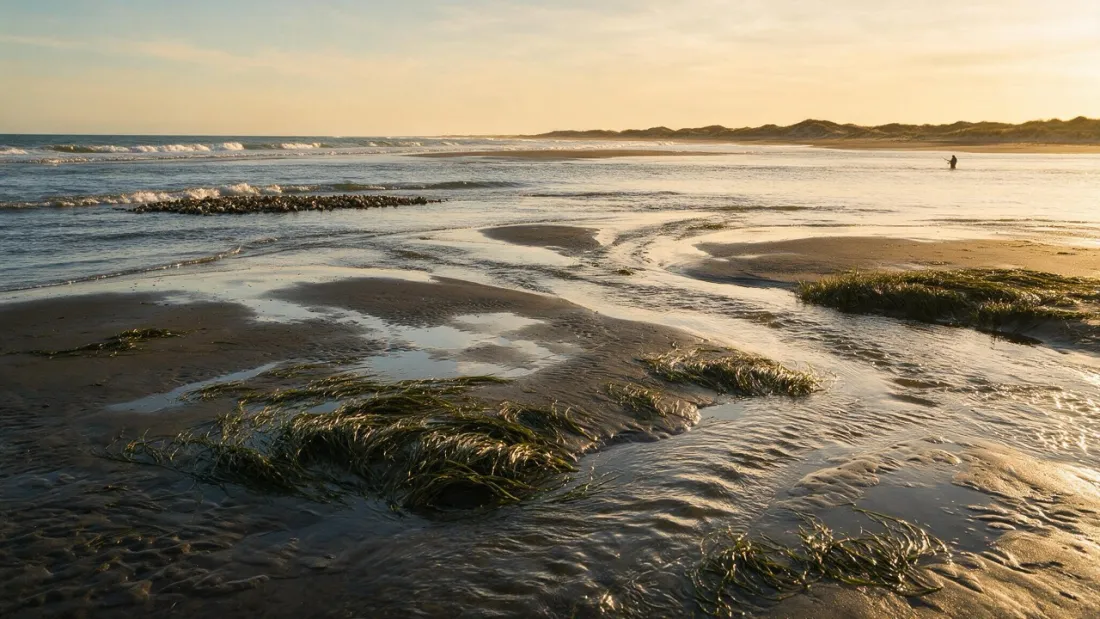
Why the water rises and falls
The moon's gravity, and to a lesser degree the sun's, pulls the oceans into bulges that the Earth rotates through. NOAA explains that this takes a lunar day of 24 hours and 50 minutes, so where there are two highs and two lows a day, highs come about 12 hours and 25 minutes apart and the water takes about six hours and 12 minutes to go from high to low. Coastlines vary: much of the East Coast has two roughly equal tides a day, the West Coast tends to have two unequal ones, and many places on the Gulf of Mexico have a single high and low.
Spring and neap tides
Twice a month, at new and full moon, the sun and moon line up with the Earth and NOAA notes that high tides run a little higher and low tides a little lower than average; these spring tides take their name from the water "springing forth," not the season. At the first and third quarter moons the two pulls work at right angles and produce smaller neap tides. Currents follow suit, running stronger at spring tides and weaker at neaps.
Tidal current and slack water
As the tide rises and falls, water moves horizontally: NOAA calls the incoming current the flood and the outgoing one the ebb. In rivers and estuaries the current reverses, with a slack period of no flow that can last from seconds to several minutes and generally comes near high or low tide. A South Carolina DNR guide to spotted seatrout says fishing at almost every location is better when the current is flowing than at slack, because changing water levels move prey and create strong currents at certain sites; it also notes that some deep spots can only be fished around slack, when a bait can reach bottom.
Incoming or outgoing
Neither is better everywhere. The same South Carolina guide describes grassy edges and coves as high-tide spots, because bait fish and shrimp hide and feed in the flooded grass, and creek mouths as places that often fish better on a falling tide, as bait leaves the marsh. Creek mouths and points funnel bait traveling along the bank and form current rips that favor larger predators over small prey. It recommends looking at each spot at different tide stages to see where the rips and eddies form, and fishing a location several times before judging it.
Reading the tide table on our pages
Coastal water pages list today's and tomorrow's predicted high and low tides, with times and heights in feet, from a named NOAA station, and the sources block links to that station. These are predictions of the astronomical tide. NOAA says it cannot predict the effect of wind, rain, freshwater runoff or other short-term weather; stations inside bays and estuaries are more affected than those on the open coast, wind along Chesapeake Bay has put Baltimore's water 1 to 2 feet above or below the prediction, and at Galveston weather can shift a tide by an hour or more.
Lakes and rivers
NOAA classes the Great Lakes as non-tidal: their true tides are under 2 inches and are masked by changes from wind and air pressure. What looks like a tide there is often a seiche, a sloshing of the lake after a sustained wind that can rise and fall over four to seven hours. Rivers below dams rise and fall on release schedules instead, which our dam guide covers.
A starter routine
Choose one spot and fish it at several tide stages over a few trips, noting the stage, the current and what you caught. That is how the South Carolina guide suggests learning a location, and it will tell you more about your spot than any general rule. If you find a pattern, the angler report form on each water page is where you can share it.
Common questions
What tide is best for fishing?
It depends on the spot. A South Carolina DNR guide notes that fishing is better almost everywhere while the current is moving, that flooded grass edges suit high tide, and that creek mouths often fish better on a falling tide.
Is slack tide bad for fishing?
Usually it is slower, because the moving water that carries bait stops for a short time near high and low tide. Some deep spots are easier to fish then, since a bait can get down without being swept away.
Are there tides on the Great Lakes?
Only tiny ones, under 2 inches, so NOAA treats the Great Lakes as non-tidal. Larger water-level swings there come from wind, pressure changes and seiches.
Pages checked
- oceanservice.noaa.gov/education/tutorial_tides/tides05_lunarday.html
- oceanservice.noaa.gov/education/tutorial_tides/tides07_cycles.html
- oceanservice.noaa.gov/facts/springtide.html
- oceanservice.noaa.gov/education/tutorial_currents/02tidal1.html
- tidesandcurrents.noaa.gov/faq.html
- oceanservice.noaa.gov/facts/gltides.html
- dnr.sc.gov/marine/mrri/insh_fish/seatrout.pdf
The facts on this page were checked against these pages, from the agencies, scientific bodies and studies that cover the subject on October 6, 2026; anything we could not verify was taken out.