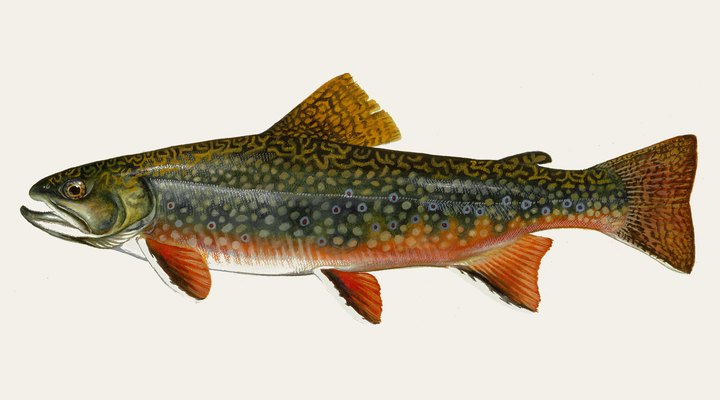
Identification and biology
Salvelinus fontinalis is a char rather than a true trout. Michigan DNR and Vermont Fish & Wildlife describe worm-like vermiculations on an olive to dark back, red spots with bluish halos on the sides, and lower fins edged in white, then black, then orange-red; spawning males turn bright orange-red on the lower sides and grow a slightly hooked jaw. The native range covers eastern Canada and runs south through the Great Lakes, upper Mississippi and the Appalachians to northern Georgia (USGS). Brook trout have been stocked far outside it, and in parts of the West USGS records them replacing native cutthroat and, through hybridization, threatening bull trout.
Small fish, short lives
Stream brook trout grow slowly. Vermont reports they rarely pass three or four years of age and that many headwater streams rarely produce fish over six or seven inches; Michigan gives 7 to 9 inches as a typical stream size and a lifespan that seldom passes six years. Lakes and ponds grow bigger fish: Maine IFW reports an average of 13.3 inches for three-year-olds in its lakes, Vermont records pond fish over 20 inches and five pounds, and Michigan's Great Lakes coasters can reach 25 inches and 10 pounds.
Cold water above all
Vermont Fish & Wildlife calls water temperature the most important factor in brook trout habitat: they thrive from near freezing to about 65°F, do best at 55 to 60°F, tolerate brief spells up to 72°F and die after a few hours at 75°F. Michigan notes that by summer they often move up into headwater tributaries in search of colder water. In ponds, Vermont says they seek cold spring upwellings in hot weather rather than going deep, while Maine IFW finds lake fish at 10 to 35 feet in summer, so where to look depends on the water.
Spawning
Brook trout spawn in fall, late September through November in Vermont and October and November in Michigan, when water cools to 40 to 50°F. They pick gravel over groundwater upwellings in streams and spring-fed spots in ponds, and Maine IFW has documented large Moosehead Lake fish spawning along the shoreline from mid-November into January. Eggs spend the winter in the gravel, about 45 days at 50°F and up to 165 days at 37°F by Vermont's figures, and Michigan stresses that they need silt-free, oxygen-rich water the whole time.
The mistakes that cost fish
Fishing a stream that is too warm: past the 72°F that Vermont gives as their brief limit, a released fish is at risk. A loud approach in small water, where brook trout hold under logs, boulders and undercut banks close to where you stand. And overlooking small water: Maine IFW notes that in northern Maine brook trout turn up in almost any stream with a source of cold water.
Temperature range
Preferred range and spawning temperatures as published by the agencies listed under Pages checked; where agencies disagree, the text names each figure. See the full temperature guide.
Tackle setups
| Situation | Setup | Why it works |
|---|---|---|
| Small-stream fly | Short rod for a 2- to 4-weight line, floating line, dry fly or a dry with a small nymph below | Short rods fit brushy streams, and a dropper covers the surface and the seam in one drift |
| Ultralight spinning | Short ultralight rod, light line, small spinners, spoons or jigs | Michigan DNR names small spoons, spinners and jigs as the most popular lures |
| Bait | Light rod, worm drifted along the bottom of deep holes and undercut banks | Michigan DNR describes drifting worms as a common stream method |
| Ponds and lakes | Fly or light spinning gear, small streamers, nymphs, dry flies or small copper lures | Maine IFW lists these for spring, summer and fall pond fishing |
Playbook by water temperature
High summer (80F+)
Water over 80°F is lethal to brook trout, which Vermont says die after a few hours at 75°F; do not fish for them. In those weeks they survive only at spring seeps and in cold headwaters.
Active season (65-80F)
Above 72°F, Vermont's brief-tolerance limit, leave them alone; when water is in the mid-60s, fish early in the day, move quietly and keep fights short.
Transition (50-65F)
The best band: Vermont's ideal is 55-60°F. Fish feed in daylight, since Michigan DNR notes they are more diurnal than other trout, and in ponds and lakes Maine IFW says spring and fall bring them near shore and the surface.
Winter (under 50F)
Below 50°F is the fall spawning band (40-50°F in Vermont), so stay off spawning gravel. In winter Maine IFW finds pond fish close to shore in 4 to 12 feet of water under the ice.
The legal season is a separate question
Everything above is about the fish. When you are allowed to keep one is a different matter entirely, set state by state, and in several states the possession season is shut for months while the water stays open for catch-and-release. Those dates are not on this page on purpose: they belong with the agency that sets them, alongside the sizes and limits that come with them.
Month by month
1 = slow, 5 = peak. Current month highlighted.
Best waters for brook trout
44 waters we report on where this species is one of the main fish, each with a daily report.
Lake Lanier
White River
Norfork Lake
Bitterroot River
Georgetown Lake
Silver Creek
Henrys Lake
Yellow Breeches Creek
Black River
Betsie River
Gunpowder River
Twin Lakes
Crane Prairie Reservoir
Beaverkill
Willowemoc Creek
Esopus Creek
Lake George
Rangeley Lake
Mooselookmeguntic Lake
Moosehead Lake
Grand Lake Stream
Rapid River
Kennebec River
Androscoggin River
Battenkill
Great Sacandaga Lake
Swift River
Somerset Reservoir
Tahquamenon River
Fish Lake
Sacandaga River
Caney Fork River
West Branch Susquehanna River
Kennebago Lake
Penobscot River
Kinnickinnic River
Cranberry River
Chesuncook Lake
China Lake
Savage River
Williams River
Umbagog Lake
East Grand Lake
Damariscotta Lake
Common questions
What do brook trout eat, and what should I use?
Michigan DNR calls them ready biters that eat aquatic and terrestrial insects, worms and small fish; worms, crickets, grasshoppers, wet and dry flies, small spoons, spinners and jigs all catch them.
How big do brook trout get?
In streams, usually 6 to 9 inches. Lakes and ponds grow larger fish: Vermont records pond fish over 20 inches, Maine IFW has documented 3- to 7-pound fish spawning in Moosehead Lake, and Michigan's Great Lakes coasters can reach 25 inches and 10 pounds.
What water temperature do brook trout need?
Vermont Fish & Wildlife gives an ideal of 55 to 60°F, a brief tolerance up to 72°F and death within hours at 75°F. Maine IFW gives a preferred range of 50 to 65°F.
Is a brook trout really a trout?
It is a char, genus Salvelinus, like the lake trout, with which it can cross to form the splake (Michigan DNR).
Pages checked
- vtfishandwildlife.com/learn-more/vermont-critters/fish/brook-trout
- michigan.gov/dnr/education/michigan-species/fish-species/brook-trout
- maine.gov/ifw/fish-wildlife/fisheries/species-information/brook-trout.html
- nas.er.usgs.gov/queries/FactSheet.aspx?speciesID=939
The facts on this page were checked against these pages, from the agencies and research bodies that manage and study this fish on October 6, 2026; anything we could not verify was taken out.