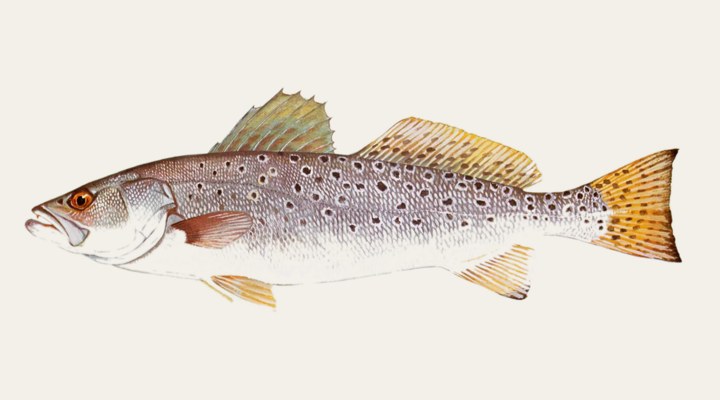
A drum, not a trout
Spotted seatrout belong to the croaker family and are close kin to red drum, black drum and Atlantic croaker (TPWD). Round black spots cover the back, the second dorsal fin and the tail, and one or two canine teeth sit at the tip of the upper jaw. In Texas, males average about 19 inches and females about 25, and most fish weigh 2 to 3 pounds (TPWD). Females grow faster and live longer: Louisiana Sea Grant notes that few males live past 5, so trout of 5 pounds and more are nearly all females, the 'sow' trout of Texas anglers. Fish mature at one to two years and can live past 12.
Staying close to home
Seatrout are largely non-migratory. Tagging in Louisiana and Texas found most recaptures in the same bay system, and the ASMFC says Atlantic fish usually stay within five to ten miles of their home estuary, though some Chesapeake Bay fish travel to North Carolina in fall. Within a bay the pattern is seasonal: TPWD describes fish over shallow seagrass in spring and summer, a move to deeper bay water and the Gulf as water cools in fall, and a return to the shallows in spring. In dry autumns many run up rivers and bayous with the first cool weather, and dredged harbors and channels hold fish too.
Spawning and cold
The spawning season is long. Louisiana Sea Grant reports that spawning starts around 68°F, peaks between 77 and 86°F and runs from April to September, with males drumming in large aggregations from sunset; SCDNR gives the same April-to-September window for South Carolina. Spawning sites differ by region: Louisiana Sea Grant describes passes and channels with good tidal flow, TPWD shallow grassy areas inside the bays. Cold is the main natural threat. North Carolina Sea Grant reports cold-stun symptoms just below 45°F, and the North Carolina Division of Marine Fisheries has closed the fishery after severe cold-stun events.
How anglers fish for them
TPWD's beginner notes call the popping cork rig the most popular setup: live shrimp, the top bait, or a soft plastic under a cork that is popped now and then to suggest feeding. Take off the cork and use a very small weight and it becomes a free-shrimping rig for drifting or strong current. Jigs fished under lights at night, spoons in the warm months and slow fish-shaped lures in cold weather round out the artificials, and floating topwater lures over shallow water in summer are a method for larger trout. In summer and fall, gulls diving over the water often mark trout pushing shrimp to the surface (TPWD).
The mistakes that cost fish
A hard hook set or a locked drag can tear the soft mouth, so keep steady pressure and a lighter drag. In hot weather, fish the shallows only early and late and move to drop-offs, channels and oyster reefs by midday (TPWD). And ice the catch at once: TPWD notes the meat loses quality quickly if left warm.
Tackle setups
| Situation | Setup | Why it works |
|---|---|---|
| Popping cork | Light to medium spinning or casting rod, live shrimp or a shrimp-tail jig under a popping cork | TPWD's most popular trout rig; the pop imitates feeding |
| Free-shrimping on the drift | Same rod, cork removed, very small weight, live shrimp | Lets the bait drift naturally from a moving boat or in strong tide (TPWD) |
| Night lights | Light rod, small jigs fished singly or in pairs | Trout gather to feed around lights after dark (TPWD) |
| Cold weather | Light to medium rod, slow-sinking fish-shaped lure | TPWD advises fishing these very slowly in deep rivers, harbors and channels |
| Summer topwater | Medium-light casting rod, floating surface lure | Surface lures over shallow water in warm months target larger trout (TPWD) |
Playbook by water temperature
High summer (80F+)
Fish the shallows at first light and late evening, then slide to drop-offs around grass flats, channels and oyster reefs as the day heats up (TPWD). Lights at night concentrate feeding trout; small jigs under them are a standard method.
Active season (65-80F)
Spring brings seatrout back over shallow seagrass, and the spawning season (April to September in Louisiana and South Carolina) keeps them feeding. Popping corks with live shrimp, free-shrimping on the drift and casting to working birds are the main tools.
Transition (50-65F)
As water cools in fall, trout leave the shallow bays for deeper water, and in dry years many run up rivers and bayous with the first cool weather (TPWD). Work fish-shaped lures and shrimp-tail jigs slower and deeper.
Winter (under 50F)
In cold weather TPWD points to deep rivers, harbors and channels, best after a norther has passed and skies clear. Below about 45°F seatrout can be cold-stunned (North Carolina Sea Grant); leave stunned fish alone.
Month by month
1 = slow, 5 = peak. Current month highlighted.
Best waters for speckled trout
47 waters we report on where this species is one of the main fish, each with a daily report.
Galveston
Port Aransas
Corpus Christi
Rockport
Pensacola
Tampa Bay
Jacksonville
Myrtle Beach
Texas City Dike
Navarre
South Padre Island
Sabine Pass
Key West
Islamorada
Sebastian Inlet
St. Augustine
Charleston
Carolina Beach
Lake Pontchartrain
Biloxi
Homosassa
Steinhatchee
Venice
Stuart
Fort Pierce
Sarasota
Mosquito Lagoon
Grand Isle
Matagorda
Baffin Bay
Port Mansfield
Dauphin Island
Morehead City
Murrells Inlet
Saint Marks River
Sabine Lake
York River
Calcasieu Lake
Apalachicola Bay
Choctawhatchee Bay
Escambia River
Mobile Bay
Pascagoula River
Rehoboth Bay
Pamlico Sound
Vermilion Bay
Tangier Sound
Common questions
Is a speckled trout really a trout?
No. It is a drum in the croaker family, related to red drum and Atlantic croaker (TPWD); the IGFA lists speckled trout and gator trout among its common names.
Why are big speckled trout almost always females?
Females grow larger and live longer. Louisiana Sea Grant notes few males live past 5 years, and TPWD says most large trout caught are females.
What is the record spotted seatrout?
The IGFA all-tackle record is 17 lb 7 oz. The Texas record listed by TPWD is 15.6 pounds and 37.25 inches.
What is the best bait for speckled trout?
TPWD names live shrimp, with live mullet or pinfish and dead shrimp as alternatives. Whenever shrimp are plentiful, the IGFA notes, seatrout feed on them almost exclusively.
Pages checked
- tpwd.texas.gov/huntwild/wild/species/strout
- asmfc.org/species/spotted-seatrout
- dnr.sc.gov/marine/species/spottedseatrout.html
- lsu.edu/departments/seagrantfish/biological/drum/spottedseatrout.htm
- ncseagrant.ncsu.edu/hooklinescience/how-does-winter-weather-affect-spotted-seatr
- igfa.org/game-fish-database/?search_type=SpeciesID&search_term_1=207
The facts on this page were checked against these pages, from the agencies and research bodies that manage and study this fish on October 6, 2026; anything we could not verify was taken out.