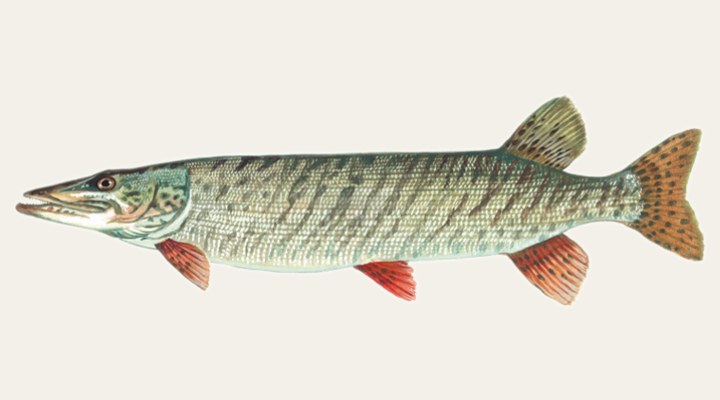
Identification and biology
Esox masquinongy is long-bodied with a duck-bill snout, a large mouth armed with canine teeth, and dark spots, bars or blotches on a light silver to green background. The quickest way to separate it from a northern pike is under the jaw: muskies have six or more sensory pores along each side of the lower jaw (USGS lists 6 to 9, Michigan DNR 6 to 10), pike five or fewer, and muskie tail lobes are more pointed. The tiger muskie, a pike and muskie hybrid, shows dark stripes on a light background. The native range covers the St. Lawrence and Great Lakes and the Mississippi basin from Quebec to southeastern Manitoba, reaching south through the Appalachians (USGS), and stocking has carried the species well outside it.
Spawning and diet
Muskies spawn in spring after the ice goes out, later than northern pike, scattering eggs over shallow vegetation with no parental care. Wisconsin DNR places the spawn between mid-April and mid-May, at water of 49 to 60°F with an optimum near 55°F, and notes that adults return to the same spawning grounds year after year. They eat mostly fish, from suckers and minnows to perch and sunfish; Michigan DNR adds that large muskies have taken small rodents, muskrats and waterfowl. They can withstand water up to about 90°F, and in peak summer heat move to slightly deeper, cooler water near a drop-off or other structure.
Where the fisheries are
Wisconsin made the muskellunge its state fish in 1955. Its muskies are most widespread in the Chippewa, Flambeau, St. Croix, Black and Wisconsin river systems, and central and southern populations exist through stocking. In Michigan, natural populations are mostly in the western Upper Peninsula, while the Great Lakes fishery centers on Lake St. Clair and the Detroit River, which the state DNR describes as world-class, with a charter fleet that trolls and a growing number of small-boat anglers who cast or jig. Farther south, USGS records Missouri stocking reservoirs with muskies from 1966.
How muskies are caught
Agency advice is consistent: big lures, often moved fast. Wisconsin DNR names large plugs, spoons and bucktails, or a live fish of 10 to 12 inches, and says daytime usually fishes best. Michigan DNR describes casting or trolling large plugs, spoons and spinners behind a wire leader at a fast rate, or fishing large suckers as bait. Many casters also finish each retrieve with a figure-eight beside the boat to give a following fish one more chance; that habit comes from anglers rather than from any agency.
Releasing a muskie
Wisconsin DNR reports that catch-and-release is almost universal among its muskie anglers and that delayed hooking mortality is low, under 5 percent, and linked to water temperature, with cold spring water giving the lowest losses. Summer fish are therefore the ones to handle fastest: keep the fish in the water, have long-nose pliers and cutters ready before the first cast, and carry a net big enough for the fish you are after.
Temperature range
Preferred range and spawning temperatures as published by the agencies listed under Pages checked; where agencies disagree, the text names each figure. See the full temperature guide.
Tackle setups
| Situation | Setup | Why it works |
|---|---|---|
| Casting bucktails and spoons | Heavy casting rod, strong braided line, wire or heavy leader, large bucktail or spoon | Wisconsin DNR lists bucktails, plugs and spoons among the best artificial baits |
| Large plugs | Extra-heavy rod matched to the lure weight, heavy leader, large plug | Large lures suit a predator that eats big prey |
| Trolling | Heavy trolling rods, large plugs or spoons, wire leader | Michigan DNR notes the Lake St. Clair charter fleet trolls for muskies |
| Live bait | Large sucker of 10 to 12 inches; check local rules on bait rigs | Both Wisconsin and Michigan DNRs list large live bait fish |
Playbook by water temperature
High summer (80F+)
Muskies tolerate warm water but in peak heat slide slightly deeper while staying near drop-offs and structure (Michigan DNR); fish early and late, and keep releases short, since Wisconsin DNR links hooking mortality to warmer water.
Active season (65-80F)
Main open-water season: cast or troll large bucktails, spoons and plugs along weed edges and other cover where muskies wait in ambush.
Transition (50-65F)
This band covers the spring spawn, which in Wisconsin runs at 49-60°F; spawning muskies eat little and rarely chase lures, Wisconsin DNR says. After the spawn, and again as fall water cools, work large lures along weed edges and structure.
Winter (under 50F)
Water under 50°F comes before the spawn in spring and at the end of the season in fall. In fall, where seasons stay open, slow-moving lures and large live suckers are the traditional approach.
Month by month
1 = slow, 5 = peak. Current month highlighted.
Best waters for muskellunge
85 waters we report on where this species is one of the main fish, each with a daily report.
Lake St. Clair
Dale Hollow Lake
Center Hill Lake
Smith Mountain Lake
Raystown Lake
Cass Lake
Potomac River
New River Gorge
Shawano Lake
Rainy Lake
James River
Delavan Lake
Chautauqua Lake
Lake Minnetonka
Detroit River
Pewaukee Lake
Lake Mendota
Castle Rock Lake
St. Clair River
Lake Arthur
Chippewa Flowage
Turtle-Flambeau Flowage
Shabbona Lake
Pineview Reservoir
Petenwell Lake
Fox River
Otisco Lake
Lake Waconia
Hamlin Lake
Lake Merwin
Lake MacBride
Lake Wissota
Fox Lake
New River
Shenandoah River
Berlin Lake
Pomme de Terre Lake
Torch Lake
Summersville Lake
Juniata River
Lake Nockamixon
Lake Ashtabula
Tippecanoe River
Connecticut River
Elk River
Tygart Lake
Merritt Reservoir
Calamus Reservoir
Cave Run Lake
Lake Tschida
Lake Audubon
Lake Hopatcong
Manasquan Reservoir
Clear Lake
Niobrara River
Bluestone Lake
Kinkaid Lake
Alum Creek Lake
Piedmont Lake
Salt Fork Lake
Lake Wisconsin
Lac Courte Oreilles
Namekagon River
Tahquamenon River
Missouri River
Tygart Valley River
Greenwood Lake
Allegheny River
Grand River
Caesar Creek Lake
Saint Croix River
Chippewa River
Gasconade River
Buffalo River
Mulberry River
Licking River
Cottonwood River
Mohawk River
Merrimack River
Turkey River
Sugar Creek
Blue River
Lake Lillinonah
Platte River
Kanawha River
Common questions
How do you tell a muskie from a northern pike?
Count the pores under the lower jaw: muskies have six or more on each side, pike five or fewer (USGS and Michigan DNR). Muskies also have more pointed tail lobes, and their markings are dark on a light background.
When do muskies spawn?
In spring after ice-out and after northern pike: mid-April to mid-May in Wisconsin, at water temperatures of roughly 49 to 60°F with an optimum near 55°F.
What is a tiger muskie?
A hybrid of northern pike and muskellunge, striped dark on a light background. Michigan once stocked them but no longer raises them in state hatcheries, and naturally produced tigers turn up more often in lakes with many pike.
What do muskies eat?
Mostly other fish, such as suckers, minnows, perch and sunfish, according to Michigan DNR, which adds that large muskies occasionally take small mammals and waterfowl.
Pages checked
- michigan.gov/dnr/education/michigan-species/fish-species/muskellunge
- dnr.wisconsin.gov/topic/Fishing/species/musky.html
- dnr.wisconsin.gov/topic/Fishing/musky
- nas.er.usgs.gov/queries/FactSheet.aspx?speciesID=679
The facts on this page were checked against these pages, from the agencies and research bodies that manage and study this fish on October 6, 2026; anything we could not verify was taken out.