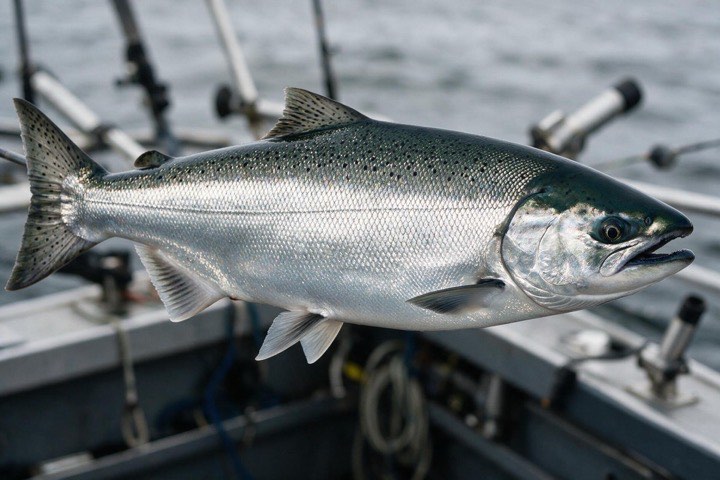
Identification and life cycle
Oncorhynchus tshawytscha is the largest Pacific salmon. NOAA Fisheries gives a maximum of 4.9 feet and 129 pounds, though typical mature fish are about 3 feet and 30 pounds, and WDFW notes most are under 50 pounds. At sea they are blue-green above and silver on the sides, with black spots on the back and on both lobes of the tail (ADF&G); black gums are a quick field mark, as Michigan DNR notes. Chinook hatch in rivers, spend one to five years at sea and return to their home stream to spawn and die. Most mature at three or four, but ADF&G notes a mature seven-year-old may pass 50 pounds.
Ocean feeders, river fasters
At sea chinook eat herring, pilchard, sand lance, squid and crustaceans and grow fast (ADF&G). They stop feeding on the spawning migration, so river fishing means drawing a strike from a fish that is not hungry. WDFW describes spring and summer runs that travel far upriver, some hundreds of miles, and fall runs that spawn closer to the ocean; ADF&G notes that Yukon River fish bound for Canada cover more than 2,000 river miles in about 60 days.
Saltwater methods
WDFW calls downrigger trolling probably the most popular way to catch salmon in salt water: an 8- to 10-foot rod rated for 12- to 30-pound line, 20- to 30-pound main line, and a flasher or dodger with a hoochie, spoon or cut-plug herring. Mooching, drifting a spinning plug-cut herring under a banana-shaped weight, is the older Puget Sound method. For chinook, WDFW suggests trolling slowly, under 2 mph, near kelp and bottom structure. Early and late in the day chinook cruise near shore in 20 to 120 feet of water; in open water they follow the bait and go deeper as the sun climbs, with 40 to 80 feet a good starting depth.
River methods
In rivers WDFW describes drift fishing roe or sand shrimp on 20- to 25-pound line for chinook; plunking, where an anchored lure waits in a travel lane; and, on the Columbia, a wobbling plug wrapped with a sardine fillet fished on heavy line. Float-fished salmon eggs work in eddies and tidewater, and in tidal lower rivers anglers troll cut-plug herring or spinners behind a dropper weight. Look for fish where the easiest route upstream meets cover: inside bends on big rivers, and tailouts above riffles on small ones.
Great Lakes kings
Chinook were planted in the Great Lakes from the 1870s, but Michigan DNR dates the modern fishery to the state's 1967 plantings, made when alewives were abundant; chinook became the dominant salmon there, and USGS, citing 2011 Michigan figures, reports that seven of every eight Lake Huron chinook came from natural reproduction. Michigan's best fishing is on Lake Michigan, where anglers use downriggers and lead-core or copper line to reach fish that are often 100 feet or more down once the sun is up, and the runs reach rivers such as the Manistee, Pere Marquette and St. Joseph by mid-August. Stocking has been cut in recent years over concern for alewife numbers.
Management and listings
Ocean salmon fishing off Washington, Oregon and California is managed under the Pacific Coast Salmon Plan: a regional fishery management council recommends each year's seasons and NOAA Fisheries implements them, while Alaska manages salmon in federal waters by delegation. As of 2025, NOAA lists two chinook populations as endangered and seven as threatened under the Endangered Species Act. Seasons, quotas and gear rules can change in-season, so check the state agency on the day you fish.
Tackle setups
| Situation | Setup | Why it works |
|---|---|---|
| Downrigger trolling | 8- to 10-ft rod rated 12-30 lb, level-wind reel, 20-30 lb main line, flasher with hoochie or herring | WDFW's description of the most popular saltwater method |
| Mooching | 8½- to 9-ft rod, level-wind reel, 10-20 lb main line, banana-shaped weight, plug-cut herring | The traditional Puget Sound drift method (WDFW) |
| River drift | 8½- to 9-ft rod rated 15-30 lb, 20-25 lb line, pencil lead or slinky weight, roe or sand shrimp | WDFW's standard drift setup for chinook |
| Plunking a wrapped plug | 8½- to 9-ft extra-heavy rod, 40-60 lb line, wobbling plug wrapped with sardine, sliding weight | WDFW notes this rig is very popular on the Columbia |
Playbook by water temperature
High summer (80F+)
Warm surface water pushes chinook deep: Michigan DNR notes Great Lakes kings are often 100 feet or more down by day, so run downriggers, lead core or copper, and fish shallow only in low light.
Active season (65-80F)
Chinook follow the bait: WDFW suggests starting at 40 to 80 feet in open salt water, fishing close to shore and kelp early and late, and going deeper as light increases.
Transition (50-65F)
Runs enter the rivers: drift roe or sand shrimp through travel lanes, plunk a wrapped plug, or float eggs in eddies and tidewater.
Winter (under 50F)
Most adult runs have spawned by now. In Washington, winter and early spring bring blackmouth fishing near the bottom in 60 to 200 feet of water where seasons are open.
The legal season is a separate question
Everything above is about the fish. When you are allowed to keep one is a different matter entirely, set state by state, and in several states the possession season is shut for months while the water stays open for catch-and-release. Those dates are not on this page on purpose: they belong with the agency that sets them, alongside the sizes and limits that come with them.
Month by month
1 = slow, 5 = peak. Current month highlighted.
Best waters for chinook salmon
53 waters we report on where this species is one of the main fish, each with a daily report.
Lake Sakakawea
Fort Peck Lake
Lake Oroville
Rogue River
American River
Trinity River (CA)
Cowlitz River
Kenai River
Westport
Columbia River
Lake Ontario
Drano Lake
Lake Michigan (Chicago)
Muskegon River
Sandy River
Sheboygan (Lake Michigan)
Monterey Bay
Coos Bay
Sitka
Kodiak
Seward
Ketchikan
Oswego River
Little Manistee River
Lake Merwin
Betsie River
Wilson River
Don Pedro Reservoir
Grand Traverse Bay
Torch Lake
Lake Chelan
Newfound Lake
Anderson Ranch Reservoir
Bois Brule River
Manistique River
Big Manistee River
Lake Washington
Klickitat River
Umpqua River
Nestucca River
Siletz River
Salmon River
Selway River
Situk River
Skilak Lake
Naugatuck River
Mokelumne River
Willamette River
Icicle Creek
Kasilof River
Talkeetna River
Naknek River
Chena River
Common questions
How big do chinook salmon get?
NOAA Fisheries gives a maximum of 129 pounds and 4.9 feet, but most mature fish are about 3 feet and 30 pounds. In Michigan the state record is a little over 46 pounds, and fish above 20 pounds are now considered large.
What is the difference between ocean and river chinook fishing?
At sea chinook are feeding, so anglers troll or mooch bait and lures at the depth of the baitfish. On the spawning run they stop feeding (ADF&G), so river anglers drift roe, plunk lures or use wrapped plugs to draw strikes from fish holding in travel lanes.
What is a blackmouth?
WDFW's name for resident chinook that stay in the Salish Sea instead of migrating to the open ocean, fished in winter and early spring, usually within 10 feet of the bottom in 60 to 200 feet of water.
When do chinook enter Great Lakes rivers?
Michigan DNR says they begin moving upstream in late summer and are usually present in catchable numbers by mid-August.
Pages checked
- fisheries.noaa.gov/species/chinook-salmon
- adfg.alaska.gov/index.cfm?adfg=chinook.main
- wdfw.wa.gov/species-habitats/species/oncorhynchus-tshawytscha
- wdfw.wa.gov/fishing/basics/salmon/marine-areas
- wdfw.wa.gov/fishing/basics/salmon/freshwater
- michigan.gov/dnr/education/michigan-species/fish-species/chinook-salmon
- nas.er.usgs.gov/queries/FactSheet.aspx?speciesID=920
The facts on this page were checked against these pages, from the agencies and research bodies that manage and study this fish on October 6, 2026; anything we could not verify was taken out.