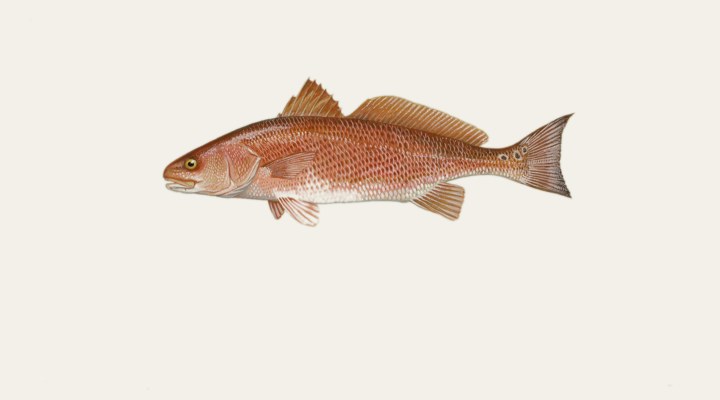
Identification and growth
TPWD points to one large black spot on the upper base of the tail as the mark to look for: several spots are common, a fish with none is rare. Color runs from nearly silver to deep copper, with reddish bronze the most common. Growth is quick; in Texas a red drum reaches about 11 inches in its first year and 22 to 24 inches by its third. The mouth sits low, suited to bottom feeding, and a fish rooting head-down in very shallow grass shows its tail above the surface, which anglers call tailing (TPWD). Males make the drumming sound with a muscle that vibrates the swim bladder (TPWD, SCDNR).
Where they live through the year
Young red drum spend their first years in bays, marsh creeks and the surf near passes, and Texas tag returns show most move less than 3 miles from where they were tagged (TPWD). As they mature they move out: on the Gulf side TPWD says adults stay in the Gulf apart from occasional visits to the bays, while on the Atlantic the ASMFC says fish older than about four live in deeper water and move offshore or south in winter. Spawning runs from mid-August to mid-October near Gulf passes and beaches (TPWD, Louisiana Sea Grant) and in late summer and fall near inlets in South Carolina (SCDNR). In winter, juveniles collect in deeper creeks, rivers and channels. The fall gathering of big adults along Gulf beaches and passes, strongest in stormy weather, is what Texas anglers call the bull redfish run.
Stock status and federal waters
The ASMFC's 2024 benchmark assessment found the northern Atlantic stock (New Jersey through North Carolina) neither overfished nor subject to overfishing, but the southern stock (South Carolina through Florida's east coast) overfished and subject to overfishing; the commission approved Addendum II in October 2025 in response. Red drum may not be kept from federal waters: NOAA Fisheries has prohibited retention in the Gulf's exclusive economic zone since 1988, and on the Atlantic a harvest moratorium and a 2007 executive order bar harvest and sale from federal waters (ASMFC). Inside state waters each state sets its own limits, and the ASMFC plan requires Atlantic states to keep a maximum size so the large spawners go back. Texas raises juvenile red drum in its marine hatcheries for stock enhancement (TPWD).
How anglers fish for them
TPWD's how-to notes cover the craft. Live shrimp under a popping cork or free-lined on a light weight, finger mullet or croaker on a slip-sinker rig, and small blue crabs on the bottom are the standard natural baits. Wading anglers on grass flats throw light gold, copper or silver spoons (weedless where the grass is thick), shallow-running plugs and soft plastics under a cork or hopped along the bottom. Fly anglers sight-cast shrimp, crab and baitfish patterns to cruising and tailing fish. For bull reds in the surf, TPWD favors natural bait such as fresh cut mullet, larger live mullet or blue crab, held in place with a grip sinker. Daily movement between shallows and deeper water follows the tide and water temperature (TPWD), so most anglers plan around moving water.
The mistakes that cost fish
Running an outboard across the flat you mean to fish pushes fish off it; sight-fishers pole or use a trolling motor instead. Landing a lure on a fish's head in skinny water usually spooks it, so lead a cruising fish and let it find the bait. And match the food: SCDNR lists menhaden, spot, anchovies and blue crab as main adult prey, so a bait that looks like what is in the water beats a guess.
Tackle setups
| Situation | Setup | Why it works |
|---|---|---|
| Grass flats, wading or poling | 6.5-8 ft medium rod, 8-15 lb line, 1/4-1/2 oz gold, copper or silver spoon (weedless in heavy grass) | TPWD lists lighter line for grass flats and these spoons as wading favorites |
| Popping cork | Medium rod, live shrimp or a shrimp-like soft plastic under a popping cork | Holds the bait over grass while the pop draws fish in |
| Shell, rocks and pilings | Same rod with 17-25 lb line, slip-sinker rig, finger mullet, croaker or small blue crab | Heavier line stands up to oyster shell and structure (TPWD) |
| Bull reds, surf and pier | Rod over 10 ft, reel holding several hundred yards of 25-40 lb line, single- or double-drop bottom rig, grip sinker, cut mullet or blue crab | TPWD's setup for big fish in the surf |
| Fly | 8.5-9.5 ft rod, 6-9 weight floating line, 7-9 ft leader, 8-15 lb tippet, shrimp, crab or baitfish flies | TPWD's fly outfit for cruising and tailing fish |
Playbook by water temperature
High summer (80F+)
In high summer, fish the shallows at first light and late in the day, then work deeper guts, channel edges and drop-offs once the sun is high. Spoons, soft plastics and live shrimp all apply.
Active season (65-80F)
Spring and early summer put redfish on grass flats, shorelines and oyster bars; on the Gulf, fish below spawning age stay inside the bays (TPWD). Sight-cast to tailing and cruising fish or drift live shrimp under a popping cork.
Transition (50-65F)
Late summer into fall is spawning time (mid-August to mid-October on the Gulf, per TPWD), and big adults gather off passes and beaches. Surf and pier anglers soak fresh cut mullet, larger live mullet or blue crab on bottom rigs.
Winter (under 50F)
In cold spells TPWD and SCDNR describe red drum gathering in tidal creeks, rivers and deeper inshore channels. Fish slowly near the bottom there with soft plastics or dead shrimp.
Month by month
1 = slow, 5 = peak. Current month highlighted.
Best waters for redfish (red drum)
63 waters we report on where this species is one of the main fish, each with a daily report.
Galveston
Port Aransas
Corpus Christi
Rockport
Gulf Shores
Pensacola
Destin
Tampa Bay
Jacksonville
Cape Hatteras
Myrtle Beach
Calaveras Lake
Outer Banks
Texas City Dike
Navarre
South Padre Island
Sabine Pass
Panama City Beach
Clearwater
Key West
Islamorada
Sebastian Inlet
St. Augustine
Charleston
Carolina Beach
Ocean City
Barnegat
Braunig Lake
Lake Pontchartrain
Biloxi
Homosassa
Steinhatchee
Venice
Stuart
Fort Pierce
Sarasota
Boca Grande
Mosquito Lagoon
Grand Isle
Matagorda
Baffin Bay
Port Mansfield
Dauphin Island
Morehead City
Murrells Inlet
Chesapeake Bay (Annapolis)
Saint Marks River
Sabine Lake
Susquehanna Flats
Nanticoke River
Calcasieu Lake
Assateague
Apalachicola Bay
Choctawhatchee Bay
Escambia River
Mobile Bay
Pascagoula River
Barataria Bay
Rehoboth Bay
Delaware Bay
Pamlico Sound
Vermilion Bay
Tangier Sound
Common questions
Can you keep redfish caught in federal waters?
No. NOAA Fisheries has prohibited keeping red drum from the Gulf's federal waters since 1988, and on the Atlantic a moratorium and a 2007 executive order bar harvest and sale from federal waters (ASMFC). Inside state waters each state sets its own size and bag limits; check the state page before keeping a fish.
How big do redfish get?
The IGFA all-tackle record is 94 lb 2 oz, a fish TPWD places on the North Carolina coast; the Texas record is 59.5 lb. The ASMFC says red drum may reach 60 inches and 60 years, while SCDNR puts the usual maximum age in South Carolina near 38.
What is a bull red?
Anglers' name for the large adults that gather along Gulf beaches and passes in fall, possibly to spawn (TPWD). Despite the name, the IGFA notes that very large red drum are usually females.
What baits work for redfish?
TPWD names live shrimp, small finger mullet, Atlantic croaker and small blue crabs as the best natural baits, and gold, copper or silver spoons, shallow-running plugs and soft plastics as the main artificials.
Pages checked
- tpwd.texas.gov/huntwild/wild/species/reddrum
- asmfc.org/species/red-drum
- asmfc.org/wp-content/uploads/2025/02/AtlanticSciaenidHabitat_RedDrum.pdf
- dnr.sc.gov/marine/species/reddrum.html
- lsu.edu/departments/seagrantfish/biological/drum/reddrum.htm
- fisheries.noaa.gov/action/gulf-mexico-red-drum-historical-amendments-and-rulemak
- igfa.org/game-fish-database/?search_type=SpeciesID&search_term_1=129
- tpwd.texas.gov/fishing/sea-center-texas
The facts on this page were checked against these pages, from the agencies and research bodies that manage and study this fish on October 6, 2026; anything we could not verify was taken out.