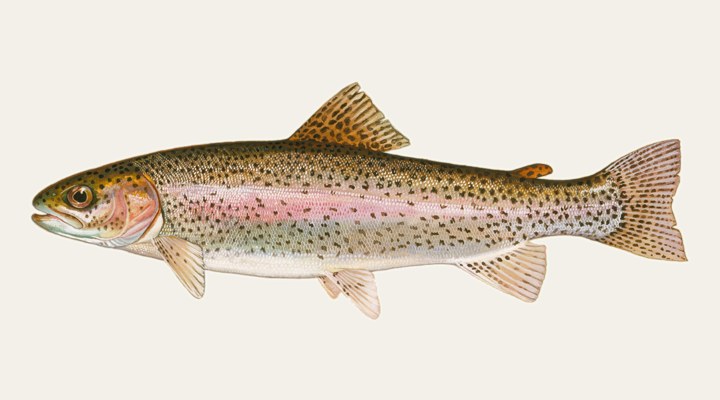
One species, two lives
NOAA Fisheries and WDFW describe steelhead as the anadromous form of rainbow trout. All hatch in gravel streams, and those that go to sea grow larger than the fish that stay in fresh water before returning to spawn. Unlike most Pacific salmon they do not necessarily die after spawning, and many go back to sea and return to spawn again. In Washington, where the steelhead is the state fish, summer runs (mostly east of the Cascades) enter rivers months before spawning and winter runs spawn closer to the ocean. WDFW gives an average of 8 to 11 pounds, with fish of 40 pounds or more.
West Coast steelhead and the Endangered Species Act
Many Pacific populations are protected: NOAA Fisheries lists one distinct population segment of steelhead as endangered and ten as threatened, plus one experimental population. Whether a wild fish may be kept, and where hatchery fish may be retained, is set state by state and river by river, so read the current rules before fishing.
Great Lakes runs
Rainbow trout came to Michigan as eggs from California in 1876, and the lake-run fish that return to spawn are called steelhead there. New York's Lake Erie fishery is built on stocked Washington-strain yearlings plus natural reproduction, with Skamania summer-run fish added in Cattaraugus Creek. NYSDEC says Washington-strain fish enter tributaries as early as mid-September, the bulk of the run arrives from mid-October through April, and spawning runs from mid-March to late April; its Lake Erie fish average 5 to 8 pounds, with 10- to 12-pound fish common.
Reading the river
NYSDEC's steelhead guide lists the habits to fish around. Steelhead gather on seams where two currents meet, hold above or below boulders and logs, favor the heads and tails of large pools, move upstream on rising and falling water, hold steady in low or flood flows, and dislike bright light, so early and late are best on sunny days. Late October through November is typically one of the best periods in New York, when Washington-strain fish feed hard, and brief winter warm spells bring new fish in.
The mistakes that cost fish
Gear that is too light: NYSDEC warns that ultralight rods and 3- or 4-weight fly rods can break, and that playing a steelhead to exhaustion can lead to delayed mortality. Too much lead: the agency's drift-fishing advice is to use just enough weight to tick the bottom now and then. And reading a single flow number instead of the trend, when New York's guide ties fish movement to rising and falling water.
Tackle setups
| Situation | Setup | Why it works |
|---|---|---|
| Spinning / drift | 8- to 10-ft light to medium rod rated for 6-12 lb line, egg sacs or spinners | NYSDEC's recommended setup for Great Lakes tributaries |
| Float / centerpin | 11½- to 14-ft rod, centerpin reel, 8-10 lb line, float with split shot graded heavy to light | Long, controlled drifts keep the bait in the strike zone (NYSDEC) |
| Fly | 10-ft 7-weight (any 8½- to 11-ft 6- to 9-weight works), floating or sink-tip line, at least 100 yards of backing | NYSDEC's suggested rod for dead-drifting eggs or swinging streamers |
| Hardware | Spinning combo with spoons, spinners or stickbaits | NYSDEC lists these for Lake Erie creeks and creek mouths |
Playbook by water temperature
High summer (80F+)
Warm surface water keeps Great Lakes steelhead out in the lake: NYSDEC says trollers find staging fish in 70-90 ft of water off the major Lake Erie creek mouths from mid-August, with spoons run near the thermocline.
Active season (65-80F)
Late summer and early fall: fish stage off creek mouths and, as creek temperatures drop in September and October, the first ones run in; casting spoons near creek mouths at dawn and dusk works then (NYSDEC).
Transition (50-65F)
Main tributary season: fish seams, pool heads and tails and structure with drifted eggs, beads, nymphs or streamers, and plan trips around rising or falling water.
Winter (under 50F)
Winter fish hold in the deeper pools; drift small baits slowly, and watch for brief warm spells, which NYSDEC says bring fresh fish into the creeks.
The legal season is a separate question
Everything above is about the fish. When you are allowed to keep one is a different matter entirely, set state by state, and in several states the possession season is shut for months while the water stays open for catch-and-release. Those dates are not on this page on purpose: they belong with the agency that sets them, alongside the sizes and limits that come with them.
Month by month
1 = slow, 5 = peak. Current month highlighted.
Best waters for steelhead
73 waters we report on where this species is one of the main fish, each with a daily report.
Rocky River
Lake Oroville
Rogue River
Presque Isle Bay
Feather River
American River
Trinity River (CA)
Cowlitz River
Pere Marquette River
Niagara River
Columbia River
Sacramento River
Lake Ontario
Drano Lake
Lake Michigan (Chicago)
Grand River
Smith River
Muskegon River
Sandy River
Grande Ronde River
Skagit River
Cattaraugus Creek
Walnut Creek
Sheboygan (Lake Michigan)
Ketchikan
St. Joseph River
Mad River
Yuba River
Kalama River
Huron River
Oswego River
South Fork Clearwater River
Humptulips River
Little Manistee River
Platte River
North Fork Clearwater River
Trask River
Wilson River
Dworshak Reservoir
Russian River
Vermilion River
Chagrin River
Conneaut Creek
Lewis River
Salmon River
Kewaunee River
Lake Memphremagog
Bois Brule River
Manistique River
Ford River
Ontonagon River
Little Bay de Noc
Big Manistee River
Skykomish River
Klickitat River
Elwha River
Umpqua River
Nestucca River
Siletz River
Salmon River
Selway River
Situk River
Genesee River
Elk Creek
Grand River
Winooski River
Mokelumne River
Willamette River
Icicle Creek
Kasilof River
Talkeetna River
Naknek River
Chena River
Common questions
When do steelhead run Great Lakes tributaries?
In New York's Lake Erie tributaries, from as early as mid-September, with most fish in the creeks from mid-October through April. After spawning they drop back toward the lake, and NYSDEC says fishing stays good into mid-May; Skamania fish run the Salmon River in summer.
What baits and flies catch steelhead?
NYSDEC lists egg imitations, nymphs and streamers on the fly; artificial eggs, beads and small plastic worms; and salmon-egg sacs, with earthworms at times. Season, water temperature, clarity and flow decide the size and pattern.
Are steelhead endangered?
Some populations are. NOAA Fisheries lists one West Coast steelhead population segment as endangered and ten as threatened. Great Lakes steelhead are introduced and supported by stocking and some natural reproduction.
Pages checked
- fisheries.noaa.gov/species/steelhead
- wdfw.wa.gov/species-habitats/species/oncorhynchus-mykiss
- michigan.gov/dnr/education/michigan-species/fish-species/rainbow-trout
- dec.ny.gov/things-to-do/freshwater-fishing/places-to-fish/great-lakes-niagara-ri
- extapps.dec.ny.gov/docs/fish_marine_pdf/ifnysteelhead.pdf
The facts on this page were checked against these pages, from the agencies and research bodies that manage and study this fish on October 6, 2026; anything we could not verify was taken out.