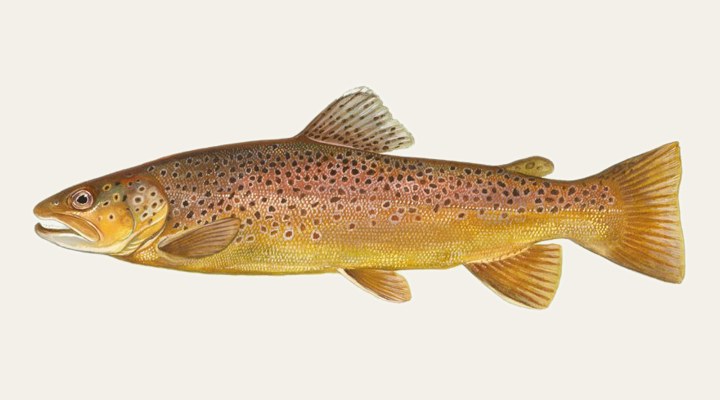
Identification and biology
The brown trout, Salmo trutta, arrived in Tasmania from England in 1864, the first successful introduction anywhere in the southern hemisphere, and from Tasmania it went to Victoria, New South Wales and the highlands, where it breeds in the wild in cold, gravel-bottomed streams and lives in the lakes they feed. It is the wild trout of Australia: bronze to olive with black and red spots, a square tail, a wariness that grows with size, and a spawning run up the inflowing creeks in autumn that is the reason the streams of New South Wales and Victoria close through winter and the Tasmanian season ends in late April or early May. Big browns are old, and the biggest come from the lakes at night and in the cold months.
Where they live through the year
In Tasmania the brown trout waters open on the first Saturday of August and close on the Sunday nearest 30 April, and the plateau lakes fish from the early-season lure and bait fishing along the edges at Arthurs and Great Lake, and fly fishing only at Penstock and Little Pine, through the spring dun hatches and the summer beetle falls into the autumn drop-offs. Most lowland rivers keep the same season, but the lower South Esk, Macquarie and Meander stay open to the Sunday nearest 31 May, the Derwent below New Norfolk is open all year, and designated rainbow waters such as Dee Lagoon run from October to May. In New South Wales and Victoria the browns of Eucumbene, Jindabyne, Eildon and Dartmouth are along the edges in autumn and spring and deep in summer, and the streams are open from spring to the June long weekend. Everywhere the biggest browns are taken at night, along the edges, on bait and slow-rolled lures in the cooler months.
The mistakes that cost fish
Fishing the rivers in the closed season, computed for this year on the state hubs; and fishing a Tasmanian water outside the dates the Inland Fishing Code sets for it, because the waters differ. Fishing too heavy and too visible in clear water, where a brown inspects the lure and turns away; a lighter leader and a longer cast fix more slow days than a lure change. Ignoring the wind on the plateau, which makes its own weather and can turn a lake dangerous in an hour. And missing the night: the best browns of the Snowy lakes are caught after dark along the edges on bait and on slowly worked lures.
Reading the report for brown trout
The water temperature estimate and the calendar show the cool-water edge seasons and the deep summer; the wind row is the number to respect on the plateau and the Snowy lakes; the level chart on the gauged lakes shows the rising water that floods new ground where the browns feed and the low water that pushes them to the drop-offs. The species card rates the month; the season line on each water says open or closed today, from the rule the agency wrote.
Tackle setups
| Situation | Setup | Why it works |
|---|---|---|
| Lake edges at night | 2.1 m rod rated 2 to 4 kg, 4 kg mono, running sinker or unweighted, worm, wattle grub or mudeye | The big browns feed along the edges after dark on bait |
| Spin and troll | 2.1 m spin rod rated 1 to 3 kg, 3 kg braid, 3 kg leader, 50 to 80 mm minnow or a Tasmanian Devil | The edges at dawn and the drop-offs by day |
| Fly on the plateau | 2.7 m 5 or 6 weight, floating line, 3 kg tippet, dun, beetle or nymph patterns | Polaroiding the shallow bays and the wind lanes on the plateau lakes |
| Streams in season | 2.1 to 2.4 m 3 or 4 weight, floating line, 2 kg tippet, dry fly or small nymph | The open-season rivers of the highlands |
Playbook by water temperature
The plan the daily report picks for brown trout in each band; the water temperature on each page is a seasonal estimate for its type of water and says so.
Hot water (over 27 °C)
Dawn at the lake edges and the cold inflows; the rivers at first light only.
Warm water (18 to 27 °C)
Early and late with flies and small lures along the weed edges and the river runs.
Cool water (10 to 18 °C)
Prime. Nymphs and streamers on the rivers, and the lake edges on the overcast days.
Cold water (under 10 °C)
The lake fishery: bait or slow lures in the deeper bays; the rivers are closed in NSW and Victoria.
The legal season is a separate question
Activity says when the fish bite; the agency says when you may keep one. These are the closures that name brown trout, computed for 2026 from each rule as written and read on the date shown. A state with no row publishes no closure for this species, which is not the same as open all year.
| State | Fishery | 2026 | Rule | Source |
|---|---|---|---|---|
| New South Wales | Trout streams | Closed 2026-06-09 to 2026-10-02 | General trout streams close from the Tuesday after the June long weekend to the last Friday before the October long weekend. Lakes and dams have no closed season. | DPIRD NSW, summary of freshwater closures, read 2026-09-23 |
| New South Wales | Trout lakes and dams | Open all year | No closed season in lakes and dams; the winter closure applies to streams only. | DPIRD NSW, summary of freshwater closures, read 2026-09-23 |
| Victoria | Trout and salmon in rivers and streams | Closed 2026-06-09 to 2026-09-04 | Rivers and streams close from the Tuesday after the King’s Birthday weekend to the Friday before the first Saturday in September. Lakes and reservoirs stay open all year. | Victorian Fisheries Authority, trout and salmon regulations, read 2026-09-23 |
| Victoria | Trout in lakes and reservoirs | Open all year | No closed season in lakes and reservoirs; the winter closure applies to rivers and streams. | Victorian Fisheries Authority, trout and salmon regulations, read 2026-09-23 |
| Tasmania | Brown trout waters | Open 2026-08-01 to 2027-05-02 | Most waters open from the first Saturday of August to the Sunday nearest 30 April; designated rainbow trout waters run from the Saturday nearest 1 October to the Sunday nearest 31 May. | Inland Fisheries Service Tasmania, season dates and times, read 2026-09-23 |
| Tasmania | Extended-season waters | Open 2026-08-01 to 2027-05-30 | The South Esk from the Storys Creek Road bridge at Avoca to Beams Hollow, the lower Macquarie, Meander and Brumbys Creek and lakes Mackintosh and Rosebery open with most waters on the first Saturday of August and close with the rainbow waters on the Sunday nearest 31 May. | Inland Fisheries Service Tasmania, Tasmanian Inland Fishing Code 2026-27, read 2026-09-24 |
| Tasmania | Designated rainbow trout waters | Open 2026-10-03 to 2027-05-30 | Designated rainbow trout waters open on the Saturday nearest 1 October and close on the Sunday nearest 31 May. | Inland Fisheries Service Tasmania, Tasmanian Inland Fishing Code 2026-27, read 2026-09-24 |
Month by month
Activity for the southern year, 1 slow to 5 peak; January is midsummer. Current month highlighted.
Waters we cover for brown trout
141 Australia waters carry brown trout on their species card, each with a daily report.
Tasmania
Victoria
New South Wales
Common questions
When does the Tasmanian trout season open?
The brown trout waters open on the first Saturday of August and close on the Sunday nearest 30 April; for 2026-27 that is Saturday 1 August 2026 to Sunday 2 May 2027, as the Inland Fisheries Service publishes. Some waters, Great Lake among them, are open all year.
Where were brown trout first introduced in Australia?
Tasmania, in 1864, from ova shipped from England; the Plenty hatchery stock founded the trout of the southern hemisphere.
What is the best way to catch a big brown trout?
At night along the lake edges in the cooler months with bait or a slowly worked lure, or at first light along the drop-offs; in the rivers, a nymph or a dry fly in the open season.