Identification and biology
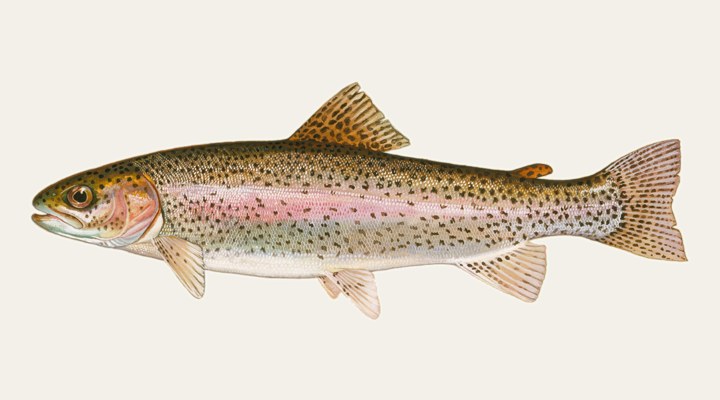
The rainbow trout of Australia, Oncorhynchus mykiss, is a stocked fish: brought from North America in the nineteenth century and released every year into the lakes of the Snowy Mountains, the Victorian highlands, the New England and Central Tablelands and the Tasmanian Central Plateau by the state hatcheries. It carries the pink band along the flank and the black spots on the tail that name it, grows fast in a rich lake, and breeds in the wild only where a cold, gravel stream runs into a lake, which in Australia is the exception rather than the rule. The state agencies publish what they stock and where, and the stocked lakes are the reason the species is on this site at all.
Where they live through the year
In the big Snowy lakes, Eucumbene and Jindabyne, the rainbows are along the edges and the drop-offs from spring to autumn, trolled, spun and fished on the fly, and in the deeper, cooler water through summer when the surface warms; the New South Wales and Victorian streams are open from the October long weekend or the first Saturday of September until the June long weekend and closed through winter, while the lakes and dams have no closed season. In Tasmania the designated rainbow trout waters open from the Saturday nearest 1 October to the Sunday nearest 31 May, later than the brown trout waters, and the plateau lakes fish through the southern summer. The stocked urban and tableland lakes give the winter fishing.
The mistakes that cost fish
Fishing the surface in a summer heat when the rainbows are in the thermocline; a lead-core line or a downrigger trolled along the drop-offs finds them, and the dawn edge bite is short. Fishing the rivers in the closed season, which is computed for this year on the state hubs and on every trout river page. Using bait where the water is artificial fly and lure only, which several New South Wales and Victorian streams are; the agency page linked from each water lists them. And expecting wild fish everywhere: the stocking lists say where the fish come from.
Reading the report for rainbow trout
The water temperature estimate places the lake in the band that decides whether the fish are on the edges or deep, and the calendar shows the southern autumn and spring as the edge seasons. The wind row decides which shore fishes on a big lake and whether a small boat should be out. Pressure matters less than for the coastal fish. The species card rates the month; the season line says whether the water is open or closed today, from the rule.
Tackle setups
| Situation | Setup | Why it works |
|---|---|---|
| Lake edges, spin | 2.1 m spin rod rated 1 to 3 kg, 3 kg braid, 2 to 3 kg fluorocarbon leader, 50 to 70 mm minnow or inline spinner | Light line in clear water; the edge bite at dawn and dusk |
| Trolling deep in summer | 1.8 m rod rated 2 to 4 kg, lead-core line or downrigger, 4 kg leader, small minnow or spoon | The fish are in the thermocline; the lure has to reach them |
| Fly | 2.7 m 5 or 6 weight, floating or intermediate line, 3 to 4 kg tippet, wet fly, nymph or dry | The plateau lakes and the Snowy edges on the fly |
| Bait where allowed | 2.1 m rod rated 1 to 3 kg, 3 kg mono, running sinker, worm or PowerBait | Stocked dams and lakes where the rule allows bait |
Playbook by water temperature
The plan the daily report picks for rainbow trout in each band; the water temperature on each page is a seasonal estimate for its type of water and says so.
Hot water (over 27 °C)
Dawn only, and deep: troll lead-core or downriggers over the thermocline, or fish the cold inflows.
Warm water (18 to 27 °C)
Early and late around the edges with lures and flies; through the day, troll the drop-offs.
Cool water (10 to 18 °C)
Prime. Shore fishing along the edges with bait, spinners and flies, and the rivers if the season is open.
Cold water (under 10 °C)
Winter lakes: bait on the bottom in the deeper bays through the middle of the day, or polaroiding the shallows on the bright days in Tasmania.
The legal season is a separate question
Activity says when the fish bite; the agency says when you may keep one. These are the closures that name rainbow trout, computed for 2026 from each rule as written and read on the date shown. A state with no row publishes no closure for this species, which is not the same as open all year.
| State | Fishery | 2026 | Rule | Source |
|---|---|---|---|---|
| New South Wales | Trout streams | Closed 2026-06-09 to 2026-10-02 | General trout streams close from the Tuesday after the June long weekend to the last Friday before the October long weekend. Lakes and dams have no closed season. | DPIRD NSW, summary of freshwater closures, read 2026-09-23 |
| New South Wales | Trout lakes and dams | Open all year | No closed season in lakes and dams; the winter closure applies to streams only. | DPIRD NSW, summary of freshwater closures, read 2026-09-23 |
| Victoria | Trout and salmon in rivers and streams | Closed 2026-06-09 to 2026-09-04 | Rivers and streams close from the Tuesday after the King’s Birthday weekend to the Friday before the first Saturday in September. Lakes and reservoirs stay open all year. | Victorian Fisheries Authority, trout and salmon regulations, read 2026-09-23 |
| Victoria | Trout in lakes and reservoirs | Open all year | No closed season in lakes and reservoirs; the winter closure applies to rivers and streams. | Victorian Fisheries Authority, trout and salmon regulations, read 2026-09-23 |
| Tasmania | Brown trout waters | Open 2026-08-01 to 2027-05-02 | Most waters open from the first Saturday of August to the Sunday nearest 30 April; designated rainbow trout waters run from the Saturday nearest 1 October to the Sunday nearest 31 May. | Inland Fisheries Service Tasmania, season dates and times, read 2026-09-23 |
| Tasmania | Extended-season waters | Open 2026-08-01 to 2027-05-30 | The South Esk from the Storys Creek Road bridge at Avoca to Beams Hollow, the lower Macquarie, Meander and Brumbys Creek and lakes Mackintosh and Rosebery open with most waters on the first Saturday of August and close with the rainbow waters on the Sunday nearest 31 May. | Inland Fisheries Service Tasmania, Tasmanian Inland Fishing Code 2026-27, read 2026-09-24 |
| Tasmania | Designated rainbow trout waters | Open 2026-10-03 to 2027-05-30 | Designated rainbow trout waters open on the Saturday nearest 1 October and close on the Sunday nearest 31 May. | Inland Fisheries Service Tasmania, Tasmanian Inland Fishing Code 2026-27, read 2026-09-24 |
Month by month
Activity for the southern year, 1 slow to 5 peak; January is midsummer. Current month highlighted.
Waters we cover for rainbow trout
141 Australia waters carry rainbow trout on their species card, each with a daily report.
Tasmania
Victoria
New South Wales
Common questions
When is trout season in New South Wales?
Streams open from the Saturday of the October long weekend to the Monday of the June long weekend and are closed between; lakes and dams have no closed season. The New South Wales hub shows this year’s dates, computed from the DPIRD rule.
Are rainbow trout native to Australia?
No. They were introduced from North America in the nineteenth century and are stocked each year by the state hatcheries; wild breeding is rare and confined to cold streams that feed the lakes.
What is the best lure for rainbow trout?
A small inline spinner or a 50 to 70 mm minnow trolled or cast along the edges in the cool months; a soft plastic on a light jighead; a wet fly or a nymph on the fly rod; PowerBait or a worm where bait is allowed.