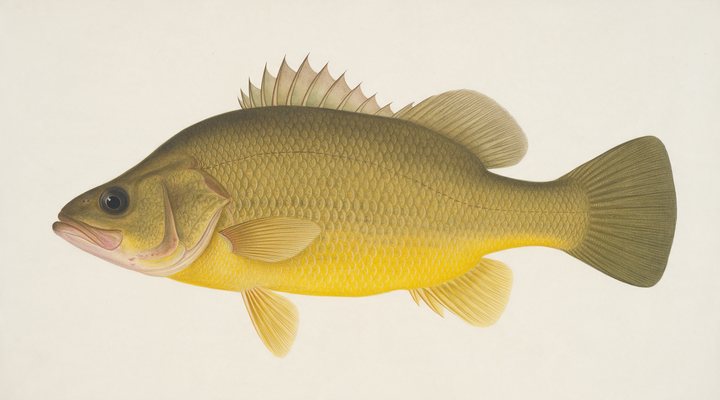
Identification and biology
The golden perch, Macquaria ambigua, yellowbelly, callop in South Australia, is the bread-and-butter native of the Murray-Darling: a deep, humped, bronze to olive fish with a yellow belly, a concave forehead and a protruding lower jaw, and a slow, dogged fight. DPIRD NSW records it to 76 cm and 23 kg but notes it is commonly 40 to 50 cm and around 5 kg, with stocked fish in impoundments generally growing larger than river fish; its natural range is the Murray-Darling, Lake Eyre and the Bulloo, and it has been translocated into other rivers. The Status of Australian Fish Stocks report gives a life of up to 27 years and maturity at 2 to 5 years. Anglers find that a rise in the river after rain brings the perch on and a dry, falling river shuts them down. Stocking supports the lake fisheries: DPIRD NSW names Copeton, Pindari, Burrinjuck and Blowering, and the ACT stocks golden perch into the Canberra lakes each year.
Where they live through the year
From spring to autumn golden perch are on the points, the timber, the rock walls and the weed edges of the lakes and in the snags and the deep bends of the rivers, feeding best in warm water in the mornings and the evenings and moving shallow on a rising lake. Summer is the peak on the lakes, trolling and casting lipless crankbaits, spinnerbaits and soft plastics along the drop-offs and the timber; in the rivers the fish run with a rise. In winter they are deep and slow, and the best of the cold months is a slow-hopped blade or a bait held still on the bottom in the warmest hours; the species has no closed season in the states covered here.
The mistakes that cost fish
Working the lure too fast: a golden perch follows a lure and takes it on the pause, and a lipless crankbait hopped along the bottom or a plastic paused beside a tree out-fishes a straight retrieve. Fishing the open water instead of the structure, when the fish hold on the points, the timber and the walls. Ignoring the level: a rising lake brings the perch shallow and a falling one pulls them deep, and the gauge on each lake page shows which is happening. And fishing cold water expecting summer fish; winter perch are a slow, midday proposition.
Reading the report for golden perch
The level chart on the gauged lakes and the water temperature estimate are the two numbers; the calendar shows the southern summer as the peak; the pressure row helps, a falling barometer bringing the perch on before a storm. The wind row decides which arm of a long lake is fishable. The species card rates the month; the state hub lists the closures that apply to the cod that share the water, so the day is planned for both.
Tackle setups
| Situation | Setup | Why it works |
|---|---|---|
| Lakes, casting the timber | 2.1 m spin rod rated 3 to 6 kg, 6 to 8 kg braid, 8 to 10 kg leader, lipless crankbait or 1/2 oz spinnerbait | Hopped along the bottom beside the trees where the perch hold |
| Trolling the drop-offs | 1.8 m rod rated 4 to 8 kg, 8 kg braid, 10 kg leader, deep-diving 60 to 80 mm hardbody | Covers the summer drop-offs and finds the schools |
| River bait | 2.1 m rod rated 3 to 6 kg, 6 kg mono, running sinker, shrimp, yabby or worm | Held still in the snag or the deep bend on a rising river |
Playbook by water temperature
The plan the daily report picks for golden perch in each band; the water temperature on each page is a seasonal estimate for its type of water and says so.
Hot water (over 27 °C)
Early and late around the standing timber and the rock walls with lipless crankbaits and spinnerbaits.
Warm water (18 to 27 °C)
Prime. Hop soft plastics and vibes around the timber, or fish shrimp and worms on the bottom.
Cool water (10 to 18 °C)
Slower. Work the deeper timber and the drop-offs with vibes and bait.
Cold water (under 10 °C)
Almost dormant; a bait fished slowly in the deepest water on the warmest afternoons.
The legal season is a separate question
Activity says when the fish bite; the agency says when you may keep one. These are the closures that name golden perch, computed for 2026 from each rule as written and read on the date shown. A state with no row publishes no closure for this species, which is not the same as open all year.
| State | Fishery | 2026 | Rule | Source |
|---|---|---|---|---|
| South Australia | Beetaloo Reservoir: open 1 May to 1 November | Open 2026-05-01 to 2026-11-01 | The Department for Environment and Water opens Beetaloo Reservoir from 1 May to 1 November only, and closes it on Total Fire Ban days and for operational work; shore fishing only, with the SA Water reservoir permit. | Department for Environment and Water, Beetaloo Reservoir, read 2026-09-28 |
Month by month
Activity for the southern year, 1 slow to 5 peak; January is midsummer. Current month highlighted.
Waters we cover for golden perch
174 Australia waters carry golden perch on their species card, each with a daily report.
New South Wales
Queensland
Victoria
South Australia
Common questions
Is there a closed season for golden perch?
None of the states covered here publishes one; size and bag limits apply and the agency page is linked from every water. The Murray cod that share the water are closed from 1 September to 30 November in New South Wales and Victoria and from 1 August to 31 October in Queensland, which changes what can be kept on a mixed trip.
What is the best lure for golden perch?
A lipless crankbait or a small spinnerbait hopped along the bottom beside timber, a 75 to 100 mm soft plastic paused beside a tree, a blade in the cool months; a shrimp, a yabby or a worm on bait.
Why are golden perch called yellowbelly?
For the yellow belly of the adult fish; South Australia calls them callop, and DPIRD NSW also lists Murray perch and white perch. All are the same species, Macquaria ambigua.
Pages checked
- dpird.nsw.gov.au/fishing/fish-species/species-list/golden-perch
- fish.gov.au/report/334-Golden-Perch-2023
- dpird.nsw.gov.au/fishing/recreational/resources/stocking
- act.gov.au/open/act-fisheries-management-plan-fish-stocking-2022-2027
The facts on this page were checked against these pages, from the agencies, park services and operators that manage the water on 27 September 2026; anything we could not verify was taken out.